
Supervisory Control and Data Acquisition (SCADA) systems form the backbone of modern industrial monitoring and control. A well-designed SCADA architecture ensures reliability, security, scalability, and performance across geographically distributed assets. This article examines the fundamental architectural patterns — centralized, distributed, and hybrid — and explores advanced design considerations including the Purdue Model, DMZ demarcation, time-series data management, Zero Trust Architecture, and AI-integrated SCADA trends shaping the 2025–2026 landscape.
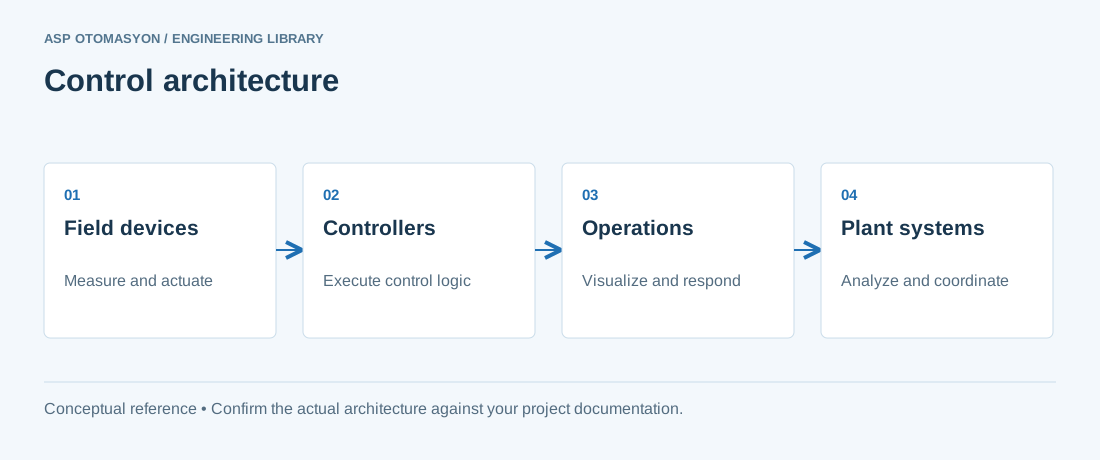
SCADA System Reference Architecture
Every SCADA system, regardless of scale, implements three essential functional layers:
- Data Acquisition Layer — Collects data from field devices (RTUs, PLCs, IEDs, smart sensors) using industrial protocols (Modbus, DNP3, IEC 60870-5, OPC UA, MQTT).
- Supervisory Layer — Processes, stores, and visualizes the acquired data. Includes alarm management, trending, reporting, and operator control interfaces.
- Communication Layer — Provides the network infrastructure connecting field devices to supervisory systems, often over wide-area networks (WAN), cellular, satellite, or private radio.
Architecture Patterns
1. Centralized Architecture
In a centralized architecture, a single SCADA server (or redundant pair) handles all data acquisition, processing, and HMI services. Field RTUs and PLCs communicate directly with the central server over WAN links.
- Advantages: Simple to design, manage, and secure; single point of configuration; lower hardware costs.
- Disadvantages: Single point of failure (mitigated by redundancy); latency-sensitive applications may suffer over long WAN distances; limited scalability beyond ~10,000 data points.
- Best For: Small to medium facilities, single-site operations, water/wastewater treatment plants.
2. Distributed Architecture
Distributed SCADA splits functionality across multiple server nodes, often geographically separated. Each regional SCADA server manages its local assets and communicates status to a master SCADA center.
- Advantages: High scalability (100,000+ points); reduced WAN bandwidth requirements (local processing); fault isolation (one region failure does not affect others).
- Disadvantages: More complex configuration; requires WAN links between regional and master centers; data consistency challenges across nodes.
- Best For: Pipelines, electrical utilities, oil and gas fields, water distribution networks spanning large geographic areas.
3. Hybrid Architecture
Hybrid SCADA combines centralized HMI/visualization with distributed data acquisition. Edge gateways perform local data collection, protocol conversion, and store-and-forward, while a central SCADA platform handles visualization, analytics, and enterprise reporting.
- Advantages: Balances local autonomy with central visibility; cloud-ready; supports modern IIoT data flows.
- Disadvantages: Requires robust edge infrastructure; integration complexity between edge and central systems.
- Best For: Modern IIoT deployments, multi-site manufacturing, smart grid applications, renewable energy farms.
Purdue Model for SCADA
The Purdue Enterprise Reference Architecture (PERA), formalized in ISA-95/IEC 62264, provides the foundational model for SCADA network design. Understanding its levels is essential for any SCADA architect:
| Level | Name | Components | Security Zone |
|---|---|---|---|
| 5 | Enterprise Network | ERP, CRM, corporate email, web services | IT Zone |
| 4 | Site Business Planning | MES, CMMS, production scheduling | IT Zone |
| 3.5 | Industrial DMZ | Jump servers, data diodes, OPC UA gateways, reverse proxies | DMZ |
| 3 | Operations Management | SCADA servers, historian, alarm management, batch servers | OT Zone |
| 2 | Supervisory Control | HMI stations, engineering workstations, OPC servers | OT Zone |
| 1 | Basic Control | PLCs, RTUs, DCS controllers, smart actuators | OT Zone |
| 0 | Process/Field | Sensors, transmitters, motors, valves, analyzers | OT Zone |
Architecture Diagram
+---------------------------------------------------------------------+
|  LEVEL 4-5: ENTERPRISE / IT ZONE                                     |
|  +------------+  +------------+  +------------+                       |
|  |   ERP      |  |   MES      |  |  Web Apps  |                       |
|  | (SAP/Oracle)|  |(Apriso/SIM)|  | (Cloud)   |                       |
|  +------------+  +------------+  +------------+                       |
+---------------------------+-----------------------------------------+
                            |
+---------------------------+-----------------------------------------+
|  LEVEL 3.5: INDUSTRIAL DMZ (IEC 62443 Zone Boundary)                  |
|  +------------+  +------------+  +------------+                       |
|  |Jump Server |  |OPC UA/     |  |  Reverse   |                       |
|  |(RDP/SSH)   |  |MQTT Gateway|  |  Proxy     |                       |
|  +------------+  +------------+  +------------+                       |
|  +---------------------------------------------------------+          |
|  |  Industrial Firewall (Stateful Inspection + DPI)          |          |
|  +---------------------------------------------------------+          |
+---------------------------+-----------------------------------------+
                            |
+---------------------------+-----------------------------------------+
|  LEVEL 2-3: OT / SUPERVISORY ZONE                                      |
|  +------------+  +------------+  +------------+  +------------+       |
|  | SCADA      |  | SCADA      |  | Historian  |  | Alarm      |       |
|  | Server A   |  | Server B   |  | (Time-Series)| | Server    |       |
|  | (Primary)  |  | (Standby)  |  |            |  | (ISA-18.2) |       |
|  +------------+  +------------+  +------------+  +------------+       |
|  +------------+  +------------+  +------------+  +------------+       |
|  | HMI        |  | Engineer-  |  | OPC UA     |  | Reporting  |       |
|  | Stations   |  | ing Workst.|  | Server     |  | Server     |       |
|  +------------+  +------------+  +------------+  +------------+       |
+---------------------------+-----------------------------------------+
                            | (Control Network - Switched Ethernet)
+---------------------------+-----------------------------------------+
|  LEVEL 0-1: FIELD DEVICE / CONTROL ZONE                                |
|  +------+  +------+  +------+  +------+  +------+  +------+         |
|  | PLC  |  | PLC  |  | RTU  |  | RTU  |  | IED  |  | DCS  |         |
|  +--+---+  +--+---+  +--+---+  +--+---+  +--+---+  +--+---+         |
|     |         |         |         |         |         |              |
|  +--+---+  +--+---+  +--+---+  +--+---+  +--+---+  +--+---+         |
|  |Sensors/  |Sensors/  |Sensors/  |Sensors/  |Sensors/  |Sensors/   |
|  |Valves   |Valves   |Valves   |Valves   |Valves   |Valves   |       |
|  +--------+ +--------+ +--------+ +--------+ +--------+ +--------+   |
+---------------------------------------------------------------------+
Redundant Server Patterns
SCADA availability depends on well-designed server redundancy. The three most common patterns are:
Active/Standby (Hot-Standby)
Two identical servers run in parallel. The active server handles all I/O communication and client connections, while the standby server synchronizes its database in real time. On failure, clients automatically reconnect to the standby. Failover time is typically 10–60 seconds depending on the platform. Implementations include GE iFIX with SCADA Watchdog, AVEVA System Platform with redundant Historian, and Siemens WinCC with multi-server systems.
Active/Active (Load-Balanced)
Both servers actively serve clients and process I/O. The total I/O load is split between them. This pattern requires careful design to ensure data consistency across servers. Active/active SCADA is less common in traditional systems but is increasingly seen in modern SCADA platforms running on Kubernetes containers with microservices architecture.
N+1 Redundancy with Failover Clustering
Multiple SCADA servers are grouped into a failover cluster. If any server fails, its workload is redistributed among remaining servers. This pattern is most common in large-scale utility SCADA deployments (e.g., power transmission, pipeline networks) where the cost of downtime justifies the infrastructure investment.
DMZ Demarcation
The Industrial Demilitarized Zone (DMZ) is the critical security boundary between the OT network (Levels 0–3) and the IT network (Levels 4–5). Proper DMZ design follows these principles:
- No Direct OT-IT Traffic — All data crossing the OT/IT boundary must be proxied through DMZ-hosted services. No direct routing between OT and IT subnets is permitted.
- Jump Hosts / Bastion Servers — All administrative access from IT to OT must go through a DMZ-hosted jump server. Sessions are logged, recorded, and time-limited.
- Unidirectional Gateways — For the highest security requirements, data diodes physically enforce one-way data flow from OT to IT, making it impossible for any attack to traverse from IT to OT.
- Application-Layer Proxies — OPC UA gateways, MQTT brokers, and reverse proxies terminate OT connections in the DMZ and re-establish them on the IT side, ensuring no transport-layer connectivity crosses the boundary.
- DMZ Firewall Rules — Two sets of firewalls: the OT Firewall permits only DMZ-initiated connections into the OT zone, and the IT Firewall permits only DMZ-initiated connections into the IT zone.
Time-Series Data Management
SCADA systems generate enormous volumes of time-series data. A single mid-size facility with 5,000 tags polled every second produces 432 million data points per day. Efficient time-series data management is essential:
Data Storage Architectures
- Rotating Files — Legacy approach where data is stored in daily files and aged out. Simple but limited query performance and no compression.
- Relational Databases — Standard SQL databases (MS SQL, Oracle) with time-series tables. Works for small systems but breaks down at high ingest rates due to row insertion overhead.
- Specialized Time-Series Databases (TSDB) — Purpose-built engines (OSIsoft PI, Canary Labs, InfluxDB, TimescaleDB) designed for SCADA data. Support high-ingest rates, lossless compression (typically 10:1 to 50:1), and fast range queries.
Compression Techniques
Modern SCADA historians use deadband-based compression (also called exception reporting):
- Swinging Door Algorithm — The most widely used compression algorithm in SCADA historians. Stores a new value only when it deviates beyond a configured deadband from the previous stored value. Typical settings: 0.5–2% of instrument range.
- Temporal Deadband — Stores a value regardless of change after a maximum time interval (e.g., store at least every 60 minutes even if the value is steady).
- Data Quality Markers — Every stored data point includes a quality code (Good, Uncertain, Bad) and timestamp precision.
AI-Integrated SCADA Trends (2025–2026)
Artificial intelligence is transforming SCADA systems from reactive monitoring to proactive, predictive operations. Key trends include:
- AI-Driven Anomaly Detection — Machine learning models analyze historical time-series data to establish normal operating envelopes. Real-time deviations from the envelope trigger early warnings, often detecting equipment degradation weeks before a traditional threshold alarm.
- Predictive Maintenance Integration — SCADA systems now feed data directly into ML models that predict remaining useful life (RUL) of critical assets. Integration with CMMS (Computerized Maintenance Management Systems) enables automatic work order generation.
- Natural Language Interfaces — Operators can query SCADA data using natural language: "Show me pump P-101 vibration trend for the last 7 days." LLM-powered assistants translate queries into historian API calls.
- Edge AI for Real-Time Analytics — ML models deployed on edge gateways perform real-time inference without cloud dependency. This is critical for safety applications where sub-second response is required.
- Digital Twin Integration — SCADA data drives real-time digital twin synchronization. Operators can run what-if simulations on the digital twin without affecting the live process.
Zero Trust Architecture for SCADA
Traditional perimeter-based security assumes everything inside the network is trustworthy. Zero Trust Architecture (ZTA) rejects this assumption and applies the principle of "never trust, always verify" to every access request, regardless of network location. For SCADA systems, ZTA implementation includes:
- Micro-Segmentation — Each SCADA component (server, HMI, PLC) is isolated into its own logical segment. Communication between components is explicitly permitted and logged.
- Continuous Authentication — Users and devices are authenticated continuously throughout sessions, not just at login. Session tokens are short-lived and re-verified.
- Least-Privilege Access — Operators have access only to the specific screens and controls required for their role. Write access to critical parameters requires supervisory approval.
- Behavioral Analytics — User and device behavior is baselined. Unusual activity (e.g., an operator logging in from an unusual location, a PLC communicating with an unexpected IP) triggers alerts and automatic containment.
Edge Computing Integration
Edge computing is reshaping SCADA architectures by moving data processing closer to field devices:
- Protocol Translation at the Edge — Edge gateways convert legacy protocols (Modbus RTU, DNP3) to modern protocols (MQTT, OPC UA) before forwarding to the SCADA server, reducing the protocol burden on the central system.
- Store-and-Forward — When WAN connectivity is lost, edge gateways buffer data locally. On reconnection, they replay the buffered data to the SCADA historian with accurate timestamps.
- Local HMI at the Edge — Edge devices host lightweight web-based HMIs that provide operator visibility even when the central SCADA server is unreachable. This is critical for remote wellheads, pipeline valve stations, and substations.
- Data Filtering and Aggregation — Edge gateways pre-process raw data, discarding redundant readings and computing aggregate values (min, max, average over windows). This reduces historian storage requirements and improves dashboard performance.
ASP OTOMASYON A.Ş. and its subsidiaries OPCTurkey and ASP Dijital provide end-to-end industrial engineering solutions for process automation, data operations and AI.
References & Further Reading
- ISA-95 / IEC 62264 — Enterprise-Control System Integration — International standard defining the Purdue Model functional hierarchy from Level 0 (field devices) to Level 5 (enterprise), fundamental to SCADA architecture design.
- ISA-99 / IEC 62443 — Security for Industrial Automation and Control Systems — International standard series providing the zones and conduits model for secure SCADA network architecture design.
- AVEVA PI System — Time-Series Data Management for SCADA — Official documentation for the PI System historian, the industry standard for time-series data storage, with swinging door compression and exception-based data collection.
- InfluxDB — Open Source Time-Series Database for SCADA — Official InfluxDB documentation for time-series data management, including data ingestion, querying, and retention policies for operational data.
- NIST SP 800-207 — Zero Trust Architecture — NIST special publication defining Zero Trust principles including micro-segmentation, continuous authentication, and least-privilege access for SCADA system security.
Apply this to your project
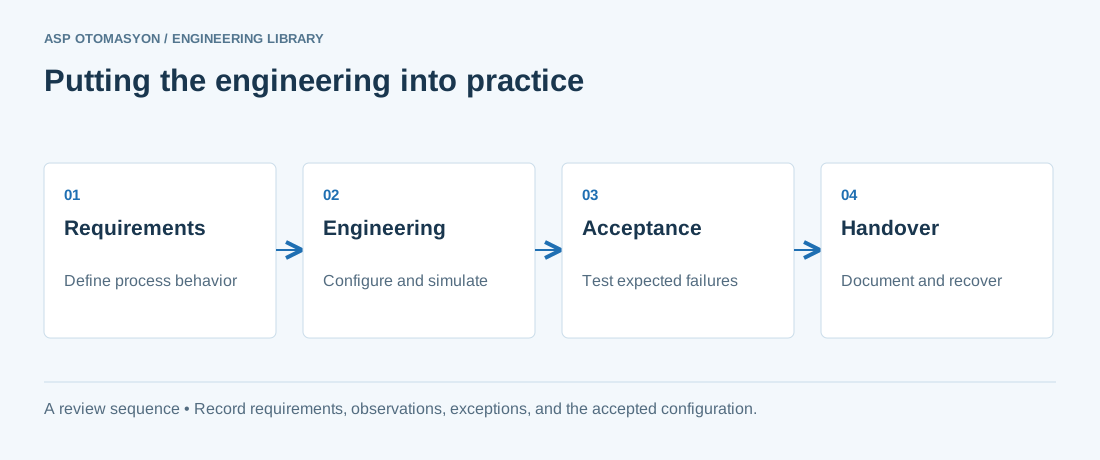
- Define the process states, timing requirements, and permitted behavior after a controller or communication failure.
- List controller, I/O, network, software, and license dependencies before choosing an architecture.
- Record acceptance results and prove that the delivered configuration can be restored from the handover package.
Follow an ASP project guide to connect the fundamentals with implementation and acceptance.
Primary references and further reading
Use the original specifications and product documentation for implementation details. The examples in this guide are illustrative engineering scenarios, not published project results.