
No plant runs one protocol: Modbus coexists with PROFINET, EtherNet/IP with OPC UA, HART with MQTT — and the systems that need the data (SCADA, MES, cloud) speak their own languages. Protocol gateways are the translators that connect these worlds: hardware gateways, software gateways (like KEPServerEX), or embedded protocol stacks. Gateway engineering is where most integration projects actually happen — and where the quality of the integration is decided by a few design decisions: where the translation happens, what the data model looks like on each side, and how failures propagate.
Gateway Types
| Type | Examples | Typical use |
|---|---|---|
| Fieldbus-to-fieldbus gateways | Modbus RTU ↔ PROFINET, EtherNet/IP ↔ PROFIBUS boxes | Connecting devices from different automation worlds (a Modbus energy meter into a PROFINET PLC network). |
| Device-to-OPC UA servers | KEPServerEX, vendor UA servers | Exposing any device's data as OPC UA for SCADA, historians, and analytics. |
| OT-to-IT gateways | MQTT/Sparkplug gateways, REST bridges, edge gateways | Plant data to cloud and enterprise systems (see the cloud integration article). |
| Protocol stacks embedded in devices | Multi-protocol PLC CPUs, drives with native OPC UA | New devices speaking the plant's standard directly — the modern direction. |
The trend is clear: native support replaces gateways where products allow it (a drive with a built-in OPC UA server needs no gateway) — but the installed base ensures gateways remain central for years.
Translation Quality: The Data Model Question
A gateway that copies registers across protocols is the easy 80%; the hard 20% is the semantics:
- Data types — a 16-bit Modbus register to a 32-bit float on the OPC UA side: the mapping (register pairs, byte order, scaling) must be explicit and documented; wrong byte order is the classic silent error.
- Addressing and naming — the gateway's tag model (channel/device/tag) becomes the data's identity; name it for the plant structure, and map the source addresses in the gateway documentation, not in someone's notebook.
- Quality and timestamps — does the gateway preserve the source's quality (device health, comms status)? A gateway that produces plausible values for a dead device is a data-integrity hazard (see the data governance article).
- Write semantics — writes through a gateway need defined behavior: who may write, what the gateway does when the target is unreachable (queue, reject, hold), and how the application learns the write failed.
- Browsing and context — an OPC UA gateway should expose a browsable, structured address space (see the information model article), not a flat register list; the gateway's model is the contract the consumers see.
Architecture Patterns
- Edge termination — the gateway terminates the legacy protocol at the edge and speaks the modern protocol (OPC UA/MQTT) beyond it; the pattern that isolates legacy protocols from the modern network (see the OPC Classic article for the DCOM case).
- Aggregation — one gateway (or software server) in front of many sources, presenting one namespace (see the aggregation server article).
- Redundant gateways — for critical paths: two gateways with failover; the redundancy is only as good as the client's failover behavior — test it.
- Hierarchy — cell-level gateways aggregating to a plant-level gateway; the pattern that scales without a single point of failure.
Operational Considerations
- The gateway is an asset — it has firmware, a lifecycle, and a maintenance need (see the lifecycle discussion in the modernization article); gateways run for a decade on average — choose them with the roadmap in mind.
- Performance limits — a gateway's tag count, polling rate, and client connections are finite; the datasheet limits are optimistic — size with the real poll loads and monitor the gateway's utilization.
- Failure semantics — what does the downstream system see when the gateway fails? The behavior (bad quality, stale value, disconnected) must be defined per consumer, and the gateway's health is monitored (see the OT monitoring article).
- Security — the gateway holds credentials for both sides and sits at a protocol boundary: it belongs in the zone design with the access controls (see the cybersecurity articles), and its management interface is protected.
- Documentation — every gateway deployment is documented: the source protocol and addresses, the target model and names, the mapping table, and the failure behavior; the documentation is what makes the integration maintainable after the integrator leaves.
Summary
Protocol gateways translate both the bytes and the meaning between automation worlds: choose the gateway type for the boundary, engineer the data model explicitly (types, naming, quality, write semantics), place it in the architecture (edge termination, aggregation, redundancy), and operate it as an asset with monitoring, security, and documentation. The best gateway is invisible — the data just arrives, correct, named, and on time. That invisibility is the engineering.
Apply this to your project
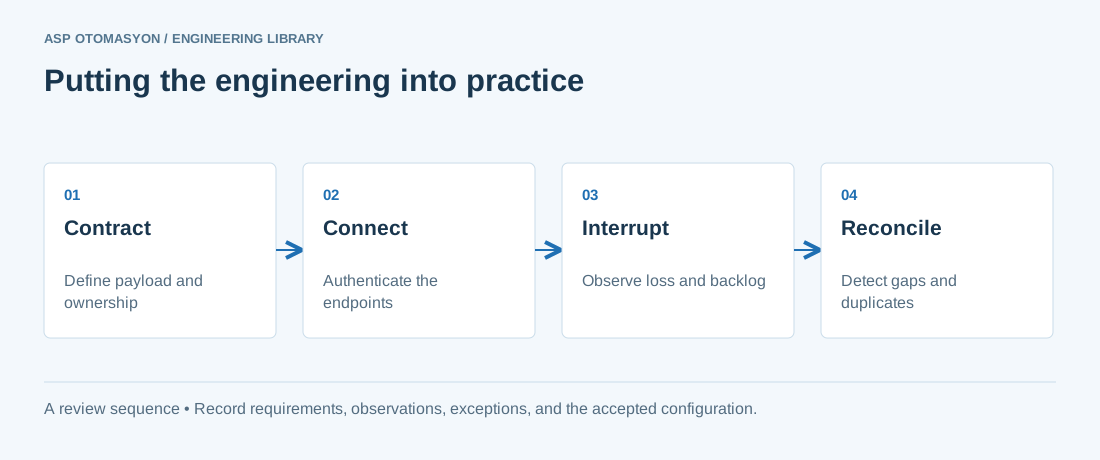
- Specify payload structure, units, identity, time semantics, access permissions, and protocol versions.
- Test backlog growth, connection loss, duplicate delivery, and restart behavior at the consuming application.
- Document how operators see failures and how the system distinguishes replayed data from current process state.
Follow an ASP project guide to connect the fundamentals with implementation and acceptance.
Primary references and further reading
Use the original specifications and product documentation for implementation details. The examples in this guide are illustrative engineering scenarios, not published project results.