Fiber optics is the industrial network's answer to distance, noise, and lightning: hundreds of meters or kilometers of runs without electrical coupling, immune to the VFD noise and ground loops that plague copper, and the only practical choice for inter-building plant backbones. Fiber used to be the specialist's domain; today it is standard practice in industrial networking — and the engineering is in the choices: single-mode vs multi-mode, connector types, termination quality, and the physical protection that plant environments demand.
Single-Mode vs Multi-Mode
| Type | Core | Distance | Use |
|---|---|---|---|
| Multi-mode (OM3/OM4) | 50 µm | Up to 300–550 m at 10 G (OM4: 400 m+ at 10G) | Intra-plant links: machine cells to cabinets, cabinet to cabinet, building to building within the site. |
| Single-mode (OS2) | 9 µm | Kilometers (10+ km standard) | Campus-wide runs, inter-building, and future-proof trunk routes; the optics cost more, the fiber is cheaper. |
Practical guidance: multi-mode OM4 for the plant's internal fiber runs (cheaper transceivers, simpler), single-mode OS2 for anything that might grow (campus backbone) — the fiber itself is the cheap, permanent part; the transceivers are the upgradeable part.
Connectors and Termination
- LC is the industrial standard — small, duplex, and the default for modern switches and transceivers; SC for legacy and some backbone gear; MTP/MPO for high-density trunks (rare in plants).
- Factory-terminated wins — pre-terminated assemblies (pigtails spliced in the factory, or pre-terminated trunk cables with pullable connectors) avoid the field termination quality lottery; field splicing is viable with fusion splicers and trained technicians, never with hand tools and hope.
- Cleanliness is a feature — the #1 fiber failure is contamination: a speck of dust on a connector face attenuates or kills the link. Inspection (with a fiber microscope) and cleaning (dry and wet cleaning kits) are standard practice; every plant fiber toolkit includes them.
Installation in the Plant
- Physical protection — armored cable (or conduit) for machine areas and floor runs; the fiber is glass — the armor is its machine guard.
- Bend discipline — respect the bend radius (typically 10× the cable diameter for installation, 15×+ for permanent); sharp bends crack the fiber invisibly — the link passes the tester and fails under temperature change.
- Separation and pathways — fiber does not need power separation (no coupling), but it shares the pathway rules: no crushing, no sharp edges, and labeled every end (see the cabling article for the labeling discipline).
- Overhead and outdoor runs — outdoor and aerial fiber needs the rated jacket (UV, moisture) and the strain relief; the entry points into buildings get surge protection and grounding per the electrical standards (fiber's lightning immunity applies to the fiber, not to the metal trays carrying it).
Testing and Documentation
Every fiber link is tested at installation with an OTDR (loss and events per segment) and a power meter (end-to-end loss against the budget); the test results are the link's birth certificate. The documentation: the fiber map (which cable, which fibers, which pairs, from/to), the connector types, and the patch panel records — a plant fiber network without the pair map is a puzzle (see the structured cabling article for the same discipline on copper).
When Fiber, When Copper
The decision per run: copper (Cat 6a) for short, clean, low-noise paths (in-cabinet, machine cells) where cost and simplicity win; fiber for everything long, noisy, or lightning-exposed: inter-cabinet trunks, motor rooms (VFD noise), between buildings, and the plant backbone. The hybrid is normal: copper to the devices, fiber to the aggregation points — the network design (see the IP/VLAN article) is where the boundary is drawn.
Summary
Fiber optic cabling is the industrial backbone technology: OM4 multi-mode inside the plant, OS2 single-mode for the campus, LC connectors with factory termination, cleanliness discipline, armor and bend protection in the field, and OTDR-verified links with documented pair maps. Fiber solves distance, noise, and ground loops that copper cannot — and its reliability is decided by the installation quality and the maintenance discipline, exactly like the rest of the network.
Apply this to your project
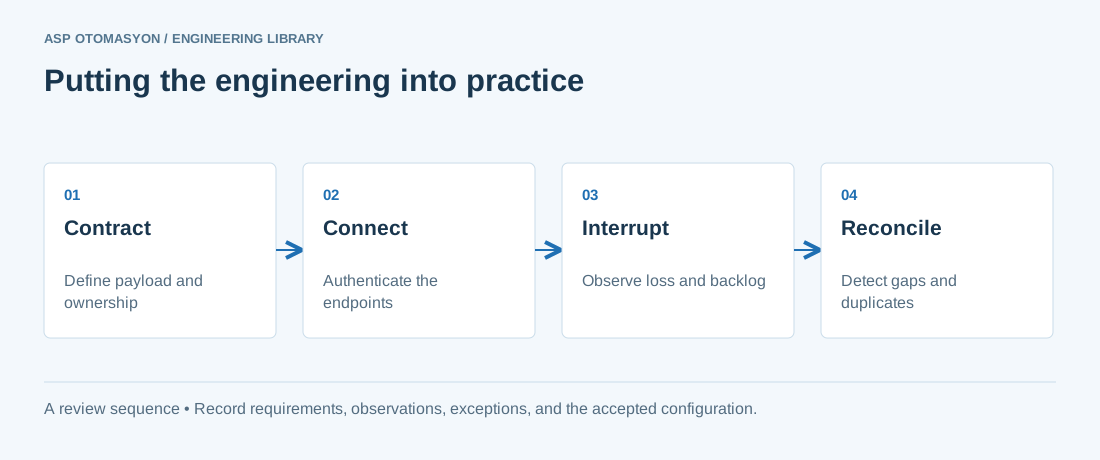
- Specify payload structure, units, identity, time semantics, access permissions, and protocol versions.
- Test backlog growth, connection loss, duplicate delivery, and restart behavior at the consuming application.
- Document how operators see failures and how the system distinguishes replayed data from current process state.
Follow an ASP project guide to connect the fundamentals with implementation and acceptance.
Primary references and further reading
Use the original specifications and product documentation for implementation details. The examples in this guide are illustrative engineering scenarios, not published project results.