
Millions of industrial assets sit where no cable goes: remote pumps, tanks, substations, compressors, and machines in the field. Cellular connectivity (LTE/4G, 5G, and the low-power cellular IoT standards NB-IoT and LTE-M) is how they join the network — a SIM card instead of a fiber. Cellular IoT is the connectivity workhorse for distributed assets, and its engineering is about the choices that decide cost, reliability, and security: the radio technology, the SIM and data plan, the hardware, and the management platform.
The Technology Options
| Technology | Data profile | Use for |
|---|---|---|
| LTE (4G) Cat 1/4 | 1–10+ Mbps, low latency, mature coverage | Gateways and controllers needing real bandwidth (SCADA remote sites, video, VPN tunnels) — the workhorse for industrial remote connectivity. |
| LTE-M (Cat M1) | ~1 Mbps, low power, deep coverage | Battery sensors with moderate data: level, pressure, vibration — designed for industrial IoT telemetry. |
| NB-IoT | Tens of kbps, ultra-low power, deepest coverage | Very small, very long-life messages: meter reads, status pings, alarm notifications. |
| 5G (standalone) | High rate, low latency, network slicing | Mission-critical and high-bandwidth mobile/industrial applications where the coverage exists (see the private 5G article). |
The selection logic: LTE for anything that tunnels or streams, LTE-M/NB-IoT for battery telemetry, 5G where latency and density demand it. The coverage reality at the actual sites decides what is viable — a coverage check at each asset location is the first engineering step.
The SIM and Connectivity Management
The SIM is the identity, and its management is the recurring cost:
- eSIM/iSIM — embedded, remote-provisionable identities replace physical SIM logistics: a device in the field changes operators without a truck roll. For fleets, eSIM is the standard answer to roaming and operator changes.
- Data plans and pooling — pooled data plans across the fleet (one bucket) smooth the per-device cost; the plan design matches the traffic profile (a device that sends 1 MB/day × 1,000 devices is a real bill — see the cost modeling in the cloud article).
- Connectivity management platforms (CMP) — the operator's or MVNO's platform: activate, deactivate, monitor usage, set limits, and diagnose remotely; the CMP is the fleet's operational console.
- Coverage and redundancy — critical sites get dual-SIM or multi-carrier capability; the failover behavior is tested, not assumed.
The Gateway Hardware
Industrial cellular gateways (the device between the asset's PLC/sensors and the network) are chosen on:
- Environment and power — temperature range, enclosure, and the power reality at the site (mains, solar, battery) — power is the #1 remote-site failure.
- Interfaces — serial (RS-232/485 for legacy PLCs — see the Modbus RTU article), Ethernet, and I/O (digital inputs for alarm contacts); the interface mix must match the asset's equipment.
- Protocol features — the gateway's own protocol support: MQTT/Sparkplug for cloud telemetry, VPN/IPsec for tunneled SCADA access, and OPC UA where the asset speaks it.
- Management — remote management (device cloud): firmware updates, configuration, and diagnostics over the air; a gateway that requires a site visit to configure is a recurring cost, not an asset.
- Security — the gateway is internet-connected by definition: hardware-backed identity, secure boot, no default credentials, and the management path secured (see the cloud/edge security article — the pattern applies fully).
Architecture Patterns
- Telemetry outbound — the gateway publishes measurements to a broker/cloud over MQTT (TLS); simple, cheap, and the standard for monitoring fleets.
- Secure tunnel — the gateway maintains an outbound VPN to the plant's remote-access concentrator; the SCADA sees the remote site as a network neighbor (see the remote access article) — for interactive access and legacy protocols.
- Hybrid — telemetry for monitoring + tunnel on demand for maintenance; the common pattern, with the tunnel access governed by the remote-access process.
Operational Reality
Cellular fleets are operated, not installed: the fleet dashboard (connectivity status per site), the data-plan review (quarterly — plans and tariffs change), the SIM lifecycle (activation, transfer, retirement), and the diagnostics (a site goes silent: is it power, coverage, SIM, or the asset?) — the gateway's remote diagnostics answer this from the desk, which is the whole point of the platform. And the regulator: each country's rules on SIM registration and radio devices apply — the fleet plan includes the compliance work.
Summary
Cellular IoT connects the assets that cables cannot reach: choose the radio technology by the data profile (LTE for bandwidth, LTE-M/NB-IoT for battery telemetry), manage the SIM fleet with eSIM and a CMP, select industrial gateways for the environment and remote management, secure them like the internet-connected devices they are, and operate the fleet with dashboards, plan reviews, and remote diagnostics. The SIM is the smallest part of the system — and the start of its management.
Apply this to your project
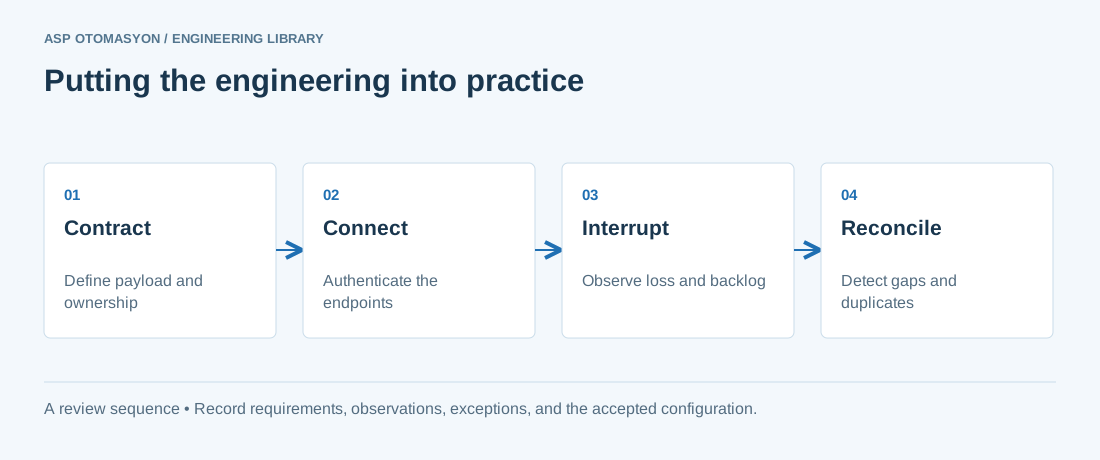
- Specify payload structure, units, identity, time semantics, access permissions, and protocol versions.
- Test backlog growth, connection loss, duplicate delivery, and restart behavior at the consuming application.
- Document how operators see failures and how the system distinguishes replayed data from current process state.
Follow an ASP project guide to connect the fundamentals with implementation and acceptance.
Primary references and further reading
Use the original specifications and product documentation for implementation details. The examples in this guide are illustrative engineering scenarios, not published project results.