
Private 5G is a dedicated cellular network that an industrial site operates (or leases) for its own use, rather than sharing a public operator's network. It brings the reliability, low latency, mobility, and scale of 5G to the factory floor — for AGVs, wireless sensors, video analytics, and remote control — without depending on crowded public spectrum or consumer-grade Wi-Fi. This article explains what private 5G is, when it makes sense for industry, and how it compares to the alternatives.
What Private 5G Provides
5G (3GPP Releases 15 and later) is designed for three service classes:
| Service class | What it targets | Industrial examples |
|---|---|---|
| eMBB (enhanced mobile broadband) | High data rates | Video analytics, AR assistance, high-res inspection |
| URLLC (ultra-reliable low-latency) | Very low, guaranteed latency | Wireless control loops, safety-related messaging, AGV coordination |
| mMTC (massive machine-type) | Very many low-power devices | Thousands of sensors, tracking tags |
A private network lets the site choose the service mix, coverage, and quality guarantees that match its applications.
Deployment Models
- Fully private (on-premises): the site licenses local spectrum (where available) and runs its own core network and radio equipment. Maximum control and data locality; highest effort.
- Neutral host / operator-managed: a mobile operator or vendor deploys and operates the network for the site on dedicated spectrum; the site gets private-network behavior without running the core.
- Network slicing (public): a slice of a public 5G network is dedicated to the site's traffic. Simple, but guarantees and coverage depend on the operator.
The right model depends on spectrum availability in the country, the site's security requirements, and whether the economics justify a dedicated network.
Private 5G vs. Industrial Wi-Fi
| Dimension | Wi-Fi 6/6E | Private 5G |
|---|---|---|
| Coverage & mobility | Handover between access points; gaps possible | Designed for seamless mobility and wide coverage |
| Determinism | Good with careful design; contention-based | Scheduled, QoS-guaranteed (URLLC class) |
| Device ecosystem | Mature, low-cost, ubiquitous | Growing; industrial modules cost more today |
| Licensing/spectrum | Unlicensed (shared, interference risk) | Licensed or licensed-shared spectrum (protected) |
| Complexity | Lower; IT skills readily available | Higher; specialized skills or managed service |
For most fixed machines and sensors, industrial Wi-Fi or wired fieldbuses remain the pragmatic choice. Private 5G earns its cost where mobility, scale, or guaranteed latency matters: large sites with fleets of AGVs, outdoor areas, high-density sensor deployments, and applications needing deterministic wireless.
Industrial Use Cases
- AGV and AMR fleets: reliable handover across large facilities, centralized traffic management.
- Wireless control and safety: e.g., remote crane or shuttle control with URLLC-grade links.
- High-density sensing: thousands of vibration, temperature, and energy sensors on one network (mMTC).
- Mobile inspection and AR: high-bandwidth video from cameras and head-mounted devices (eMBB).
- Machine networking in hard-to-cable areas: rotating equipment, moving gantries, outdoor tanks.
Integration with the OT Architecture
A private 5G network is a transport layer — it must integrate cleanly with the plant's existing architecture:
- Network segmentation: private 5G is not one flat network; segment the radio network into zones (control, monitoring, IT) with VLANs/network slicing, consistent with the Purdue Model.
- Data path: sensor data from 5G devices flows through gateways to the historian/MQTT broker/OPC UA layer exactly like wired devices (see the IIoT sensor integration article).
- Security: SIM-based authentication, encryption on the air interface, and the same OT security controls (monitoring, asset inventory, patching of the radio infrastructure itself).
- Latency engineering: edge computing (MEC) at the site keeps latency low for control-critical traffic; don't route time-critical flows through a distant core.
Business Case Realities
- Costs: spectrum (where licensed), radios, core, installation, and specialized engineers or a managed-service contract. 5G modules are still pricier than Wi-Fi chips.
- When it wins: large sites, outdoor coverage, high device density, deterministic wireless needs, and long lifecycle requirements (5G networks are designed for decade-scale operation).
- When it loses: small sites, fixed machines with existing cabling, and applications that Wi-Fi already serves reliably.
Summary
Private 5G is a powerful tool for specific industrial problems — seamless mobility, guaranteed wireless latency, and massive sensor scale — delivered as a dedicated network with protected spectrum. Compare it honestly with industrial Wi-Fi and wired infrastructure on coverage, determinism, cost, and skills; integrate it into the OT architecture like any other network segment; and start with a pilot that matches a real, measured pain point. For the right site, it is transformative; for others, it is an expensive solution to a problem Wi-Fi already solves.
Apply this to your project
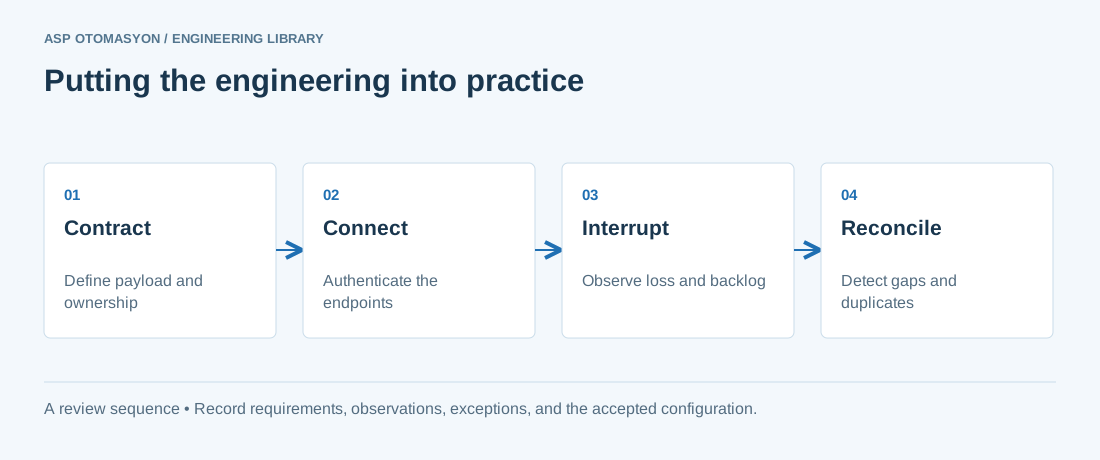
- Specify payload structure, units, identity, time semantics, access permissions, and protocol versions.
- Test backlog growth, connection loss, duplicate delivery, and restart behavior at the consuming application.
- Document how operators see failures and how the system distinguishes replayed data from current process state.
Follow an ASP project guide to connect the fundamentals with implementation and acceptance.
Primary references and further reading
Use the original specifications and product documentation for implementation details. The examples in this guide are illustrative engineering scenarios, not published project results.