
Industrial wireless is not one technology but a family, each engineered for a different problem: low-power battery sensors (LoRaWAN, WirelessHART, ISA100), high-bandwidth plant networks (Wi-Fi), and mission-critical machine connectivity (5G/private LTE). The common mistake is choosing by familiarity — "we have Wi-Fi, use Wi-Fi" — when the real decision is defined by data rate, latency, power, range, and determinism. This article maps the technologies to their applications.
The Technology Families
| Technology | Data profile | Best at | Not for |
|---|---|---|---|
| WirelessHART / ISA100.11a | 1–10 kbps per device, mesh, battery years | Process instrumentation (pressure, temperature, level) in plants; the process industry standard, coexisting with HART. | |
| LoRaWAN | 0.3–50 kbps, star-of-stars, battery years | Wide-area sensor networks: energy meters, environmental monitoring, tank levels across a campus. | |
| Industrial Wi-Fi (Wi-Fi 5/6/6E) | 100 Mbps+, low-latency burst traffic | Mobile equipment (AGVs, cranes, robots), tablets, cameras, maintenance tools — the general-purpose plant network. | |
| Private 5G / LTE | 10–100 Mbps per device, licensed-quality spectrum, very low latency | Mission-critical and highly mobile applications: AMRs at scale, video, control loops over wireless (with the right design), large sites. | |
| Bluetooth LE / proprietary mesh | Low rate, very low cost | Vibration sensors and tool tracking where the ecosystem already speaks BLE. |
The Selection Decision
Five questions decide the technology:
- What is the data rate? — a temperature trend needs 1 kbps; a video stream needs 10 Mbps. Rate requirements sort the field immediately.
- What is the latency and determinism? — control traffic needs deterministic sub-100 ms paths (5G with the right configuration, or Wi-Fi with careful design); monitoring tolerates seconds.
- How is the device powered? — battery devices dictate low-power protocols (LoRaWAN, WirelessHART); mains-powered devices can use any.
- What is the range and environment? — through steel and tanks, sub-GHz (LoRaWAN, WirelessHART) penetrates better than 2.4/5 GHz; outdoor campus scale favors LoRaWAN.
- What does the ecosystem support? — the instrument's wireless options (HART devices speak WirelessHART natively), the gateway availability, and the integration into the plant's systems (OPC UA from the wireless gateway is the common integration).
Coexistence, Not Competition
Mature plants run all of them: WirelessHART on the process instruments, Wi-Fi for the mobile workforce and AGVs, LoRaWAN for the campus sensors, and 5G where the operation demands it. The architecture question is the integration: every wireless network terminates in a gateway that connects to the plant's wired backbone and presents data over standard interfaces (OPC UA, Modbus, MQTT) — the wireless world is a set of edge networks around the wired core, not a parallel universe.
Design Considerations
- RF survey first — every deployment starts with a site survey (spectrum analysis and propagation measurement); wireless installed without a survey is gambling with the plant's data paths.
- Reliability engineering — mesh protocols (WirelessHART) self-heal; star protocols depend on gateway placement; plan redundancy for the critical paths (dual gateways, overlapping coverage).
- Security — all industrial wireless standards include encryption and authentication; the plant configures them deliberately (no default keys) and manages the wireless gateways as network assets (see the cybersecurity articles).
- Spectrum realities — 2.4 GHz is shared (Wi-Fi, Bluetooth, microwaves, some mesh): coexistence design matters; licensed and sub-GHz bands are cleaner but have duty-cycle rules (LoRaWAN) or cost (5G).
- Latency in practice — published latencies are best-case; the engineering values (with load, distance, retries) are what the control design must respect.
Summary
Industrial wireless is a portfolio: WirelessHART/ISA100 for process instruments, LoRaWAN for wide-area low-power sensing, Wi-Fi for mobile and general plant networking, and 5G for mission-critical and high-mobility applications. Select by rate, latency, power, range, and ecosystem; survey the RF before deploying; secure every link; and integrate all of it through gateways to the wired backbone. The best wireless network is the one sized to the problem — not the one already in the office.
Apply this to your project
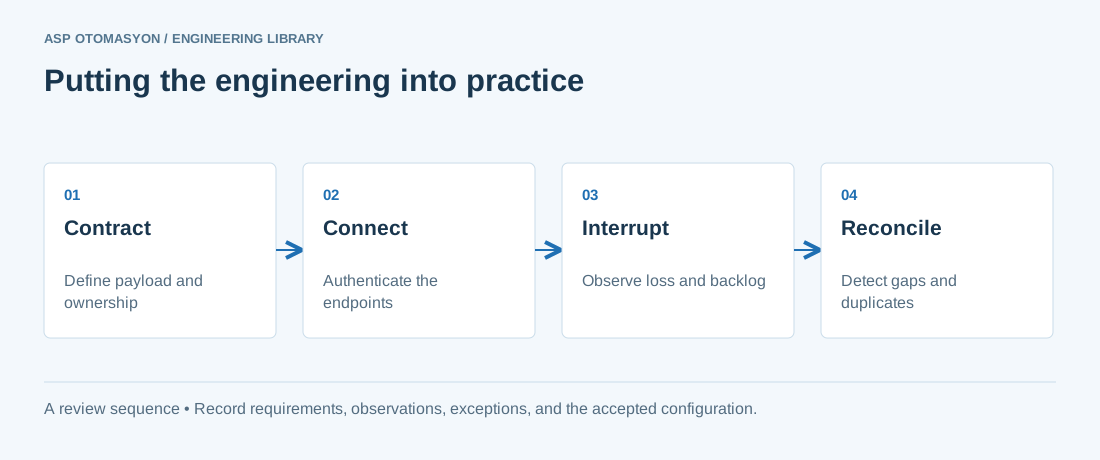
- Specify payload structure, units, identity, time semantics, access permissions, and protocol versions.
- Test backlog growth, connection loss, duplicate delivery, and restart behavior at the consuming application.
- Document how operators see failures and how the system distinguishes replayed data from current process state.
Follow an ASP project guide to connect the fundamentals with implementation and acceptance.
Primary references and further reading
Use the original specifications and product documentation for implementation details. The examples in this guide are illustrative engineering scenarios, not published project results.