
WirelessHART (IEC 62591) is the leading wireless communication standard for industrial process measurement and control. Built on the proven HART protocol and operating in the 2.4 GHz ISM band, WirelessHART provides a reliable, secure, and interoperable wireless mesh network for connecting field instruments to control and asset management systems. With an estimated 25 million wired HART devices installed worldwide, WirelessHART enables wireless connectivity for the vast installed base of HART-compatible instruments.
Technical Architecture
WirelessHART uses a time-synchronized, self-organizing, self-healing mesh architecture:
- TDMA (Time Division Multiple Access) — Each second is divided into 100 time slots of 10 ms each. The entire network is synchronized across these slots, enabling collision-free, deterministic communication.
- FHSS (Frequency Hopping Spread Spectrum) — The network changes channel with each time slot across 15 of the 16 available 2.4 GHz channels. Channel blacklisting avoids heavily congested frequencies.
- Mesh routing — Every field device acts as a router, forwarding messages from other devices. This creates multiple redundant communication paths for reliability.
- Graph routing — The network manager centrally determines communication paths and distributes them to field devices. Source routing is used for diagnostics.
- IEEE 802.15.4 radios — The underlying wireless technology uses standard 2.4 GHz IEEE 802.15.4 radios with O-QPSK modulation.
Network Components
| Component | Function |
|---|---|
| Field devices | WirelessHART transmitters (pressure, temperature, level, flow, vibration, pH, etc.) that measure process variables and transmit data wirelessly. |
| Gateway | Connects the WirelessHART mesh network to the host system (DCS, PLC, asset management). Translates WirelessHART protocol to HART, Modbus, or OPC. |
| Network manager | Embedded in the gateway. Manages network configuration, scheduling, routing, and optimization. |
| Security manager | Manages encryption keys, device authentication, and join procedures. |
| Access points | Optional devices that extend network coverage by providing additional connection points for field devices. |
Backward Compatibility with HART
WirelessHART maintains full backward compatibility with the HART "user layer" (commands and data structures). This means:
- Existing HART configuration tools (AMS Device Manager, FieldMate, PDM) work with WirelessHART devices through the gateway.
- All HART universal commands, common practice commands, and device-specific commands are supported.
- Multivariable devices transmit all process variables (primary, secondary, tertiary, quaternary) wirelessly.
- Device diagnostics, alerts, and status information are available through the same HART mechanisms.
Network Performance
| Parameter | Typical Value |
|---|---|
| Update rate | Configurable: 1 s to 60 s (typical: 8–30 s for process monitoring) |
| Reliability | >99.9% packet delivery (with mesh redundancy) |
| Range (device to gateway) | 200–300 m line-of-sight; 50–100 m through obstacles |
| Network size | Up to 100+ devices per gateway (practical limit: 50–100) |
| Latency | <1 s for typical update rates |
Security
WirelessHART incorporates multiple layers of security:
- AES-128 encryption — All wireless communications are encrypted using 128-bit AES in CCM mode.
- Device authentication — New devices must authenticate with the network manager using a join key before being admitted to the network.
- Message integrity — Each message includes a message integrity code (MIC) to detect tampering.
- Key management — Session keys and network keys are managed by the security manager and can be rotated.
- Jamming resistance — Frequency hopping and channel blacklisting provide resilience against intentional interference.
ISA100.11a Comparison
WirelessHART's main competitor is ISA100.11a (IEC 62734), developed by the International Society of Automation:
| Feature | WirelessHART (IEC 62591) | ISA100.11a (IEC 62734) |
|---|---|---|
| Protocol basis | HART (IEC 62591) | Native (not based on existing field protocol) |
| Backhaul | HART, Modbus, OPC | IPv6, 6LoWPAN |
| Market share | ~75–80% of industrial wireless | ~15–20% |
| Turkey adoption | Dominant standard | Limited |
| Vendor support | Emerson, ABB, Endress+Hauser, Pepperl+Fuchs, Siemens | Yokogawa, Nivis, Honeywell |
ASP OTOMASYON designs and deploys WirelessHART networks for process monitoring applications across Turkish industrial facilities, enabling cost-effective connectivity for hard-to-reach measurement points.
Apply this to your project
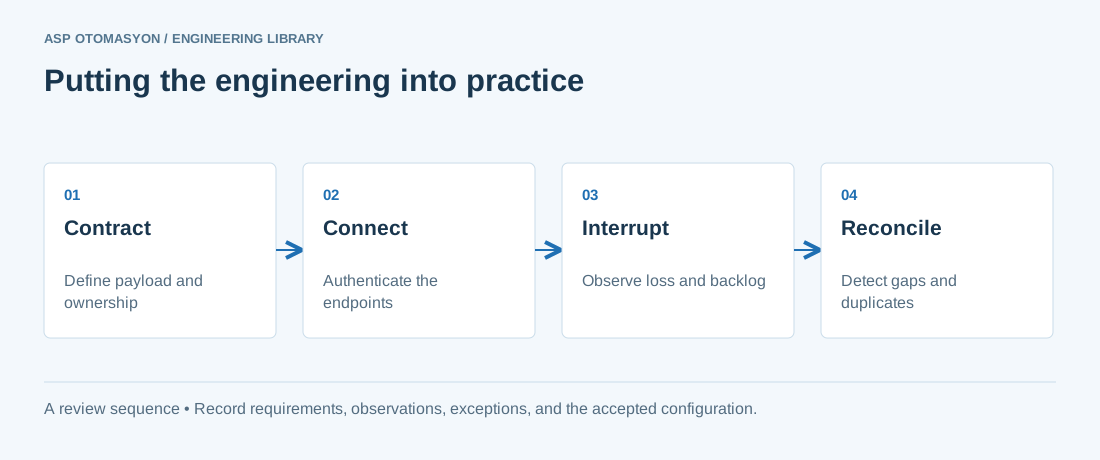
- Specify payload structure, units, identity, time semantics, access permissions, and protocol versions.
- Test backlog growth, connection loss, duplicate delivery, and restart behavior at the consuming application.
- Document how operators see failures and how the system distinguishes replayed data from current process state.
Follow an ASP project guide to connect the fundamentals with implementation and acceptance.
Primary references and further reading
Use the original specifications and product documentation for implementation details. The examples in this guide are illustrative engineering scenarios, not published project results.