
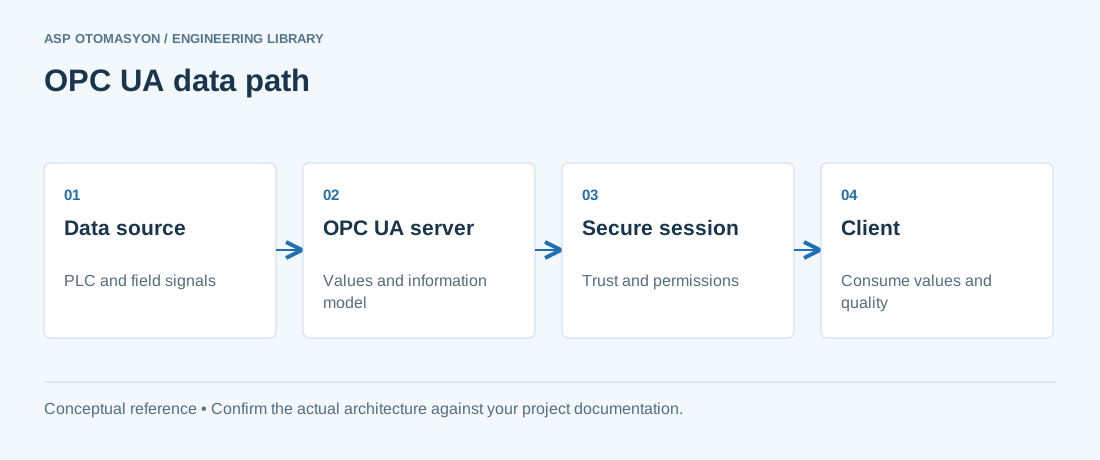
Traditional OPC UA runs over binary TCP on port 4840 — a protocol that browsers, serverless functions, and web applications cannot speak natively. As industrial data moves into web dashboards, mobile apps, and cloud services, the OPC Foundation has standardized web-friendly transports: OPC UA over HTTPS/JSON (Part 6 mapping) and the WebSocket transport (Part 6/Part 14 WebSocket mapping, released with OPC 10000-14 amendments). These mappings make OPC UA data accessible from any platform that can speak HTTP and JSON — without custom protocol stacks.
Why Web Mappings Exist
Three forces drive web transport support:
- Browser access — plant dashboards, quality portals, and maintenance apps that run in browsers cannot open raw TCP sockets; HTTPS and WebSockets are the browser's native channels.
- Cloud and serverless — functions-as-a-service and managed platforms typically restrict egress to HTTPS; a JSON mapping lets them consume UA data through standard web APIs.
- Proxies and gateways — HTTPS rides through corporate proxies, CDNs, and load balancers that would block or mangle binary TCP streams.
The Mappings at a Glance
| Transport | Encoding | Characteristics |
|---|---|---|
| OPC UA Binary over TCP (classic) | UA Binary | Lowest overhead, lowest latency; native UA features; port 4840. |
| OPC UA over HTTPS (REST-style) | UA JSON (Part 6 mapping) | Request/response over standard HTTP; uses standard web auth (OAuth 2.0/JWT); goes through any HTTPS-capable path. |
| OPC UA over WebSocket | UA JSON or UA Binary | Full-duplex channel for subscriptions/push; browsers and mobile native; supports the same session model over WS. |
The JSON encoding covers the core services: browse, read, write, call methods, and create subscriptions with monitored items; the event and alarm model also has JSON representations. Payloads are larger than binary, but for web clients the transport convenience outweighs the overhead in most cases.
Security Over Web Transports
HTTPS and WebSocket mappings reuse the web's security stack instead of UA's native certificate handshake:
- TLS — transport security comes from TLS as in any web service; the server presents a normal web certificate.
- Authentication — OAuth 2.0 bearer tokens (JWT) are the standard mechanism: the client obtains a token from an identity provider and the UA server validates it. This fits enterprise identity (Azure AD, Keycloak) and avoids per-client X.509 management.
- Authorization — user roles map onto the UA server's access model: which nodes the authenticated user may read, write, or execute.
- Deployment — because it is plain HTTPS, the server can sit behind a reverse proxy with WAF rules, rate limiting, and standard monitoring.
The trade-off: the rich UA certificate trust model (application-level identity) is replaced by web identity — appropriate for internet-facing or IT-managed paths, less so for direct plant-floor device-to-device traffic.
Practical Implementation Patterns
- Dashboards and portals — a web app subscribes over WebSocket to a UA server in the DMZ and renders live values; no thick client, no open inbound ports beyond HTTPS.
- Mobile maintenance — field staff read machine status and acknowledge alarms through a mobile web app using the same JSON endpoints.
- Cloud ingestion — a serverless function polls (or receives webhooks from) the UA-over-HTTPS endpoint and pushes into the data lake — a pattern that fits provider-managed platforms perfectly.
- System integration — enterprise systems (ERP, quality) that already speak REST consume plant data through the JSON mapping without new middleware.
When to Prefer Classic Binary
Web mappings are not a replacement for binary UA everywhere. For high-rate process data between plant systems, for device-level connectivity, and where low latency matters, UA Binary over TCP remains the right choice. The JSON/WebSocket endpoints are the demilitarized zone face of the same data: secure, manageable, web-native — with the understanding that payload overhead and TLS handshakes make them better for human-facing and moderate-rate machine-to-web traffic than for high-frequency streaming.
Summary
OPC UA's HTTPS/JSON and WebSocket mappings extend the UA data model to the web: standard TLS, OAuth 2.0 identity, JSON payloads, and full-duplex subscriptions. Use them at the web edge of the architecture — dashboards, portals, mobile, and cloud ingestion — while keeping UA Binary for plant-floor integration. The same information model, the same semantics, with the transport that fits the audience.
Apply this to your project
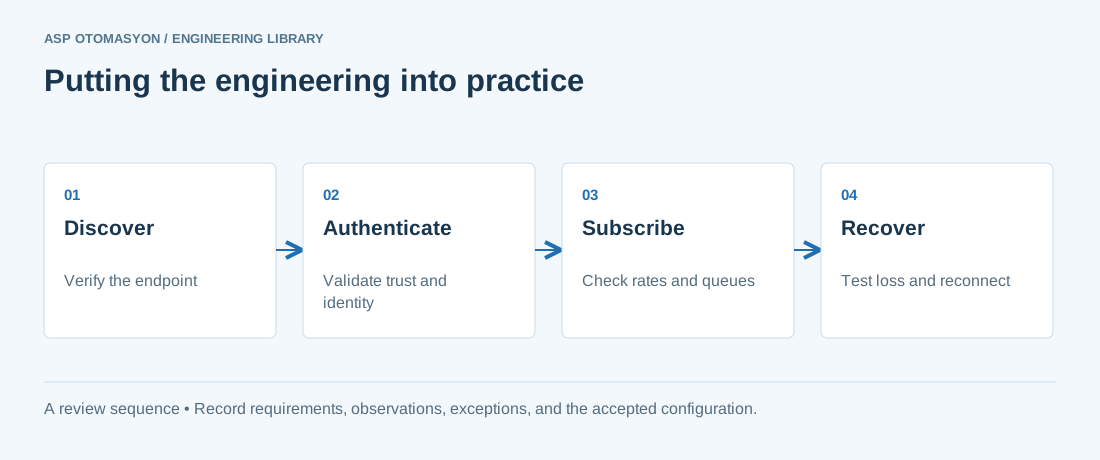
- Record the endpoint, supported security policies, application identity, certificate expiry, and user permissions.
- Verify the value, engineering unit, StatusCode, and source timestamp together at the receiving application.
- Test disconnection and recovery with representative subscriptions; preserve evidence of any data gaps or repeated values.
Follow an ASP project guide to connect the fundamentals with implementation and acceptance.
Primary references and further reading
Use the original specifications and product documentation for implementation details. The examples in this guide are illustrative engineering scenarios, not published project results.