Cloud platforms offer industrial organizations computing power, analytics, and collaboration that on-premises systems cannot match — but the plant floor speaks OPC UA, MQTT, and fieldbuses, while the cloud speaks HTTPS, message brokers, and managed IoT services. OPC UA to cloud integration is the discipline of connecting those worlds safely and reliably: which data leaves the plant, over what protocol, through which gateway, with what security, and how it arrives structured enough for analytics.
Reference Architecture
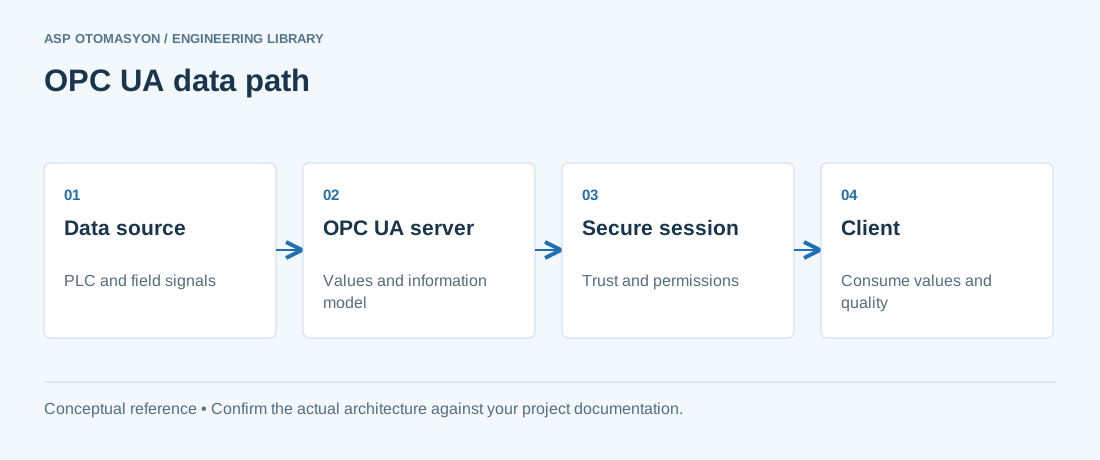
A typical industrial-to-cloud path has four stages:
- Data sources — PLCs, sensors, and systems speaking native protocols, aggregated by an OPC UA server at the edge (KEPServerEX, platform gateways, or embedded UA servers).
- Edge gateway — a device or VM in the plant DMZ that terminates OPC UA, applies data selection and buffering, and forwards to the cloud over an outbound-only connection (MQTT or HTTPS).
- Cloud ingestion — the provider's IoT service: Azure IoT Hub, AWS IoT Core, or a managed MQTT broker — with device identity, per-device keys, and message routing.
- Cloud processing — data lakes, time-series databases, analytics, dashboards, and ML services consuming the ingested streams.
The critical architectural rule: outbound-only, at the plant edge. No cloud service ever connects inbound to the OT network; the edge gateway is the only crossing point and it sits in a DMZ behind the plant firewall.
Gateway Design Patterns
- MQTT/Sparkplug B — the de facto standard for industrial-to-cloud telemetry: lightweight, TLS-protected, with Sparkplug B's structured namespace (birth/death certificates, templates) that preserves data context end to end.
- OPC UA Pub/Sub — native UA publish/subscribe (UDP multicast or MQTT transport) for architectures that want UA semantics all the way; the cloud side then consumes UA payloads directly.
- REST ingestion — HTTPS POST/GET to cloud APIs for event-driven or low-frequency data (daily KPI uploads, alert notifications); simplest to secure, weakest for high-frequency streaming.
- Azure IoT Edge / AWS Greengrass — managed edge runtimes with local processing (filtering, ML inference) that only send what matters; they run UA clients or MQTT publishers on the edge.
Most projects combine patterns: Sparkplug B or UA Pub/Sub for telemetry, REST for configuration and command responses, and the provider's edge runtime where local logic is required.
Security Architecture
Cloud integration multiplies the attack surface; the security design must be explicit:
- Identity — every gateway device gets its own cloud credential (X.509 device certificate preferred over shared keys), stored in hardware where possible.
- Transport — TLS 1.2+ everywhere, certificate pinning or provider CA verification on the gateway.
- Network — the gateway's outbound destinations are allow-listed at the firewall; no inbound ports from the internet.
- Data minimization — send only the tags the use case needs; a "send everything" policy multiplies risk, cost, and noise.
- Secrets management — cloud keys and connection strings live in the edge device's secure store or the provider's device shadow, never in scripts or tag names.
- Audit — log gateway config changes and cloud-side access; tie the logs to the OT incident response plan.
Data Contracts and Context
Raw tag streams lose meaning in the cloud unless the context travels with them. Define the message contract before implementation:
- Stable, documented tag/asset naming (asset hierarchy: Site → Line → Machine → Point) mapped consistently from UA namespace to cloud twin.
- Units and data types preserved (Sparkplug B and UA templates carry units in the payload; verify the cloud-side mapping doesn't drop them).
- Timestamps: use UTC with original source timestamps; a tag's source timestamp must survive gateway buffering and network delay.
- Quality: map OPC UA quality codes to the cloud schema so analytics can distinguish good data from stale or substituted values.
- Schema versioning: the contract will evolve; version the payload and the asset model so old and new devices can coexist.
Reliability and Operations
Cloud links are less reliable than plant networks by nature. Plan for it:
- Edge buffering — the gateway must queue data during outages (disk-backed, with size limits and oldest-first eviction policy) and replay in order on reconnect.
- Exactly-once vs at-least-once — with Sparkplug B, at-least-once with deduplication on the cloud side is standard; design analytics to tolerate duplicates.
- Monitoring — the cloud connection itself is a monitored asset: gateway health, queue depth, message latency, and rejection rates visible in both OT and IT monitoring.
- Cost control — cloud ingestion is metered; message rate and payload size directly drive the bill. Batch where latency allows, filter where possible, and profile the message size before scaling the deployment.
Summary
OPC UA to cloud integration is an edge architecture problem: terminate UA at a DMZ gateway, publish structured telemetry outbound over MQTT/Sparkplug or UA Pub/Sub, secure identity and transport per device, carry context (units, quality, timestamps) in the contract, and engineer buffering and monitoring for imperfect networks. Done right, the cloud becomes an extension of the plant's data architecture; done wrong, it becomes an uncontrolled data leak with a monthly bill.
Apply this to your project
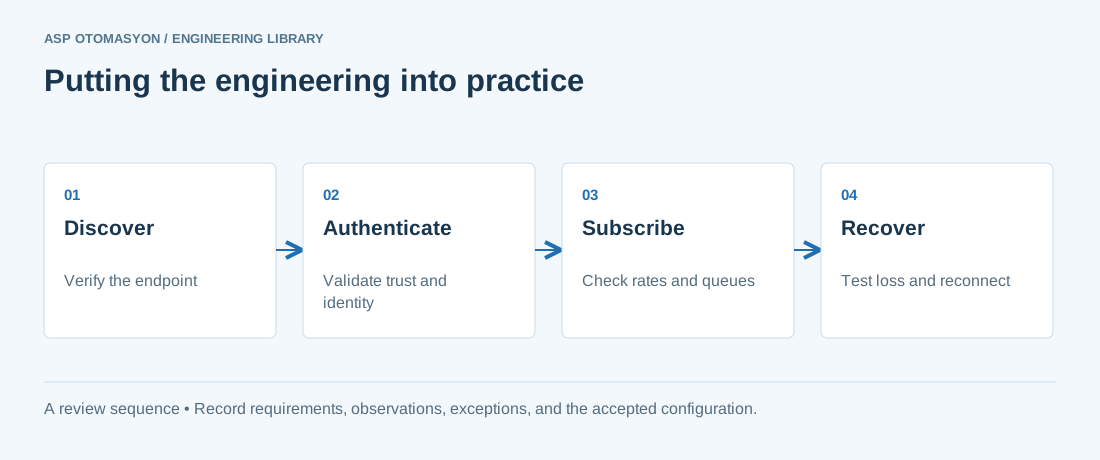
- Record the endpoint, supported security policies, application identity, certificate expiry, and user permissions.
- Verify the value, engineering unit, StatusCode, and source timestamp together at the receiving application.
- Test disconnection and recovery with representative subscriptions; preserve evidence of any data gaps or repeated values.
Follow an ASP project guide to connect the fundamentals with implementation and acceptance.
Primary references and further reading
Use the original specifications and product documentation for implementation details. The examples in this guide are illustrative engineering scenarios, not published project results.