Industrial plants run on control systems with lifecycles measured in decades, but the underlying platforms age faster: processors reach end of life, operating systems lose security support, spare parts disappear, and the workforce that knows the old system retires. Control system modernization — replacing or upgrading legacy DCS, PLC, and SCADA platforms — is one of the highest-value capital investments a plant can make, but it carries real risk to production continuity. A disciplined migration plan is the difference between a controlled upgrade and a forced, expensive shutdown.
Why Modernize: Drivers and Triggers
- Obsolescence — the vendor announces end-of-life: no more patches, no more spares. This is the most common trigger.
- Security — legacy platforms cannot run modern security controls (encrypted protocols, patching, monitoring) and become the weakest point in the OT network.
- Capability — the plant needs functions the old system cannot deliver: advanced control, historian integration, remote access, IIoT connectivity.
- Reliability — increasing failure rates and growing maintenance effort make continued operation uneconomic.
- Workforce — retiring engineers take the knowledge; new engineers refuse to learn 30-year-old tools.
Migration Strategies
| Strategy | Description | When to choose |
|---|---|---|
| Same-platform refresh | Upgrade hardware and OS on the same product family; logic is largely re-imported. | System is healthy, vendor supports the path, minimal risk appetite. |
| In-place evolution | Add new controllers or servers alongside, migrate unit by unit while the plant runs. | Continuous production with short maintenance windows. |
| Parallel systems / cutover | Install the new system fully, test against a simulated or shadowed environment, then switch over in one planned window. | Complex integrated plants where per-unit migration risks interfaces. |
| Full replacement | New platform, new I/O or fieldbus, new HMI — usually with a staged unit-by-unit plan. | Old I/O is also obsolete; control strategies need redesign. |
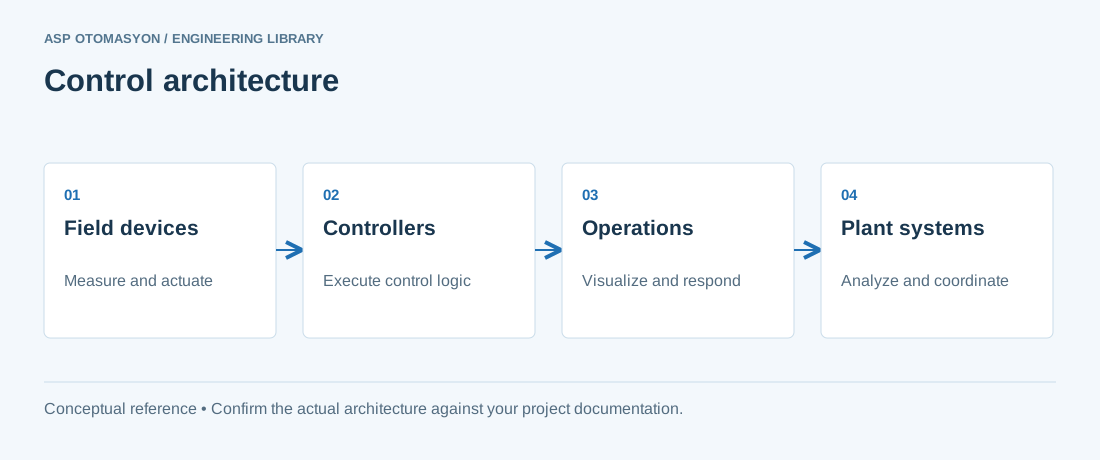
Most plants end up with a hybrid: new controllers connected to the existing I/O through gateway or remote-I/O strategies, replaced progressively. Keeping the old I/O wiring alive for one migration phase is often the cheapest way to limit outage risk.
Key Planning Steps
- Inventory and baseline — document every controller, I/O point, network, tag, alarm, and interlock. The I/O list and control narratives are the contract for the new system.
- Risk and impact assessment — classify each unit by production criticality, hazard, and interface complexity; this sets the migration order.
- Define the target architecture — new hardware, network topology, security zones, historian, and reporting, aligned with ISA-95 layers and IEC 62443 zones.
- Logic conversion strategy — decide per unit: automatic conversion (documented, then revalidated), manual rewrite, or redesign. Automatic conversion of ladder to the new platform is rarely sufficient without rework; budget for it.
- Testing strategy — simulation, factory test with the actual I/O lists, and a site test plan with acceptance criteria per unit.
- Cutover planning — sequence, permissions, safety measures, rollback triggers, and a clear decision authority for aborting the cutover.
- Training — operators and maintenance staff trained on the new HMI and tools before cutover, with the old system still available as reference.
- Data migration — historical data, recipes, and alarm history migrated or archived so the plant retains its memory.
Managing the Risks
The biggest modernization risks are not technical but organizational: unclear ownership, undefined acceptance criteria, and schedule pressure that skips testing. Mitigations that work in practice:
- Freeze the scope: new features are nice-to-haves recorded for phase 2, never mixed into a cutover.
- Rehearse the cutover in simulation, including the rollback sequence.
- Keep the old system recoverable for at least one production cycle after cutover (disconnected, but bootable).
- Assign a single migration manager with authority to stop the clock.
- Verify every interlock and safety function on the new platform — no shortcuts, no assumptions from the old logic.
Summary
Modernization is a project like any other: inventory, target architecture, staged migration strategy, rigorous testing, and rehearsed cutover. The payoff — security, reliability, capability, and maintainability — justifies the investment when the old platform's lifecycle ends. The risk is managed by discipline: freeze scope, test thoroughly, rehearse, and keep rollback alive until the new system has earned trust in production.
Apply this to your project
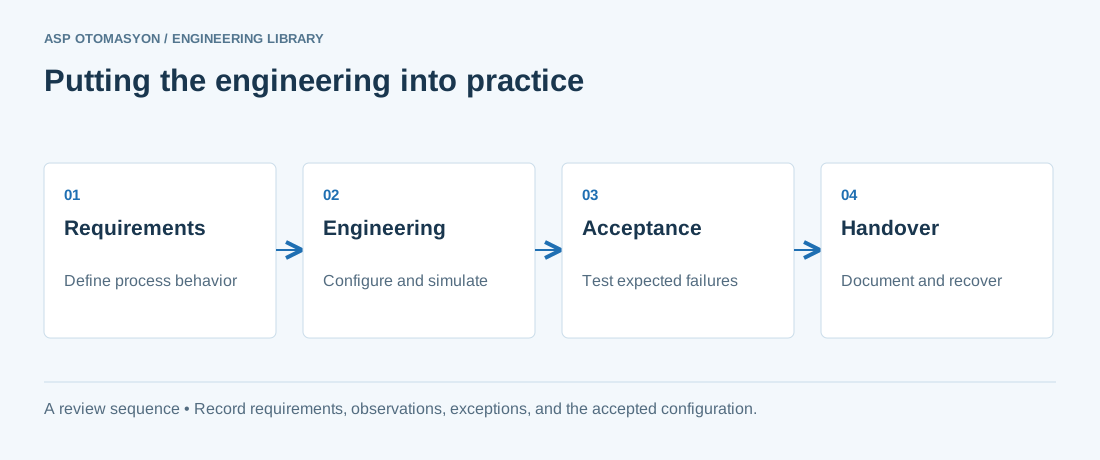
- Define the process states, timing requirements, and permitted behavior after a controller or communication failure.
- List controller, I/O, network, software, and license dependencies before choosing an architecture.
- Record acceptance results and prove that the delivered configuration can be restored from the handover package.
Follow an ASP project guide to connect the fundamentals with implementation and acceptance.
Primary references and further reading
Use the original specifications and product documentation for implementation details. The examples in this guide are illustrative engineering scenarios, not published project results.