
Single-loop PID control is the backbone of process automation, but many processes are too coupled, too slow, or too disturbed for one isolated loop. Advanced control strategies — cascade, ratio, feedforward, and their variants — are structured ways of combining loops and process knowledge to achieve tighter control, faster disturbance rejection, and smoother operation. They are implemented in DCS and modern PLC systems using the same PID blocks configured with different structures.
Cascade Control
Cascade control uses two controllers where one output is set by the other: the primary (outer, master) loop controls the slow variable and generates the setpoint for the secondary (inner, slave) loop, which controls a fast variable close to the disturbance source.
The classic example is temperature control of a heat exchanger via steam flow: the primary loop measures product temperature and outputs a steam-flow setpoint; the secondary loop measures steam flow and manipulates the valve. Steam pressure disturbances are rejected by the inner loop before they affect product temperature.
Design rules for cascade:
- The secondary loop must be significantly faster (3–5×) than the primary; otherwise the loops interact and the cascade becomes unstable.
- Tune the inner loop first, then the outer loop with the inner loop in automatic.
- Anti-windup matters: the primary's output (secondary setpoint) must be clamped and tracked so the secondary does not wind up while the primary is saturated.
- If the secondary measurement fails, the controller should fail back to a configured safe setpoint or manual, never to an uncontrolled output.
- Bumpless transfer: when switching cascade to/from manual, both controllers must track each other's outputs.
Ratio Control
Ratio control maintains a fixed proportion between two flows — the classic application is fuel-to-air ratio in burners, or reactant-to-carrier flows in dosing. The structure is simple: the wild (uncontrolled) flow is measured and multiplied by the ratio to generate the setpoint for the follower flow controller.
Implementation details that matter:
- The ratio is a process variable that operators may adjust; provide validated limits and clamping to prevent unsafe ratios.
- Ratio control should be biased to a minimum follower flow so the relationship holds at turndown (low wild flow), where a pure ratio would demand impractically small follower flows.
- Use the same engineering units and correct density/temperature compensation when flows are measured in different conditions.
- Consider cross-limited structures for combustion: when increasing firing, add fuel after air; when decreasing, reduce fuel first. This prevents explosive mixtures during transients.
Feedforward Control
Feedback control reacts after a disturbance affects the process. Feedforward acts before: the disturbance is measured directly and the manipulated variable is adjusted by a model-based prediction, ideally keeping the controlled variable perfectly steady.
Feedforward is most valuable when:
- The disturbance is measurable and its effect on the process is significant and predictable.
- The process has long dead time, where feedback reacts too late.
- Large, frequent setpoint or load changes occur (e.g., batch reactors, variable throughput plants).
The feedforward element is a steady-state model of the process: MV = f(disturbance). A static feedforward uses a gain and possibly a lead/lag block to shape the dynamic compensation. In practice, feedforward is almost always combined with feedback (the feedback loop trims the residual error), forming a feedforward–feedback structure:
- Identify the disturbance-to-output model (gain and time constant) from step tests or plant data.
- Implement the static feedforward gain (or curve) in the controller.
- Add a lead–lag filter so the feedforward action is timed correctly; too much lead causes overshoot, too little leaves residual error.
- Tune the feedback loop for the residual error only — it can be slower and more robust than without feedforward.
- Validate over the full operating envelope, including inverse response or nonlinear gain regions.
Related Structures
Two more structures deserve mention. Override (selector) control applies the most restrictive of several outputs — for example, a high-temperature override on a flow loop, implemented with low/high signal selectors. Split-range control lets one controller drive two final elements sequentially or proportionally, such as a cooling-water valve and a steam valve on the same temperature loop. Both are configured in the same block-oriented way as cascade and require careful, documented tuning.
Practical Implementation Notes
- Document the strategy with a control narrative and a loop diagram; future engineers must be able to reconstruct the intent.
- Provide manual/auto/cascade modes with bumpless transfer at every level.
- Use external reset feedback between interacting controllers to avoid reset windup — a standard option in DCS PID blocks.
- Simulate or dry-run the strategy in a test environment before commissioning; switching a live plant to a new structure without rehearsal is a leading cause of process upsets.
Summary
Cascade, ratio, and feedforward are the three most powerful extensions of classical PID. Cascade separates fast disturbances from slow objectives, ratio enforces proportions safely, and feedforward cancels known disturbances before they arrive. Each requires a measurable secondary variable or disturbance, careful tuning order, anti-windup handling, and complete documentation — but the control quality payoff in throughput, stability, and energy is substantial.
Apply this to your project
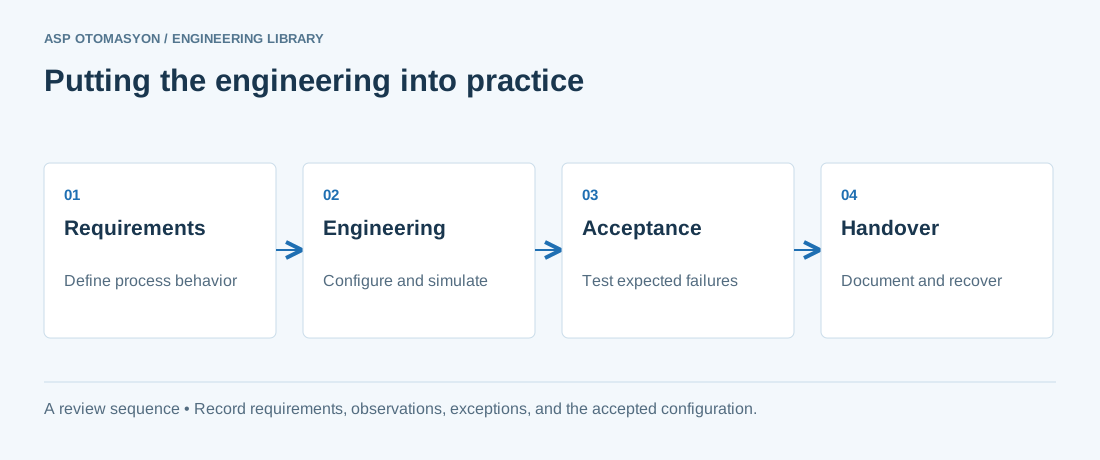
- Define the process states, timing requirements, and permitted behavior after a controller or communication failure.
- List controller, I/O, network, software, and license dependencies before choosing an architecture.
- Record acceptance results and prove that the delivered configuration can be restored from the handover package.
Follow an ASP project guide to connect the fundamentals with implementation and acceptance.
Primary references and further reading
Use the original specifications and product documentation for implementation details. The examples in this guide are illustrative engineering scenarios, not published project results.