
Modbus is the oldest and most widely deployed industrial communication protocol in the world. Originally developed by Modicon (now Schneider Electric) in 1979 for PLC communication, Modbus has been adapted for serial (Modbus RTU/ASCII) and TCP/IP networks. Despite its age, Modbus remains the backbone of industrial communication due to its simplicity, openness, and ubiquity. This article provides a comprehensive technical deep dive into Modbus TCP/IP — covering the MBAP header structure, function codes, addressing, performance characteristics, security limitations, and best practices for industrial deployment.
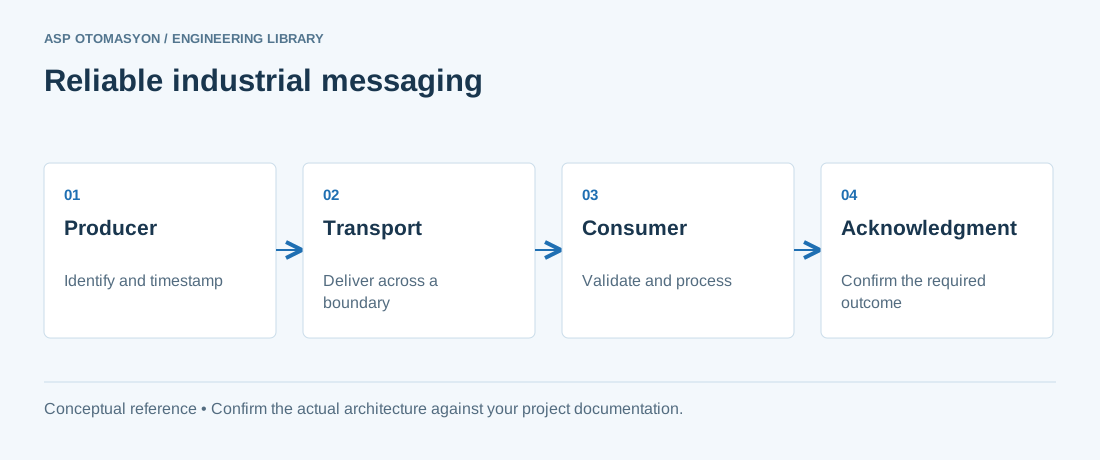
Protocol Overview
Modbus TCP/IP is an application-layer protocol that operates over TCP/IP networks, typically port 502. It follows a client/server (historically called master/slave) communication model:
- Client (Master) — Initiates requests to read or write data. Typically a SCADA server, HMI, or OPC gateway.
- Server (Slave) — Responds to client requests. Typically a PLC, RTU, drive, or intelligent instrument.
Unlike Modbus RTU (which uses RS-232/485 and has a single master polling multiple slaves), Modbus TCP/IP supports multiple simultaneous clients connecting to multiple servers over switched Ethernet. Each server is identified by its IP address rather than a device ID, and the unit ID field is typically set to 255 (broadcast) or match the RTU slave ID when bridging to a serial Modbus network.
MBAP Header Structure
The Modbus Application Protocol (MBAP) header is the TCP wrapper that distinguishes Modbus TCP/IP from Modbus RTU. Every Modbus TCP/IP packet begins with a 7-byte MBAP header, followed by the Protocol Data Unit (PDU):
Modbus TCP/IP Packet Structure:

+-----------------------------------------------------------+
|  MBAP Header (7 bytes)                                      |
+---------+---------+----------+----------+----------+------+
| Transaction | Protocol | Length    | Unit ID |              |
| Identifier  | Identifier|          |         |              |
| (2 bytes)   | (2 bytes) | (2 bytes) | (1 byte)|              |
+---------+---------+----------+----------+----------+------+
|  PDU (varies)                                                |
+-----------------------------------------------------------+
|  Function Code (1 byte)  |  Data (0-252 bytes)            |
+-----------------------------------------------------------+
Header Fields
| Field | Size | Description |
|---|---|---|
| Transaction Identifier | 2 bytes | Unique identifier for matching requests and responses. Incremented by the client for each new request. The server copies this value into its response. |
| Protocol Identifier | 2 bytes | Always 0x0000 for Modbus. Used for future protocol multiplexing. |
| Length | 2 bytes | Number of remaining bytes in the packet (Unit ID + Function Code + Data). Excludes the MBAP header itself. |
| Unit Identifier | 1 byte | Server address. In a native TCP device, typically 0xFF (255). When bridging to serial Modbus, contains the slave ID (1–247). |
| Function Code | 1 byte | The operation to perform (read coils, read registers, write coil, etc.). |
| Data | 0–252 bytes | Parameters and data for the function. Varies by function code and operation. |
Function Codes
Modbus defines three categories of function codes: Public (well-defined, standardized), User-Defined (65–72, 100–110), and Reserved. The most commonly used public function codes are:
| Code | Name | Description | Max Data Size |
|---|---|---|---|
| 01 (0x01) | Read Coils | Read the ON/OFF status of discrete outputs (coils). Returns 1 bit per coil. | 2000 coils (250 bytes) |
| 02 (0x02) | Read Discrete Inputs | Read the ON/OFF status of discrete input points (read-only). | 2000 inputs (250 bytes) |
| 03 (0x03) | Read Holding Registers | Read the binary contents of holding registers (read/write, 16-bit each). Most common function for analog data. | 125 registers (250 bytes) |
| 04 (0x04) | Read Input Registers | Read the binary contents of input registers (read-only, 16-bit each). | 125 registers (250 bytes) |
| 05 (0x05) | Write Single Coil | Force a single coil (digital output) to ON or OFF. | 1 coil |
| 06 (0x06) | Write Single Register | Write a single holding register (16-bit). | 1 register |
| 15 (0x0F) | Write Multiple Coils | Force multiple coils ON or OFF in a single request. | 1968 coils (246 bytes) |
| 16 (0x10) | Write Multiple Registers | Write multiple holding registers in a single request. | 123 registers (246 bytes) |
| 22 (0x16) | Mask Write Register | Modify a holding register using AND/OR masks (atomic bit field modification). | 1 register |
| 23 (0x17) | Read/Write Multiple Registers | Read registers and write registers in a single transaction. | 125 read / 121 write |
Exception Responses
When a server cannot process a valid request, it returns an exception response with the function code most significant bit set (0x80 | function code) followed by an exception code:
| Code | Name | Meaning |
|---|---|---|
| 01 | Illegal Function | The function code is not supported by the server. |
| 02 | Illegal Data Address | The requested register/coil address does not exist. |
| 03 | Illegal Data Value | The data value in the request is out of range. |
| 04 | Slave Device Failure | An unrecoverable error occurred while processing the request. |
| 05 | Acknowledge | The request is being processed (long operation). The client should poll for completion. |
| 06 | Slave Device Busy | The server is busy processing another request. The client should retry later. |
| 08 | Memory Parity Error | The server detected a parity error in memory. |
| 10 | Gateway Path Unavailable | The gateway is not configured or cannot reach the target device. |
| 11 | Gateway Target Device Failed to Respond | The target device did not respond within the gateway timeout. |
Addressing Scheme
Modbus data is organized into four data tables, each representing a different address space:
| Table | Type | Access | Address Range (PLC Convention) | Modbus PDU Address |
|---|---|---|---|---|
| Discrete Inputs | 1 bit | Read-only | 10001–19999 | 0–9998 |
| Coils | 1 bit | Read/Write | 00001–09999 | 0–9998 |
| Input Registers | 16 bits | Read-only | 30001–39999 | 0–9998 |
| Holding Registers | 16 bits | Read/Write | 40001–49999 | 0–9998 |
Important: The PLC convention (e.g., 40001) is based on 1-indexed addressing, while the Modbus PDU uses 0-indexed addressing. A register at PLC address 40001 is accessed as register 0 in the Modbus PDU. Most configuration interfaces in SCADA and OPC servers handle this translation automatically, but it is a common source of "off-by-one" configuration errors.
Data Encoding
- 16-bit Registers — Big-endian (most significant byte first). This is critical when integrating devices from different vendors — some devices (especially older Rockwell/Siemens) use little-endian encoding, requiring byte swap configuration in the client.
- 32-bit Values (Floats, Longs) — Typically stored across two consecutive registers (ABCD order). The Modbus specification does not mandate 32-bit ordering, leading to four common variants: AB CD (big-endian), CD AB (little-endian byte swap), BA DC (word swap), DC BA (mixed). This is the most common source of Modbus integration errors.
- String Data — Often ASCII-encoded across consecutive registers, each register holding two characters (high byte, low byte). Null-terminated or space-padded depending on the device manufacturer.
Performance Characteristics
Understanding Modbus TCP/IP performance limits is essential for system design:
| Parameter | Value | Implication |
|---|---|---|
| Max PDU Size | 253 bytes (including FC) | 125 holding registers or 2000 coils per request |
| Minimum TCP Payload | 12 bytes (MBAP + FC + 4-byte data for some requests) | Inefficient for single-point reads |
| Typical Scan Rate | 100–1000 ms per poll | Depends on client polling strategy and server response time |
| Max Throughput (100 Mbps) | ~8000 packets/second per connection | Theoretical; actual depends on server CPU and network conditions |
| Connection Persistence | TCP connection kept open for multiple transactions | Reduces handshake overhead vs. HTTP-based protocols |
| Response Time (deterministic) | No built-in determinism | Depends on TCP stack and network load; not suitable for hard real-time without additional scheduling |
Polling Strategy Optimization
- Burst Reads — Read all required data from a device in as few requests as possible. Reading 125 registers in one query is significantly more efficient than 125 individual register reads.
- Scan Rate Management — Group tags by required update frequency. Process-critical analog values (PID PVs) may need 500 ms scans, while equipment status (running/stopped) can update every 5 seconds.
- Connection Pooling — For SCADA systems managing hundreds of Modbus devices, use connection pooling to limit simultaneous open TCP connections. Most OPC servers handle this automatically.
- Timeout Configuration — Set appropriate timeouts (3–10 seconds is typical). Too short causes false communication alarms; too long delays error detection.
Security Considerations
Modbus TCP/IP has no native security. The protocol was designed in an era when control networks were physically isolated and trusted. In modern environments, this creates significant risk:
Inherent Vulnerabilities
- No Authentication — Any device that can reach a Modbus TCP server on port 502 can send arbitrary commands. There is no login, password, or session concept.
- No Encryption — All data, including setpoints, control commands, and process values, is transmitted in plaintext. Anyone with network access can read or modify the data.
- No Integrity Checking — The TCP checksum provides bit-level integrity, but there is no cryptographic integrity check. Man-in-the-middle attacks can modify packets undetected.
- No Anti-Replay — An attacker who captures a valid Modbus write request can replay it later, potentially causing unintended control actions.
- Function Code Abuse — Function Code 08 (Diagnostics) can be used for device enumeration and reconnaissance. Function Code 05 and 06 can force outputs without any authorization check.
- Broadcast Writes — Function Codes 05, 06, 15, and 16 can be sent with Unit ID 0 to broadcast to all devices on a serial network segment, affecting multiple devices simultaneously.
Mitigation Best Practices
- Network Segmentation — Isolate Modbus TCP traffic within the OT network. Never expose Modbus TCP servers (PLCs, RTUs) directly to the enterprise network or internet. Use firewalls to restrict access to Modbus TCP (port 502) to only authorized SCADA servers and engineering workstations.
- Modbus TCP over VPN/TLS — When Modbus traffic must traverse untrusted networks (e.g., remote site connectivity), encapsulate it in a VPN tunnel (IPsec) or use Modbus/TLS (Modbus Security Application — MBTS) per IEC 62351-3, the recently standardized secure extension for Modbus.
- Industrial Firewalls with DPI — Deploy firewalls that understand the Modbus protocol at the application layer. Configure whitelist rules that permit only required function codes from specific source IP addresses.
- Modbus TCP Deep Packet Inspection Rules
# Example Industrial Firewall Rule Set (Modbus-specific) # ===================================================== # ALLOW: SCADA reads analog data from PLC-01 ALLOW SRC=SCADA_Svr_IP DST=PLC_01_IP PROTO=MODBUS_TCP FC=03 REG=0-250 # ALLOW: SCADA writes setpoints to PLC-01 ALLOW SRC=SCADA_Svr_IP DST=PLC_01_IP PROTO=MODBUS_TCP FC=16 REG=100-105 # BLOCK: All other Modbus writes to PLC-01 DENY DST=PLC_01_IP PROTO=MODBUS_TCP FC=05,06,15 LOG=YES # BLOCK: Modbus diagnostics DENY PROTO=MODBUS_TCP FC=08 LOG=YES # BLOCK: All Modbus traffic not from authorized sources DENY DST=* PROTO=MODBUS_TCP LOG=YES - Unit ID Validation — Where possible, validate that the Unit ID in Modbus requests matches the expected device address. This prevents attackers from scanning across serial gateway attached devices.
- Anomaly Detection — Deploy OT NDR (Network Detection and Response) sensors that learn the normal Modbus traffic baseline and alert on anomalies: unexpected function codes, excessive write operations, communication with unknown IP addresses, or messages outside normal business hours.
Modbus TCP/IP vs. Modbus RTU
| Feature | Modbus TCP/IP | Modbus RTU (Serial) |
|---|---|---|
| Physical Layer | Ethernet (10/100/1000BASE-T) | RS-232 (point-to-point) or RS-485 (multi-drop) |
| Topology | Star (via switch) or daisy-chain | Daisy-chain (RS-485) or point-to-point (RS-232) |
| Max Distance | 100 m per segment / unlimited via switches | 15 m (RS-232) / 1200 m (RS-485) |
| Max Devices | 254 per /24 subnet | 32 per RS-485 segment |
| Data Rate | 10/100/1000 Mbps | 9600–115200 baud (typical) |
| Addressing | IP address + Unit ID | Device ID (1–247) |
| Error Detection | TCP checksum (transport), no application-level | CRC-16 (2 bytes) in every message |
| Header | MBAP (7 bytes) | Address (1 byte) + CRC (2 bytes) |
| Concurrent Clients | Multiple simultaneous clients | Single master only |
| Best For | New installations, high-speed, multi-vendor, large I/O counts | Harsh EMI environments, long distances (RS-485), retrofit of existing field wiring |
Best Practices for Industrial Modbus TCP/IP Deployments
- Use Coherent Read Requests — Configure your OPC server or SCADA master to read contiguous register blocks rather than individual registers.
- Understand Endianness — Always verify 16-bit and 32-bit data encoding before commissioning. Use diagnostic tools (Modbus Poll, Modscan, QModMaster, Simply Modbus) to inspect raw register values and confirm byte ordering.
- Configure Appropriate Timeouts — Set Modbus timeout longer than the slowest device response time. A remote RTU over a satellite link may need 30+ seconds, while a local PLC responds in under 50 ms.
- Implement Retry Logic with Backoff — For communication failures, retry after 1 second, then 2 seconds, then 4 seconds (exponential backoff). Continuous rapid retries can overload a struggling device.
- Monitor Communication Quality — Track Modbus error counters in your SCADA platform: timeout count, exception count, CRC error count (for serial bridges). A rising trend indicates a developing network or device issue.
- Document Your Addressing — Maintain a register map document for every Modbus device. Include register address, data type, scaling factor, engineering units, and description.
- Plan for Security — Never run plain Modbus TCP outside a secured OT network segment. Always use firewalls, VPNs, or Modbus/TLS when crossing trust boundaries.
ASP OTOMASYON A.Ş. and its subsidiaries OPCTurkey and ASP Dijital provide end-to-end industrial engineering solutions for process automation, data operations and AI.
References & Further Reading
- Modbus Organization — Modbus Application Protocol Specification v1.1b3 — Official Modbus protocol specification document detailing the MBAP header, function codes (01-127), exception codes, and PDU structure for Modbus TCP/IP.
- Modbus Organization — Modbus Messaging Implementation Guide — Official implementation guide covering Modbus TCP/IP network topology, addressing, performance considerations, and interoperability guidelines.
- IEC 61158 — Digital Data Communications for Measurement and Control — International standard series that includes Modbus TCP/IP as a recognised industrial communication protocol profile within the fieldbus standardisation framework.
- IEC 62351-3 — Power Systems Management and Associated Information Exchange — Data and Communication Security — International standard for Modbus security extensions including Modbus/TLS (MBTS) and cryptographic integrity protection for industrial protocols.
- TCP Protocol Specification — RFC 793 — Official IETF specification for the Transmission Control Protocol underlying Modbus TCP/IP, fundamental for understanding connection management, timeouts, and retry behaviour.
Apply this to your project
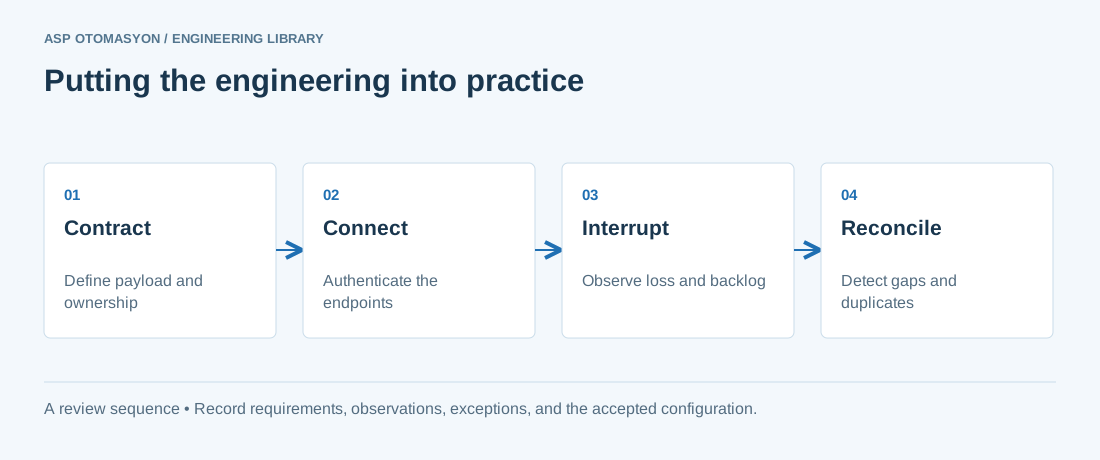
- Specify payload structure, units, identity, time semantics, access permissions, and protocol versions.
- Test backlog growth, connection loss, duplicate delivery, and restart behavior at the consuming application.
- Document how operators see failures and how the system distinguishes replayed data from current process state.
Follow an ASP project guide to connect the fundamentals with implementation and acceptance.
Primary references and further reading
Use the original specifications and product documentation for implementation details. The examples in this guide are illustrative engineering scenarios, not published project results.