
Mining is the industry where ore becomes material — and where automation increasingly decides the economics: a mine's throughput, recovery, and energy use are control problems, from the crusher to the flotation cell. Modern mining is a remote, 24/7, data-rich operation: autonomous trucks, remotely controlled crushers, and advanced process control on the concentrator. The automation spans discrete (material handling, mobile equipment) and process (grinding, flotation, leaching) domains — often at sites with extreme climate and distance.
The Process Chain
| Area | Process | Automation focus |
|---|---|---|
| Mining (open pit/underground) | Drilling, blasting, loading, hauling | Fleet management systems (dispatch), autonomous/tele-remote haulage, conveyor control, mine ventilation (underground) — a safety-critical control domain. |
| Crushing and screening | Primary/secondary/tertiary crushing, screening | Crusher feed control, chamber level control, belt protection (metal detectors, misalignment); the classic choke-feed optimization. |
| Grinding (SAG/ball mills) | Size reduction to liberation size | The energy giant (40–60% of the concentrator's power): mill load and power control, cyclone feed density and pressure, and the SAG mill's model-based optimization. |
| Flotation | Separation by surface chemistry | Level and air control per cell, reagent dosing (the classic ratio/feedforward problem), and online analysis (XRF) feeding grade-recovery optimization. |
| Dewatering and tailings | Thickeners, filters, tailings management | Thickener underflow density control, flocculant dosing, and the tailings dam monitoring (levels, piezometers) — a safety-critical, often regulated monitoring task. |
Advanced Control in the Concentrator
Mineral processing is a stronghold of advanced process control: the value function (recovery at grade) is controlled by variables (grind size, reagent, air, pH) that interact and lag. The standard toolkit:
- MPC on the grinding circuit — coordinating SAG power, feed rate, and cyclone operation to maximize throughput within the stability envelope; the classic MPC payback case.
- Flotation optimization — level/air/reagent setpoints from the online analyzer (head, concentrate, tail grades) with expert systems or models; the grade-recovery trade-off is the operating point decision.
- Expert systems — the industry's long-standing use of rule-based supervisory systems (mill downtime reduction, operator guidance) — a reminder that control need not be model-based to be effective.
The data reality: online analyzers are sparse and slow, so the models rely on inferential measurements and the operators' eyes; the automation's job includes keeping the measurement quality high (sampling, calibration — see the analytical instrumentation article).
Mobile Equipment and Fleet Automation
Mining's discrete-automation frontier is the mobile fleet:
- Fleet management systems (FMS) — dispatch optimization (which truck to which shovel), real-time positioning (GPS), and productivity reporting; the FMS is the mine's MES.
- Autonomous haulage — self-driving haul trucks on defined roads, managed by traffic control systems — the most publicized mining automation, delivering real safety and productivity gains at large operations.
- Tele-remote and automation of fixed plant — crushers and conveyors operated from control rooms hundreds of kilometers away (remote operations centers), which puts cybersecurity and communications reliability at the center of the automation architecture (see the remote access and cloud/edge articles).
Safety and Environment
Mining automation carries high safety responsibility: conveyor systems (interlocks, pull-cords, belt-slip protection), underground ventilation on demand (gas monitoring linked to the ventilation control), tailings monitoring (the failure mode of the industry — monitoring, alarms, and emergency response are automation-critical), and the environmental monitoring (water discharge quality) that permits the operation. These systems follow the safety and alarm disciplines described throughout this wiki, with the mining-specific consequence that a monitoring failure can be catastrophic.
Summary
Mining and mineral processing automation spans fleet and mobile equipment management, conveyor and crushing control, grinding and flotation advanced control, and safety-critical monitoring (ventilation, tailings) — at remote sites where reliability and remote operation define the architecture. The value is measured in throughput, recovery, and safety: the control loops and the models of the concentrator set the mine's economic performance, and the monitoring systems protect its license to operate.
Apply this to your project
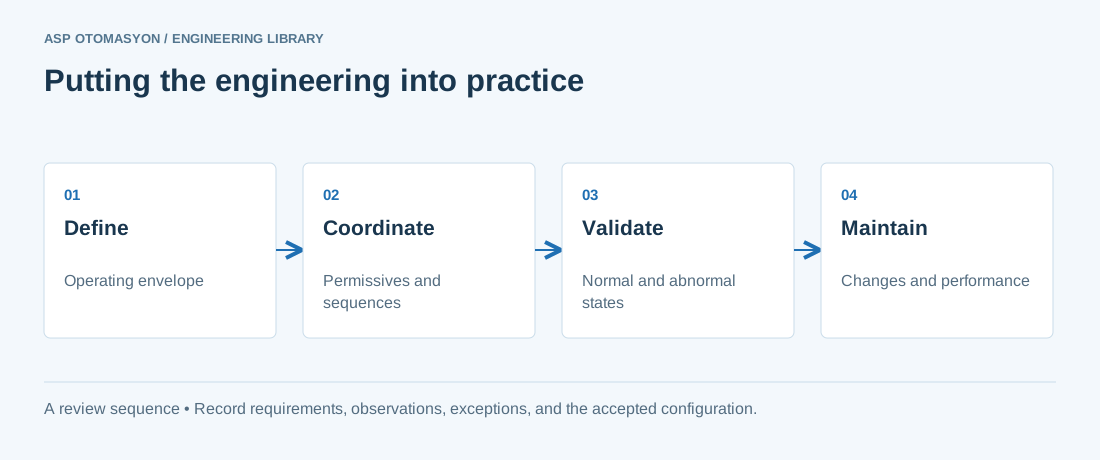
- Record process boundaries, required operating states, and interactions with independent protective systems.
- Check instrument quality, control authority, permissives, and operator responsibilities during state changes.
- Agree how tests, deviations, and configuration changes will be recorded within the facility's engineering procedures.
Follow an ASP project guide to connect the fundamentals with implementation and acceptance.
Primary references and further reading
Use the original specifications and product documentation for implementation details. The examples in this guide are illustrative engineering scenarios, not published project results.