
Maintenance costs manufacturing plants 10–30% of their operating budget, and the way that money is spent — reactively, preventively, or predictively — shapes reliability, safety, and production output. The three classic strategies are not a ladder of sophistication but a portfolio to be applied where each fits: reactive for cheap, non-critical assets; preventive (PM) for assets with known wear patterns; predictive (PdM) for critical assets whose condition can be measured; and RCM as the methodology that decides the mix rationally.
The Strategy Definitions
| Strategy | Principle | When it fits |
|---|---|---|
| Reactive (run-to-failure) | Repair after failure | Low failure cost, no safety impact, no production impact, short repair time. |
| Preventive (time/usage-based) | Replace or service at fixed intervals before expected failure | Known wear-out pattern (bearings, seals, filters), failure is age-correlated. |
| Predictive (condition-based) | Maintain when condition data says it is needed | Critical assets with measurable degradation (vibration, temperature, oil analysis) and random-ish failure times. |
| RCM (reliability-centered) | Select strategies per failure mode based on consequence | The plant-wide decision framework itself. |
The industry's rough distribution target: 10–20% reactive, 40–50% preventive, 30–40% predictive for mature programs — but the correct mix is a consequence-driven calculation, not a ratio target.
Preventive Maintenance Done Right
PM fails when it becomes a calendar ritual: tasks performed without regard to condition, intervals set by vendor default, and work orders closed by signature. Effective PM has:
- Task validity — each PM task must prevent, detect, or delay a specific failure mode; if the task cannot be justified, it is waste (and its "completion" is theater).
- Data-capturing tasks — every PM includes measurements and observations (vibration readings, temperatures, visual findings) recorded in the CMMS, turning PM rounds into a data stream for PdM analysis.
- Interval optimization — intervals set from failure history and condition data, and adjusted as data accumulates; fixed forever intervals are a symptom of a static program.
- Findings handling — a defect found during PM is a work order with priority, not a note in a drawer; the loop from PM finding to scheduled repair is what makes PM effective.
Predictive Maintenance: From Vibration to Data
PdM detects the early stages of failure. The mainstream techniques: vibration analysis (bearings, unbalance, misalignment, resonance), oil analysis (wear metals, contamination), thermography (electrical and thermal faults), motor current analysis, and ultrasonic (leaks, early bearing damage). The deployment pattern that works:
- Route-based collection — portable data collectors on a defined route per period, building the baseline; then fixed online sensors for the most critical assets.
- Baselines and trends — the value is in the trend: a bearing that rises slowly for months, then accelerates, is the PdM success story. One reading means nothing; twelve readings mean everything.
- Alarm bands — set alerts on rate-of-change and level with asset-specific thresholds; generic factory defaults generate alarm fatigue.
- Integration with planning — a PdM alert must become a planned repair at the next window — the full value is captured only when the condition data changes the schedule.
Modern PdM adds machine learning on the historian data (see the AI in manufacturing article): models trained on normal operation flag deviations the human analyst would miss — but the human and the process remain the core.
RCM: The Decision Framework
RCM (SAE JA1011) asks seven questions per asset: functions and performance standards; failure modes; failure causes; failure effects; consequences (hidden, safety, environmental, operational, non-operational); and the applicable, effective task for each consequence. The output is a per-failure-mode decision: scheduled restoration, scheduled discard, condition-based task, failure-finding task (for hidden failures), or redesign. RCM is an analysis, not a schedule — it produces the rationale for the PM/PdM mix, and it is worth doing once, deeply, for the critical assets, rather than superficially for everything.
Making the Program Work
- Criticality first — score assets by consequence (production, safety, environment, repair cost); spend the analysis effort where the score is high.
- CMMS as the spine — the maintenance management system holds the asset register, the tasks, the history, and the KPIs; without it the program is anecdotes.
- KPIs that measure effectiveness — not just PM compliance (a compliance number can be perfect while the program is useless) but: breakdown frequency, MTBF/MTTR, maintenance cost per asset, and the trend of PdM findings converted to scheduled repairs.
- Continuous review — failure data revises tasks and intervals; the review meeting (monthly, per area) is where the strategy adapts.
Summary
Maintenance strategy is a portfolio decision: reactive for the trivial, preventive for the wear-out, predictive for the critical, and RCM as the method that chooses rationally by consequence. Make PM tasks justified and data-capturing, make PdM trend-based and schedule-changing, and run the whole program on the CMMS with effectiveness KPIs. The goal is not to eliminate failures — it is to decide, deliberately, which failures are affordable.
Apply this to your project
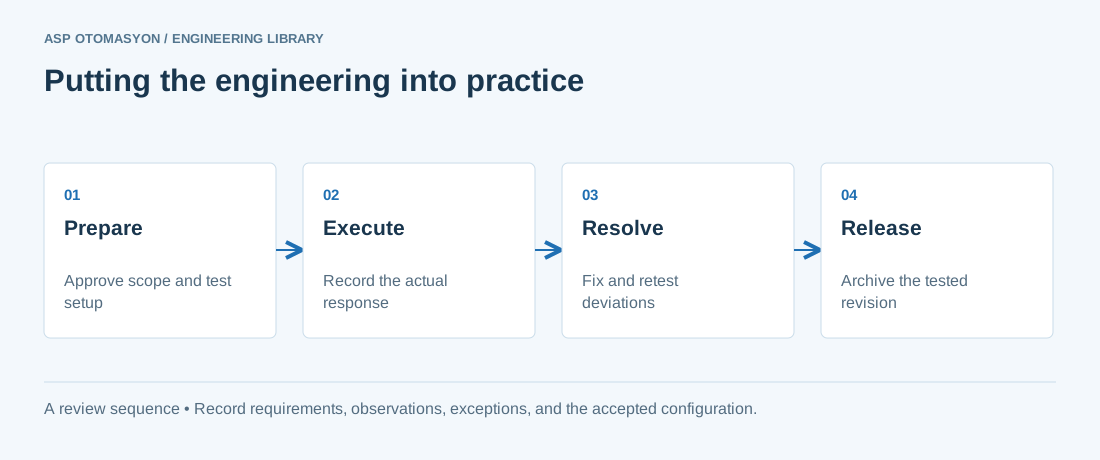
- Agree the test boundary and site authorization, especially where outputs or communications can affect operating equipment.
- Record expected and actual values, equipment identifiers, software revision, test conditions, and exceptions.
- Retest changed behavior and archive the final configuration with the test record and recovery instructions.
Follow an ASP project guide to connect the fundamentals with implementation and acceptance.
Primary references and further reading
Use the original specifications and product documentation for implementation details. The examples in this guide are illustrative engineering scenarios, not published project results.