
Machine vision gives machines eyes: cameras and image-processing software that inspect, measure, locate, and identify parts at production speed. Modern vision systems — from compact smart cameras to multi-camera PC systems with deep-learning tools — are a standard element of quality assurance, robot guidance, and process control. Integration quality, not camera resolution, usually decides whether a vision application meets its accuracy and throughput targets.
System Building Blocks
- Camera and lens — area or line-scan, monochrome or color; resolution, sensor size, and lens field of view chosen together with the required resolution per pixel (typically 0.1–0.5 mm/pixel for inspection, much tighter for metrology).
- Lighting — the most underestimated component: ring, bar, dome, backlight, or structured light, chosen for contrast and robustness to ambient light. 90% of vision problems are lighting problems.
- Trigger and synchronization — a sensor or encoder triggers image capture at exactly the right part position; missed or double triggers destroy throughput.
- Processing platform — smart camera (embedded), industrial PC with frame grabber, or camera-link hardware; processing must fit the cycle budget with margin.
- Software — vendor libraries, configurable inspection tools, and deep-learning frameworks for defect classes that classical algorithms cannot define.
- Integration interface — digital I/O, fieldbus, or Ethernet/TCP to the PLC, plus reject mechanisms (air jet, pusher, gate) with verified reliability.
Designing for Robustness
An inspection that works in the lab and fails on the line is the classic vision project failure. Robustness measures that matter:
- Stabilize the image — fix the part position (fixtures, guides), isolate vibration, and control ambient light with hoods or high-frequency lighting.
- Design the lighting around the feature — backlight for profile and measurement, dark-field for surface defects, structured light for height.
- Set thresholds with statistics — collect images from good and bad parts across the expected variation (temperature, line speed, batch) before fixing thresholds; a threshold tuned on five parts fails on five hundred.
- Add self-diagnostics — image quality checks (contrast, focus, exposure) so a dirty lens or failed lamp generates a maintenance call, not silent false rejects.
- Plan for false rejects — a false reject costs product; a false accept costs quality. Set the operating point deliberately with the customer's cost ratio.
PLC and Robot Integration
The vision system's results must reach the control system with defined semantics:
- Pass/fail with counted outcomes — the PLC tracks totals, rejects, and the reject mechanism's confirmation; a reject mechanism that fails to fire must alarm.
- Measurement results as data — numeric results (dimensions, positions) are typically sent over Ethernet (TCP/IP or OPC UA) for SPC analysis and archiving; keep the real-time pass/fail on discrete I/O for determinism.
- Robot guidance — the vision system returns an offset (X, Y, rotation) relative to the taught position; calibrate the camera-to-robot transform carefully and verify with test parts of known position.
- Recipe switching — different products need different inspection jobs; the PLC selects the job and the vision system confirms the job identity to avoid inspecting with the wrong parameters.
Deep Learning in Vision
Deep-learning vision tools (anomaly detection, defect classification, OCR of complex text) have moved from research to production in inspection applications where rule-based algorithms cannot capture the defect's variability. Practical rules for adopting them:
- Collect a representative training set from the real line, including the defect classes you know and room for unknown classes (anomaly detection covers the latter).
- Budget for ground-truth labeling effort — it is the largest cost, not the GPU.
- Validate on a held-out test set from a different batch than training; accuracy on the training set is meaningless.
- Keep a classical fallback for critical pass/fail decisions where the failure mode of the neural network is not acceptable without evidence.
- Version the model with the product recipe so changes are traceable and rollback is possible.
Lifecycle and Maintenance
Vision systems drift: lamps age, lenses collect dust, part surfaces change with supplier batches. Establish a calibration/validation routine (test pieces with known properties run at shift start), track reject-rate trends in the historian as an early warning, and keep spare lamps/filters in stock. Document the image, lighting, and threshold settings for every product — the engineer who tuned them will not always be available.
Summary
Machine vision delivers measurement and inspection at line speed when the system is engineered as a whole: stable imaging, deliberate lighting, statistical thresholds, defined PLC interfaces, and diagnostics. Choose the platform for the processing budget, validate on real production variation, and treat the model and thresholds as maintained configuration. Vision is a reliability discipline as much as an image-processing one.
Apply this to your project
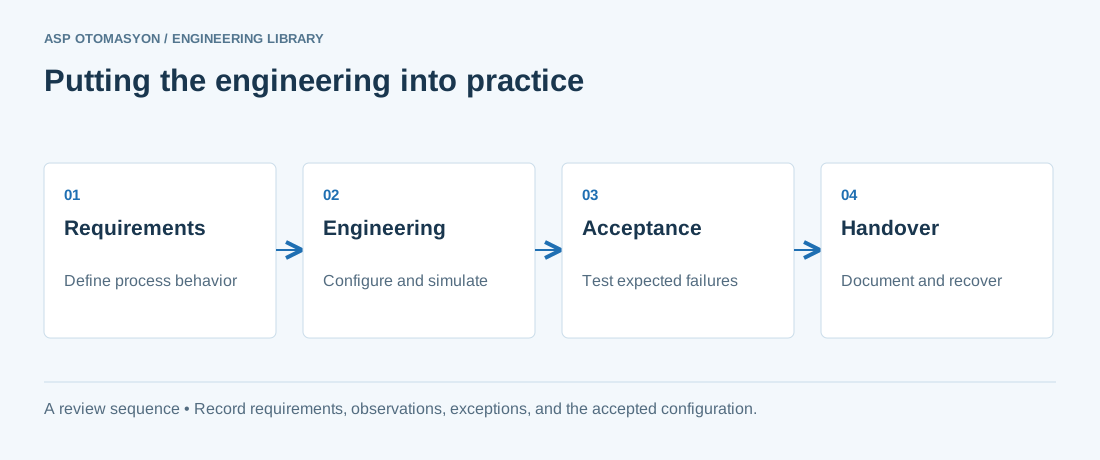
- Define the process states, timing requirements, and permitted behavior after a controller or communication failure.
- List controller, I/O, network, software, and license dependencies before choosing an architecture.
- Record acceptance results and prove that the delivered configuration can be restored from the handover package.
Follow an ASP project guide to connect the fundamentals with implementation and acceptance.
Primary references and further reading
Use the original specifications and product documentation for implementation details. The examples in this guide are illustrative engineering scenarios, not published project results.