
Commissioning is the structured process of proving that a machine or system works as designed — from the first power-on to productive operation. In automation projects, commissioning is organized around two formal milestones: the Factory Acceptance Test (FAT), performed at the builder's site, and the Site Acceptance Test (SAT), performed at the customer's site after installation. Done well, commissioning catches defects while they are cheap to fix; done poorly, it turns into unplanned redesign on the plant floor under schedule pressure.
Preparation Before FAT
A FAT is only as good as its preparation. Before the test week starts:
- Freeze the test scope: the FAT protocol must be agreed with the customer, listing every function to be demonstrated with its acceptance criteria.
- Complete hardware staging: panels wired, I/O verified against loop drawings, and instruments simulated with precision signal sources.
- Complete software: all programs loaded, versioned, and backed up; simulation mode available for process I/O that cannot be looped back.
- Prepare documentation for the witness: P&IDs, loop diagrams, I/O lists, control narratives, and alarm lists.
- Assign roles: a test leader, an operator, a recorder, and named customer witnesses for each test block.
The FAT Protocol
A typical FAT covers, in order:
- Visual and hardware inspection — panel build quality, labeling, wire termination, grounding, and component ratings against the approved drawings.
- Power-up and checks — insulation tests, power supplies, 24 VDC distribution, and network diagnostics.
- I/O check — every input and output verified against the I/O list, including alarms and diagnostics on the fieldbus level.
- Functional tests — each control function demonstrated: interlocks, sequences, safety functions, alarming, and operator displays.
- Safety function tests — emergency stop, light curtains, and each safety function with its certified reaction time verified.
- Performance tests — cycle times, throughput, and response times measured against the specification.
- Fault injection — sensor failures, communication loss, and power dips: the system must fail in a documented, safe way.
- Documentation review and sign-off — deviations listed, responsibilities for closure assigned, and the FAT certificate issued.
Every deviation found at FAT gets a formal disposition: fix at builder's site, fix at site, or accept as a documented deviation with a risk statement. Unresolved deviations must not silently disappear — track them in a punch list that follows the project to SAT.
From FAT to SAT
Between FAT and SAT, the machine is shipped, installed, and connected to utilities. The SAT repeats the critical FAT tests under real site conditions and adds installation-specific checks:
- Site power quality, grounding, and earth loop verification at the installed location.
- Real field wiring and instruments: the I/O check is repeated against the as-built loop drawings.
- Integration with site networks: SCADA/ERP/MES connections, time synchronization, and cybersecurity checks (ports, credentials, patch levels).
- Interfaces to existing equipment: conveyors, upstream/downstream machines, and shared services.
- Environmental conditions: temperature, vibration, and dust behavior over a defined soak period.
SAT acceptance criteria should have been written into the contract and the FAT protocol. If site conditions legitimately change behavior (e.g., longer cable runs, different supply voltage), the change must be documented and re-tested rather than waived verbally.
Startup: The First Production Runs
With SAT passed, startup moves from proving to optimizing:
- Dry run — run the full sequence without product to validate motions and timing.
- First product — short runs at low speed with extra supervision; record all alarms and anomalies.
- Ramp-up — gradually increase throughput; tune loops and adjust timers with change control.
- Performance qualification — measure quality, throughput, and availability against the acceptance values over a defined period (e.g., 72 hours).
- Handover — as-built documentation, backups, spare parts list, and training certificates transferred to the owner.
Common Commissioning Failures
Most startup problems trace to a short list of root causes: incomplete I/O checks (a field point wired differently than drawn), safety functions tested only on the bench, missing interlocks found during first fault injection, and documentation that did not follow the as-built changes. A rigorous punch-list discipline — every finding numbered, owned, and closed with evidence — is the single most effective tool for keeping commissioning on schedule.
Summary
FAT and SAT are the quality gates of machine delivery. Prepare a testable scope, witness function and failure behavior, track deviations formally, repeat the critical tests after installation, and ramp up with change control. Commissioning is not a ceremony — it is the final verification that the engineering intent survived the journey from drawing to production.
Carry evidence from FAT into site acceptance
Identify which requirements were demonstrated in the factory and which depend on the installed site environment. Record simulated interfaces, temporary wiring, substituted hardware, and unresolved deviations. SAT should verify the real installation and close those limitations. Keep test results tied to the software revision, and repeat affected checks when logic or configuration changes after acceptance.
Continue with the related practical guide.
Apply this to your project
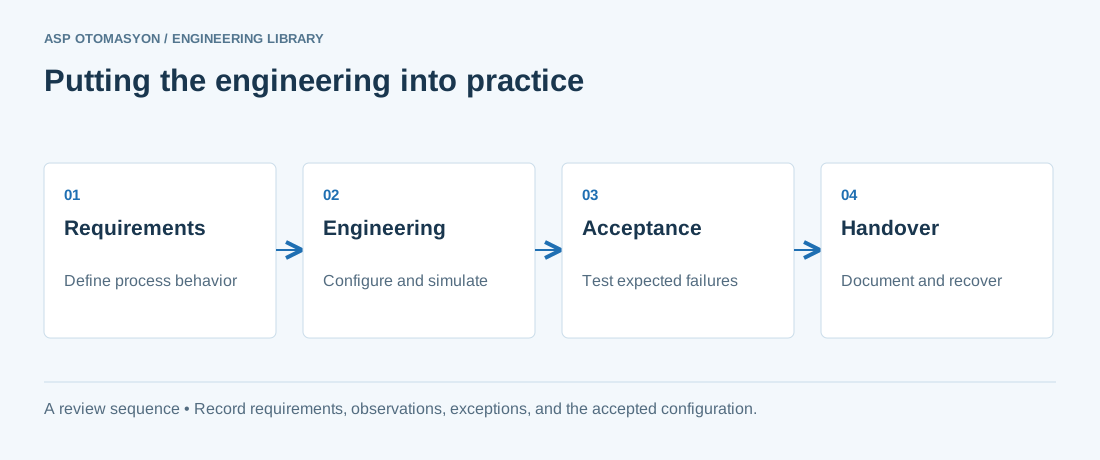
- Define the process states, timing requirements, and permitted behavior after a controller or communication failure.
- List controller, I/O, network, software, and license dependencies before choosing an architecture.
- Record acceptance results and prove that the delivered configuration can be restored from the handover package.
Follow an ASP project guide to connect the fundamentals with implementation and acceptance.
Primary references and further reading
Use the original specifications and product documentation for implementation details. The examples in this guide are illustrative engineering scenarios, not published project results.