
Commissioning a process plant — a chemical unit, a refinery section, a utility island — is the riskiest phase of its life: systems are energized, fluids are introduced, and control is transferred from construction to operations, often on a schedule that punishes delay. Unlike machine commissioning (FAT/SAT driven), process plant startup follows a staged methodology where every step makes the next one safe: pre-commissioning, mechanical completion, commissioning, startup, and performance testing. This article outlines the methodology and the controls that keep it safe and on schedule.
The Commissioning Pyramid
- Pre-commissioning — everything that can be done before energizing: line flushing and cleaning, hydrostatic testing, instrument loop checks (as-installed), motor rotation, control valve stroking, and punch list closure. The rule: no system is energized until its checks are complete and signed off.
- Mechanical completion — the formal milestone when construction is declared complete per the design: as-built drawings updated, documentation delivered, punch list items closed or formally deferred.
- Commissioning — energizing systems one at a time: utilities first (instrument air, cooling water, electrical, steam), then support systems, then process units — each with its own checks and permits.
- Startup — introducing process fluids under controlled conditions: inerting, leak testing with process, filling, and bringing the unit to operating conditions — with the control system fully verified and operators trained and present.
- Performance test — demonstrating the guaranteed capacities, efficiencies, and qualities over a defined run (e.g., 72 hours at full load) — the contract's acceptance evidence.
The pyramid is bottom-heavy by design: a missed check at the base appears later as an emergency at the top.
Loop Check: The Automation Core
The instrument loop check is the automation engineer's commissioning heart: for each loop, verify the sensor signal end to end (inject at the transmitter, confirm at the DCS/PIC), the scaling and alarms, the control logic (simulate inputs, observe outputs), the final element (stroke the valve, confirm position feedback), and the HMI/ESD interaction. Discipline points:
- Check every loop against the as-built loop diagram, not the issued-for-construction one.
- Test failure paths: what happens on signal loss, on ESD activation, on utility failure (air, power) — the plant's safe state must be proven, not assumed.
- Record results per loop with evidence (signatures, dates, and the instrument's calibration certificate reference).
- Confirm interlock and SIS loops separately from regulatory control — a safety loop that cannot be proof-tested is a liability, not a feature.
Startup Organization
A plant startup runs on procedures and permits:
- Startup procedures — step-by-step instructions per unit with hold points, sign-offs, and emergency responses; written by the engineers who will support them, reviewed by operations.
- Permits and coordination — energization permits, confined space, hot work, and line-breaking permits integrated with the startup schedule; one shift's shortcut can invalidate the whole sequence.
- Shift staffing — operators, instrument techs, electricians, and process engineers present around the clock during startup; the support roster is a plan, not a hope.
- Daily startup meetings — status, deviations, and decisions recorded; the startup log becomes the plant's memory of how it was brought up.
- Deviations management — any deviation from the startup procedure or design is formally assessed (risk, consequence, approval) before proceeding. "We'll watch it" is not a disposition.
Control Loop Tuning at Startup
Loops tuned on simulation need retuning on the real process. Practical startup tuning order: stabilize the utilities and flows first (level and flow loops), then temperatures and pressures, then quality loops; tune in automatic with wide margins and tighten after the unit is stable. Use step tests on the real process (small, documented disturbances) rather than guesswork, and log every change with the as-found/as-left values. The startup is the last chance to correct design assumptions at low cost — measurement and valve problems found here are still cheap.
Common Startup Failures
The pattern of plant startup problems is remarkably consistent: utilities underestimated (air capacity, cooling water quality), instrument checks skipped under schedule pressure (the loop that was "checked visually" fails at first demand), interlocks not fully tested (found by the first real trip), and documentation drift (as-built diverging from design without control). Each of these is a process failure, not a technical one — which is why the methodology exists and why skipping its steps costs more than the schedule it saves.
Summary
Process plant commissioning is a staged pyramid: pre-commissioning checks, mechanical completion, systematic energization, controlled startup with permits and procedures, and performance testing. The automation work — loop checks, failure-path tests, interlock proof tests, and real-process tuning — is the connective tissue between construction and operations. Discipline at the base protects everything above it; shortcuts at the base are paid for at the top, with interest.
Apply this to your project
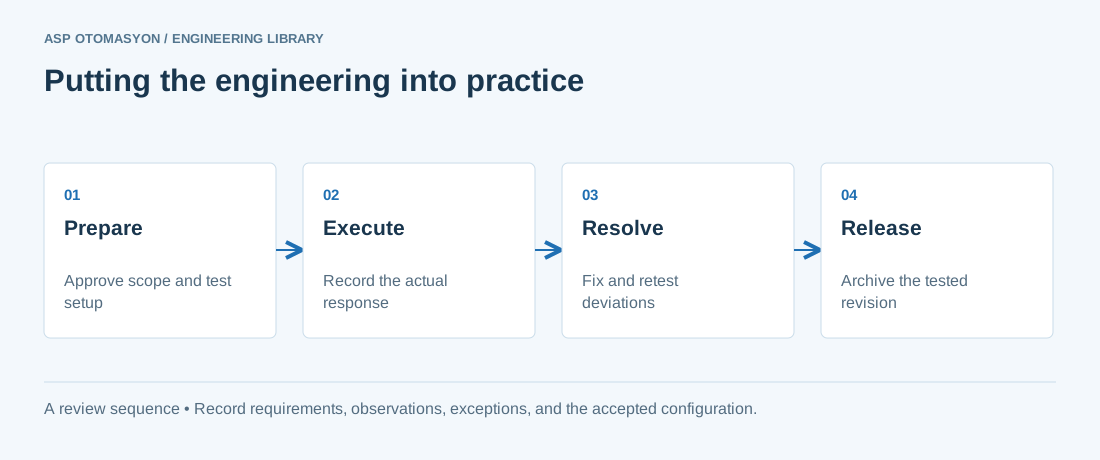
- Agree the test boundary and site authorization, especially where outputs or communications can affect operating equipment.
- Record expected and actual values, equipment identifiers, software revision, test conditions, and exceptions.
- Retest changed behavior and archive the final configuration with the test record and recovery instructions.
Follow an ASP project guide to connect the fundamentals with implementation and acceptance.
Primary references and further reading
Use the original specifications and product documentation for implementation details. The examples in this guide are illustrative engineering scenarios, not published project results.