
Industrial lighting is easy to ignore and hard to waste cheaply: in a 24/7 plant, lighting can be 10–20% of the electricity bill, and most of it lights empty aisles, unoccupied zones, and daylight hours. Modern LED technology has changed the economics — and modern lighting control (occupancy sensing, daylight harvesting, scheduling, and networked management) has changed what a lighting system can do. For the automation engineer, industrial lighting control is also an automation project: sensors, controllers, and a network — just with a faster payback than most.
The Efficiency Stack
Lighting efficiency is achieved in layers, in this order:
- The light source — LED replaces HID/fluorescent: 50–70% lower consumption, longer life, instant restrike, and better controllability. The retrofit decision is usually economic on energy alone, plus the maintenance savings of a 50,000–100,000 hour lifetime.
- Lighting design — the right luminaire, mounting height, and spacing for the task's illuminance level (EN 12464-1 defines values by task); over-lighting is the most common silent waste.
- Controls — switching and dimming that match the light to the presence and the daylight: the layer this article focuses on.
- Maintenance — cleaning and group relamping keep the installed performance; a dirty luminaire loses 20–30% of its output silently.
Control Strategies
| Strategy | Principle | Typical savings vs uncontrolled |
|---|---|---|
| Occupancy detection | Lights on only when presence is detected (PIR/microwave sensors), with time delays tuned to the area's traffic. | 30–70% in intermittent-use areas (warehouses, corridors, washrooms). |
| Daylight harvesting | Dim or switch luminaires near windows/skylights based on ambient light sensors. | 20–40% in perimeter zones with daylight. |
| Scheduling | Time-based scenes per shift: production on, breaks dimmed, off-hours off (with safety lighting maintained). | Large in off-hours — the biggest single saving for 24/7 facilities with quiet periods. |
| Constant light / dimming | Luminaire dims as it ages to maintain constant illuminance — extends life and saves energy. | 5–10% plus longer lamp life. |
Safety is a constraint, not an option: emergency lighting (EN 1838) must remain independent of the general control system, and areas with defined minimum illumination (safety-relevant walkways, control rooms) get their floor levels guaranteed by design — controls reduce light above the requirement, never below it.
Networked Lighting Control
Modern industrial lighting is increasingly networked: DALI-2 (the standard for addressable lighting control), wireless mesh (Zigbee, Bluetooth mesh, or vendor systems), or IoT lighting where luminaires are nodes on the building network. Networked lighting gives the plant what a pile of standalone sensors cannot:
- Central management: scene programming, scheduling, and per-area override from one software (or the BMS).
- Feedback: real energy data per zone, fault reporting (a failed driver reports itself), and occupancy data that doubles as building intelligence.
- Flexibility: reconfiguring zones after layout changes is software, not rewiring.
- Integration: the lighting system connects to the BMS/SCADA for coordinated control (shift schedules, emergency modes, energy dashboards).
For the automation department, the integration question is standard: the lighting controller exposes its data (energy, status, alarms) over the same protocols the plant already uses (Modbus, BACnet, or MQTT for IoT lighting) — define the interface at procurement, not after.
Implementation Guidance
- Audit first — map the current lighting: fixtures, hours, zones, and the off-hours baseline (a night walk reveals everything).
- Retrofit by zone priority — start with the highest hours × wattage zones; the payback calculation per zone is trivial with LED economics.
- Controls for the intermittent zones first — warehousing, storage, and maintenance areas deliver the fastest occupancy-control savings.
- Standardize on one protocol — one control platform (DALI-2 or a single wireless ecosystem) keeps commissioning and spares simple.
- Commission properly — sensor placement and time delays must match the actual movement patterns; a badly tuned occupancy sensor causes complaints and gets bypassed — which kills the savings.
- Verify with metering — compare consumption before/after per zone; the lighting dashboard shows the savings continuously, which is what justifies the next retrofit round.
Summary
Industrial lighting efficiency is LED first, then controls: occupancy detection for intermittent areas, daylight harvesting for perimeter zones, scheduling for off-hours, and networked management for visibility and flexibility. Treat it as an automation project with a fast payback: audit the zones, standardize the protocol, commission the sensors properly, and verify with energy data. Lighting is the most controllable energy load in most plants — and the least controlled.
Apply this to your project
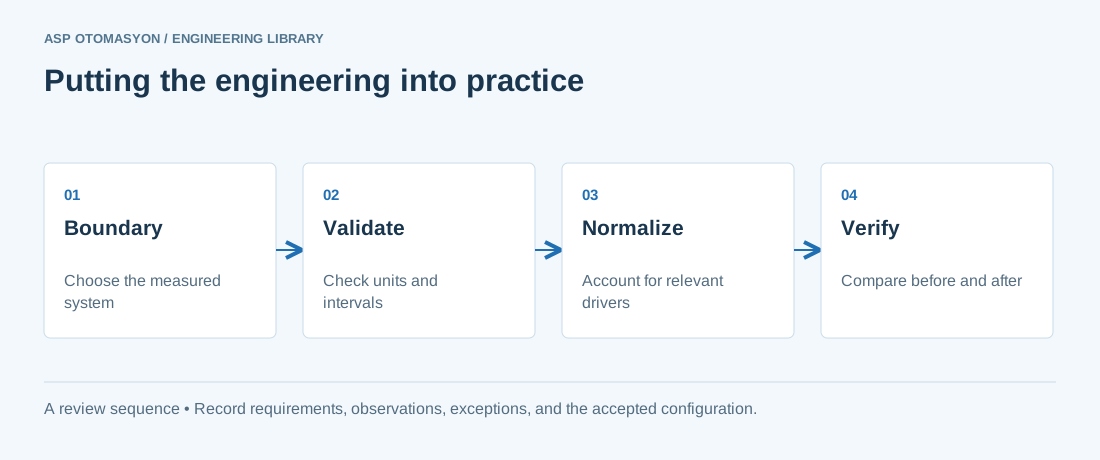
- Define the measurement boundary, meter ratios, units, time interval, and treatment of missing or reset readings.
- Capture production quantity, operating hours, and other relevant drivers alongside energy use.
- State the baseline and normalization assumptions when reporting a change; separate measured results from estimates.
Follow an ASP project guide to connect the fundamentals with implementation and acceptance.
Primary references and further reading
Use the original specifications and product documentation for implementation details. The examples in this guide are illustrative engineering scenarios, not published project results.