
Electric motors consume more than two-thirds of industrial electricity, and their efficiency classes have become regulation: IEC 60034-30-1 defines the classes from IE1 (standard) to IE4 (Super Premium), with IE5 (Ultra Premium) arriving as synchronous reluctance and permanent-magnet designs. Minimum efficiency standards (MEPS) in the EU and elsewhere now mandate IE3 as the floor, with IE4 required for many power ranges — and the life-cycle arithmetic often favors IE4/IE5 even without regulation. This article covers the classes, the selection decisions, and the motor management that makes the efficiency real.
The Efficiency Classes
IEC 60034-30-1 defines efficiency levels for line-operated motors (50/60 Hz, rated 0.12–1000 kW):
| Class | Name | Typical efficiency gain vs IE1 (11 kW, 4-pole) |
|---|---|---|
| IE1 | Standard | Baseline (~87–88%) |
| IE2 | High | +2–3% |
| IE3 | Premium | +3–5% |
| IE4 | Super Premium | +4–6% |
| IE5 | Ultra Premium | +5–8% (often synchronous reluctance / PM-assisted) |
The percentages look small; the arithmetic is not: a 100 kW motor running 6,000 hours/year at 50 €/MWh costs roughly 25–30 k€ per year in electricity. Two efficiency points on that motor save ~500–600 €/year — for the motor's 15–20 year life, typically 2–3× the price difference of an IE4 over IE3.
Selection Decisions
- IE4 induction vs IE5 synchronous — IE5 is usually a synchronous reluctance (SynRM) or PM-assisted design, with the same frame and an efficiency 1–2 points above IE4 induction. SynRM motors need a VFD — an important system fact: they are the natural choice for new VFD-driven applications, while IE4 induction remains the workhorse for direct-on-line.
- Efficiency at the load point — motors are most efficient near full load; an oversized motor running at 40% load is wasting more than its class saves. The selection question is sizing first, class second (see below).
- VFD + motor as a system — the drive and motor efficiency interact (harmonics, cooling); the system efficiency (IEC 61800-9-2 defines IE-classes for complete drive systems) is what matters for new installations.
- Environment and duty — the efficiency class does not change the mechanical selection: enclosure, insulation class, mounting, and duty cycle still drive the frame choice; efficiency is the last decision, not the first.
The Oversizing Trap
The biggest motor efficiency problem is not the class — it is the load. Industrial motors are chronically oversized: sized for peak, then the peak never occurs; replaced with the same frame out of habit. A motor at 40% load can be less efficient than a correctly sized IE3 at 80% load. The motor management discipline:
- Measure the actual load (current/power logging) on the largest motors.
- Match the motor to the real duty; where the load varies, the VFD becomes the efficiency measure.
- Apply the system approach: a smaller IE4 motor plus VFD is often the right answer, not a larger motor of any class.
Motor Management: The Plant Program
Efficiency classes live or die in the plant's motor policy (IEC 60034-30-1 plus the ISO 50001 context):
- A motor replacement policy — "any motor replaced or rewound is replaced with IE3/IE4 as a minimum" — the rule that captures the opportunities as they arise; a failed motor is the cheapest moment to upgrade.
- The rewind decision — rewinding a burned-out motor loses 0.5–1.5% efficiency (sometimes more on repeated rewinds); for large or long-hour motors, the replacement calculation (new efficiency × run hours vs rewind cost) usually favors replacement.
- Spares policy — the spare stock should match the policy: stocking IE3/IE4 for the critical sizes, with the inventory reviewed as motors are replaced.
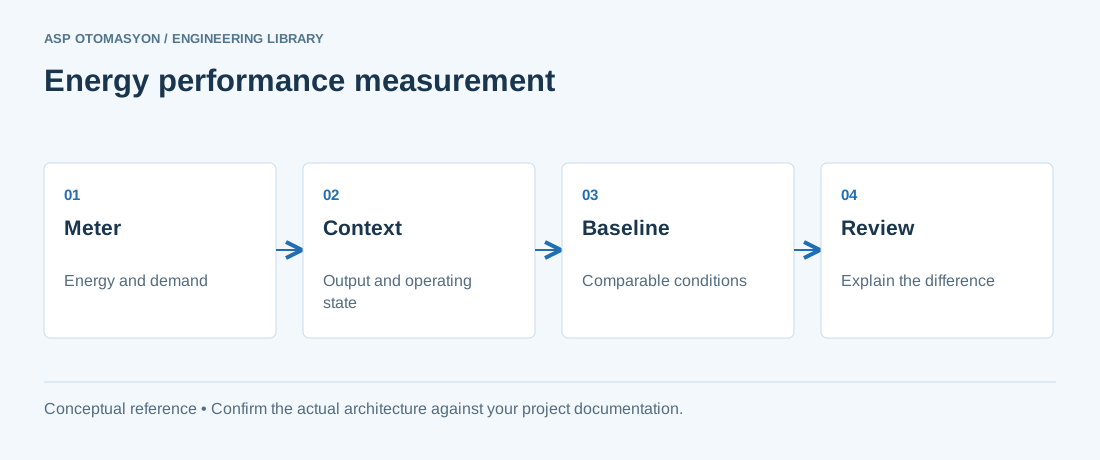
- The motor register — every motor tagged with size, class, load, and duty in the CMMS; the register is what makes the policy enforceable and the savings measurable.
Verification and Maintenance
Efficiency is also a maintenance result: bearings, alignment, and cooling all degrade motor efficiency; an aligned, well-lubricated motor runs at its class, a neglected one does not. Where the savings matter most (large, long-hour motors), energy measurement (power meters or VFD energy data) before and after a change verifies the gain — and the energy management system trends motor efficiency over time as a health indicator.
Summary
IE4/IE5 motors deliver real, compounding energy savings — on top of the sizing and system decisions that dominate motor energy: right-size the motor, drive the variable loads, then choose the best class the life-cycle arithmetic supports. The plant's motor policy (replace-with-IE4, rewind-vs-replace, spares aligned) turns the decision from an exception into a default. Motors are the largest industrial energy consumer; motor management is the largest single efficiency lever most plants still hold un-pulled.
Apply this to your project
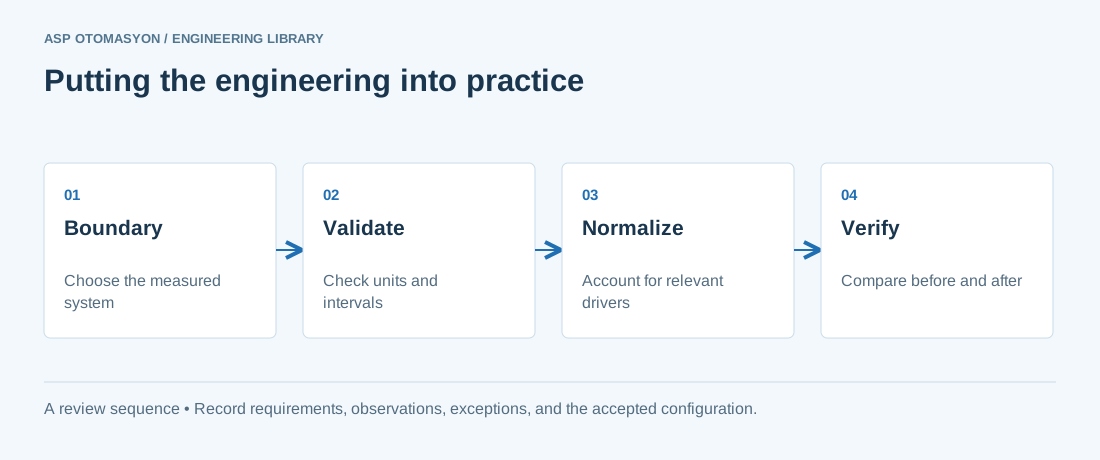
- Define the measurement boundary, meter ratios, units, time interval, and treatment of missing or reset readings.
- Capture production quantity, operating hours, and other relevant drivers alongside energy use.
- State the baseline and normalization assumptions when reporting a change; separate measured results from estimates.
Follow an ASP project guide to connect the fundamentals with implementation and acceptance.
Primary references and further reading
Use the original specifications and product documentation for implementation details. The examples in this guide are illustrative engineering scenarios, not published project results.