IEC 61850 is the international standard for communication networks and systems in power utility automation — the protocol suite that turns a substation's protection, control, and monitoring devices into one interoperable system. For industrial plants with their own medium-voltage distribution, cogeneration, or grid interconnection, IEC 61850 is increasingly the expected language of the electrical automation layer, and it differs fundamentally from the process control protocols most automation engineers know.
The IEC 61850 Model
IEC 61850 is not a single protocol but a framework built on three pillars:
- Information model — every device (breaker, transformer, switch, measurement) is described with standardized logical nodes (XCBR for circuit breaker, XSWI for disconnector, MMXU for measurements, Pxxx for protection functions) in an object-oriented data model. A breaker's position, control, and health are the same logical structure in any vendor's device.
- Abstract services (ACSI) — standardized services for reporting, control with safety interlocking, data access, and file transfer, independent of the transport.
- Protocol mappings — services mapped onto MMS over TCP/IP for client-server communication, GOOSE for fast peer-to-peer messages, and SV (Sampled Values) for raw current/voltage samples over the station bus.
The device's capabilities are described in a machine-readable SCD/ICD files (System Configuration Description), which is also how engineering data is exchanged between tools — replacing the traditional point-by-point signal lists with a single configuration file.
GOOSE: The Fast Path
GOOSE (Generic Object Oriented Substation Event) messages carry protection and interlocking signals between devices over Ethernet with deterministic timing: a trip signal typically arrives in under 3–10 ms. Unlike a client-server request, GOOSE is multicast — every subscribed device receives the message simultaneously. GOOSE includes a state number and time-to-live: receivers know immediately when a publisher stops sending (communication loss detection) and can take fallback action. This makes GOOSE the natural replacement for hardwired interlocking between bays.
Engineering Workflow
- System specification — single-line diagram, protection schemes, and control requirements documented in the SSD (System Specification Description).
- Device configuration — each IED (Intelligent Electronic Device) is configured with its vendor tool, producing an ICD file.
- System integration — a system configurator merges all ICDs, wires the GOOSE subscriptions and reports, and produces the SCD file.
- Download and test — each device receives its slice (CID) of the SCD; the whole system is tested with a GOOSE simulator and a network analyzer to verify timing and subscriptions.
- Commissioning — secondary injection tests and end-to-end tests of every protection and interlock function.
Configuration management discipline is critical: the SCD file is the single source of truth, and every change must flow back through the system configurator. Devices with mismatched SCD versions are a leading cause of commissioning delays.
Industrial Plant Considerations
For a plant engineer integrating IEC 61850 with the process automation world:
- Gateway to SCADA/DCS — IEC 61850 client-server (MMS) is typically aggregated by a gateway or directly by modern SCADA; the plant DCS sees the substation through this gateway, not through raw GOOSE.
- Network design — the station bus must be engineered for multicast traffic: VLANs and multicast filtering keep GOOSE and SV traffic bounded. Sampled Values demand high bandwidth (hundreds of Mbit/s per bay) — usually a separate process bus.
- Time synchronization — IEC 61850 events need sub-millisecond alignment: IRIG-B or IEEE 1588 PTP (power profile) for accurate sequence-of-events (SOE) recording.
- Cybersecurity — IEC 62351 provides the security extensions (authentication for GOOSE/MMS); follow IEC 62443 zone design for the substation network, especially when interconnecting with the OT plant network.
- Skills — IEC 61850 engineering is a distinct specialty; plan training or partner support for the first project.
Summary
IEC 61850 standardizes how substation devices describe themselves and communicate: a rich object model, MMS for data exchange, GOOSE for fast interlocking, and SCD files for engineering. For industrial power systems it delivers interoperability, reduced wiring, rich diagnostics, and event quality — in exchange for disciplined configuration management, careful network engineering, and dedicated expertise. Treat it as a specialist domain within the wider automation architecture.
Apply this to your project
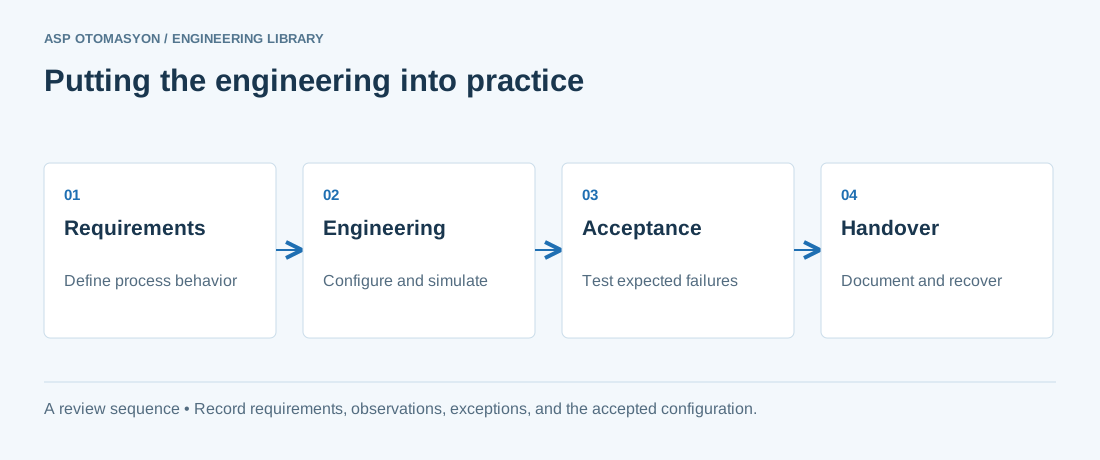
- Define the process states, timing requirements, and permitted behavior after a controller or communication failure.
- List controller, I/O, network, software, and license dependencies before choosing an architecture.
- Record acceptance results and prove that the delivered configuration can be restored from the handover package.
Follow an ASP project guide to connect the fundamentals with implementation and acceptance.
Primary references and further reading
Use the original specifications and product documentation for implementation details. The examples in this guide are illustrative engineering scenarios, not published project results.