
Falling renewable costs and rising grid prices have made on-site generation a mainstream industrial decision: rooftop solar, wind, combined heat and power, and — increasingly — the microgrid that combines generation, storage, and control into a system that can operate connected to or independent of the grid. For an industrial facility, renewable integration is an engineering and economic question with real operational consequences: power quality, reliability, and the interplay with the plant's electrical and automation infrastructure.
The Building Blocks
- Solar PV — rooftop and ground-mount; output predictable on seasonal scales but variable on minutes; the most common industrial entry point. Economics depend on the site's load profile and the utility's net metering / self-consumption rules.
- Wind — site-dependent; industrial use is less common than solar but attractive at windy sites with high load factors.
- CHP (combined heat and power) — the workhorse of industrial self-generation: gas engines or turbines producing electricity and using the heat; the thermal load determines the economics — a plant that needs steam or hot water is a CHP candidate.
- Battery energy storage (BESS) — shifts solar to the evening peak, shaves demand peaks, provides backup — see the BESS article for the details.
- The controller — the microgrid energy management system (EMS): forecasts load and generation, dispatches the assets, and manages the grid interface.
Why a Microgrid (and When Not)
A microgrid adds the control layer that makes the assets work as a system: it can island (disconnect and operate independently) during grid outages, optimize dispatch against time-of-use tariffs, and maintain power quality within its own boundary. The decision framework:
- Islanding value — if the site's operations cannot tolerate grid outages (process plants, data centers, critical infrastructure), the island capability is the driver; it changes the reliability conversation from "grid outage" to "system event."
- Economic optimization — without islanding needs, a microgrid controller still pays by dispatching storage and generation against tariff structures (peak shaving, arbitrage) — but the payback must be calculated with real tariff data, not optimistic projections.
- Complexity budget — a microgrid is a significant engineering and operations commitment: protection coordination, control system, maintenance, and the expertise to run it. For small sites, simple solar + BESS with fixed rules may beat a full microgrid.
Engineering the Integration
The electrical and automation engineering of on-site generation is where projects succeed or stall:
- Protection coordination — the site's protection (incoming feeder, transformers, and now generation sources) must be re-studied; generators change fault currents and create islanding hazards (backfeed). Anti-islanding protection for grid-tied inverters is mandatory and tested.
- Power quality — inverters and generators interact with the site's loads (harmonics, voltage flicker, reactive power); the EMS and the inverters' grid-support functions (volt-var, frequency-watt) must be configured to the utility's and the plant's requirements.
- The control interface — the microgrid EMS is an automation system: it talks to the inverters/controllers (Modbus, IEC 61850, SunSpec), the plant's SCADA/BMS (OPC UA), and the utility (where demand response or export is contracted). The integration standards are the same as any OT integration — the EMS data (generation, storage SOC, island status) belongs in the plant's energy dashboards.
- Island transition — the disconnect/transition sequence (grid → island, island → grid) must be tested with the real loads; a plant that islands only on paper is a plant that will fail its first real outage.
Operational and Commercial Considerations
- Tariff and regulatory analysis — export rules, self-consumption incentives, capacity charges, and carbon pricing shape the project; the analysis is per-site and changes — review it annually.
- Maintenance — solar is low-maintenance but not no-maintenance; CHP is a rotating machine with a service contract; BESS has degradation and safety considerations. The O&M plan is part of the business case.
- Safety — generation on site adds electrical safety requirements: labeling, lockout procedures for inverters and storage, and fire safety for BESS (see the BESS article).
- Resilience testing — the island capability is a safety function; it deserves the same discipline as any safety system: tested, documented, and rehearsed.
Summary
Industrial renewables and microgrids combine generation (solar, wind, CHP), storage, and a control system that dispatches them: economically for tariff optimization, operationally for islanding and power quality. The engineering is protection coordination, power quality, and control integration; the discipline is real tariff analysis, tested island transitions, and a maintained O&M plan. The microgrid is an automation project with its own power system — the plants that treat it as both succeed at both.
Apply this to your project
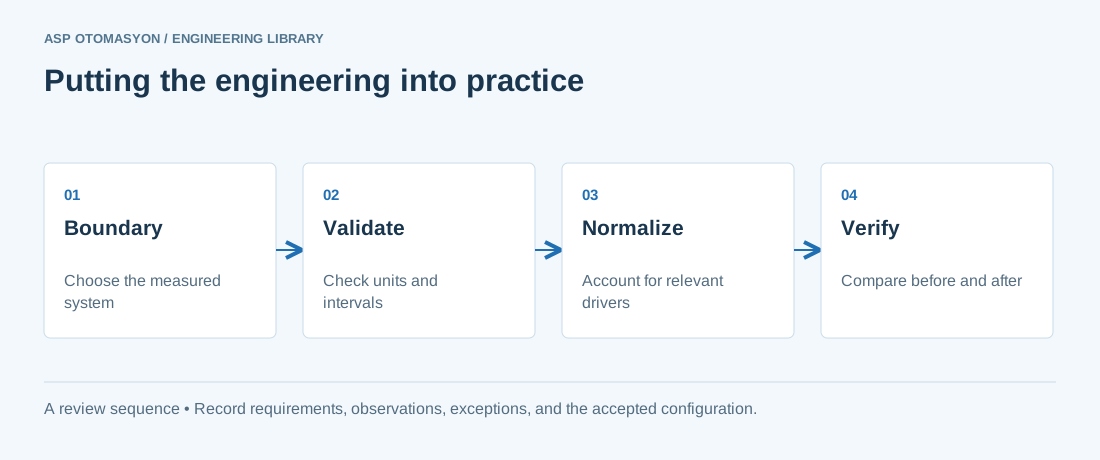
- Define the measurement boundary, meter ratios, units, time interval, and treatment of missing or reset readings.
- Capture production quantity, operating hours, and other relevant drivers alongside energy use.
- State the baseline and normalization assumptions when reporting a change; separate measured results from estimates.
Follow an ASP project guide to connect the fundamentals with implementation and acceptance.
Primary references and further reading
Use the original specifications and product documentation for implementation details. The examples in this guide are illustrative engineering scenarios, not published project results.