
A Modbus connection can return data successfully while the application reads the wrong value. Common causes include confusing reference numbers with protocol addresses, choosing the wrong function, applying the wrong data type, or decoding a multi-register value in the wrong order. Validate a register map before scaling up a polling configuration.
Design the requirement before the configuration
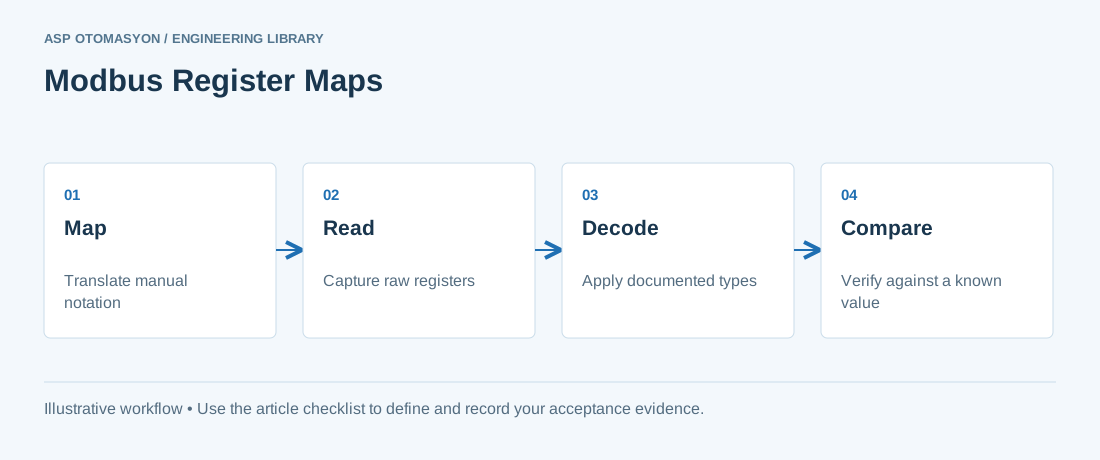
Treat the device manual as the authority for register meaning and access. Document the function code, protocol address, data width, signedness, scaling, unit, and any validity flag. A manual’s 40001-style holding-register notation is not necessarily the address a client expects you to enter. Modbus defines byte ordering within protocol fields, but how a vendor represents a 32-bit or 64-bit application value across registers must be confirmed for that device.
Worked scenario
An illustrative device manual labels a holding register 40001 and states that its protocol address is zero. One client may ask for 40001 while another asks for offset 0; both can be correct under their own configuration conventions. Read a known value and compare it with the device display. For a floating-point pair, use a changing test value and the documented word order instead of accepting the first plausible number.
What to verify
| Check | Evidence to record |
|---|---|
| Address | Record manual notation and actual protocol offset |
| Function | Distinguish coils, discrete inputs, input and holding registers |
| Representation | Width, signedness, byte/word order, scaling, and unit |
| Behavior | Confirm update rate, exception responses, and invalid states |
Acceptance and handover
Begin with read-only values and a conservative polling load. Keep a small evidence table of raw registers and decoded results. Test zero, a known nonzero value, and a negative value where supported. Obtain explicit operational authorization before testing any write-capable register.
Continue the engineering work
Use the related technical library for deeper background, or follow an ASP project guide to plan the implementation sequence.
Primary references and further reading
Use the original specifications and product documentation for implementation details. The examples in this guide are illustrative engineering scenarios, not published project results.