
An industrial control panel is the physical heart of an automation system — and one of the most regulated pieces of it. Panel design is governed by standards that cover safety, wiring, and clearances: IEC 60204-1 (safety of machinery — electrical equipment) as the global baseline, UL 508A in North America, and the relevant enclosure standards (IEC 60529 / NEMA). Getting the design right at the drawing stage prevents failures, rework, and certification problems at commissioning.
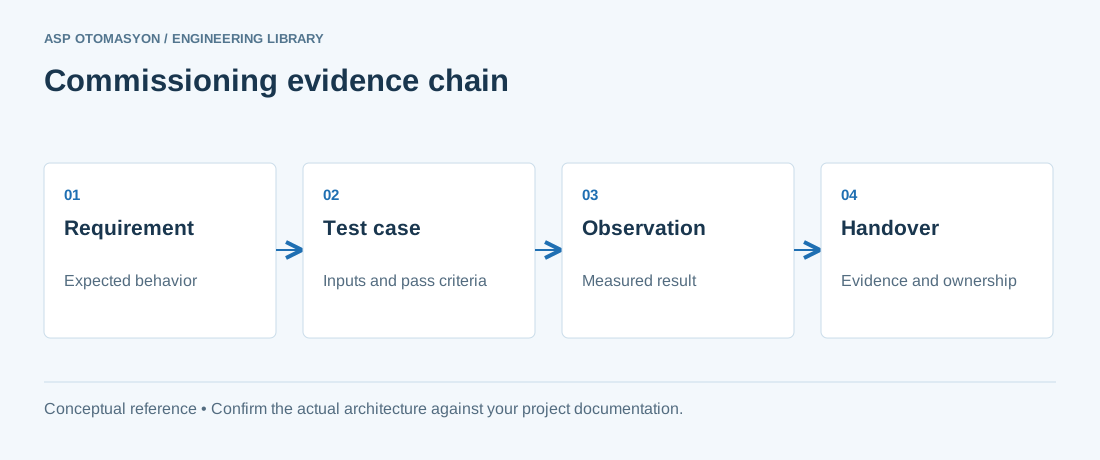
Standards Overview
| Standard | Scope | Key requirements |
|---|---|---|
| IEC 60204-1 | Electrical equipment of machines | Disconnect means, protection against electric shock, control circuits, wiring practice, marking, documentation. |
| UL 508A | Industrial control panels (North America) | Short-circuit current rating (SCCR), component spacing, wire sizes, workmanship, labeling. |
| IEC 61439-1/-2 | Low-voltage switchgear assemblies | Verification of construction, temperature rise, and short-circuit withstand for power distribution panels. |
| IEC 60529 / NEMA 250 | Enclosure protection | IP rating (dust/water) and NEMA type for the environment. |
The machine-level standard (IEC 60204-1) and the panel-level standard (UL 508A) are complementary: a machine panel must satisfy both where both apply. Check the customer's region early — retrofitting a UL-listed design later is expensive.
Layout Principles
- Segregate by voltage — power circuits (400 V) and control circuits (24 V) in separate compartments or with physical separation and barriers; signal wiring (analog) further separated from both.
- Top-down power flow — incoming supply at the top, distribution in the middle, control components and terminals at the bottom; gravity and convention make this the maintainable arrangement.
- Thermal design — every component has a heat budget; VFDs and power supplies dominate. Calculate temperature rise, size ventilation/fans or cooling, and leave air flow paths — a panel cooking at 60 °C fails at the worst moment.
- Access and service space — maintain minimum clearances around components (wire bending space, component removal), front-accessible where possible, and safe working distances for live parts per the standards.
- Wireway and duct sizing — wire ducts filled to 40–60% allow future additions; the panel will grow, and re-wiring a full duct is a week of work.
Component Selection and Protection
Protection coordination starts at the supply: main disconnect (lockable), short-circuit protection per branch (breakers or fuses sized to the wire and the load), and overcurrent protection for control transformers and 24 V supplies. Rules that matter:
- SCCR — the panel's short-circuit current rating must equal or exceed the available fault current at the installation point (UL 508A requires the label; IEC 61439 requires verification). A beautiful panel with the wrong SCCR is a safety violation.
- 24 VDC distribution — each PLC input group, output group, and field instrument group on its own protected branch; never one unprotected rail for the whole panel.
- Control transformer protection — primary and secondary fusing, with the secondary fuse sized for the inrush of the loads it feeds.
- Surge protection — SPDs on incoming power and on fieldbus/analog lines entering the panel in lightning-prone environments; cheap insurance for the I/O cards.
Wiring and Marking
Wire sizing follows the standard tables (ampacity, insulation rating, temperature). Beyond the minimums: wire colors per convention (green/yellow for PE, blue for DC common/neutral, red/black for DC supply), ferrule every stranded conductor, and mark every wire with its number at both ends. Component labels match the schematic reference designations; terminal blocks carry the terminal numbers from the terminal diagram. The panel is documentation made physical — every unlabeled wire is a future service call.
Documentation Set
A complete panel ships with: the schematic and terminal diagram (as-built), the I/O list, the cable schedule, component data sheets and ratings, the layout/drilling drawing, and the test report (insulation, continuity, functional test, and the verification of protective devices). The as-built status matters legally and practically: the panel that left the workshop is the panel that must be maintainable in ten years.
Summary
Control panel design is standards-driven engineering: IEC 60204-1 and UL 508A for safety and construction, proper protection coordination including SCCR, thermal design, voltage segregation, and disciplined wiring and marking. Design for the environment and the service life, size for heat and future growth, and ship the as-built documentation. The panel is judged every time someone opens its door — usually in a hurry, under load, in the middle of a shift.
Apply this to your project
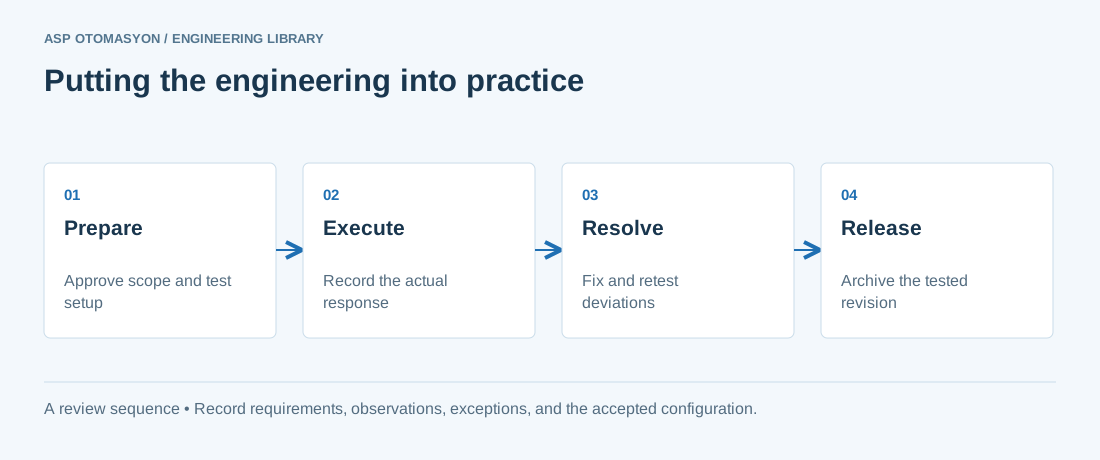
- Agree the test boundary and site authorization, especially where outputs or communications can affect operating equipment.
- Record expected and actual values, equipment identifiers, software revision, test conditions, and exceptions.
- Retest changed behavior and archive the final configuration with the test record and recovery instructions.
Follow an ASP project guide to connect the fundamentals with implementation and acceptance.
Primary references and further reading
Use the original specifications and product documentation for implementation details. The examples in this guide are illustrative engineering scenarios, not published project results.