
Time-Sensitive Networking (TSN) is a set of IEEE 802.1 standards that make standard Ethernet deterministic: bounded latency, low jitter, and scheduled delivery for time-critical traffic, on the same network as ordinary IT traffic. For industrial automation, TSN promises converged networks — control, motion, safety, and IT on one infrastructure — and it is the foundation for the next generation of industrial Ethernet (including OPC UA over TSN and the IEC/IEEE 60802 industrial profile). This article explains what TSN does, its key mechanisms, and what it means for industrial networks today.
The Problem TSN Solves
Standard Ethernet is not deterministic: frames can be queued behind others, causing unpredictable latency and jitter. Industrial protocols worked around this by reserving networks (PROFINET, EtherNet/IP on dedicated segments) or using proprietary timing. TSN adds standardized mechanisms to Ethernet so that time-critical frames get guaranteed bandwidth and delivery time — while best-effort traffic (web, file transfers, video) uses the remaining capacity.
Key TSN Mechanisms
| Mechanism | Standard | What it does |
|---|---|---|
| Time-aware shaper (TAS) | IEEE 802.1Qbv | Schedules time-critical traffic into reserved time windows; gates queues so control frames are never blocked |
| Frame preemption | IEEE 802.1Qbu / 802.3br | Pauses low-priority frames mid-transmission to let high-priority frames through immediately |
| Frame replication and elimination (FRER) | IEEE 802.1CB | Sends duplicate frames over redundant paths and eliminates the duplicates — zero-loss redundancy |
| Precision time protocol (gPTP) | IEEE 802.1AS | Synchronizes clocks across the network to sub-microsecond accuracy for scheduling and motion control |
| Stream reservation | IEEE 802.1Qcc / Qat | Reserves bandwidth and latency for streams end-to-end across the network |
How It Works in Practice
Time-aware network (TSN switch fabric)

Time window 1: control traffic (Qbv gate open)
Time window 2: motion/safety traffic
Time window 3: best-effort (HMI, file, IT)

All devices synchronized by gPTP to the same clock
A TSN network is configured with a central controller (the "CNC" — centralized network configuration) that plans the schedules and reserves resources, or with distributed configuration per IEC/IEEE 60802 profile rules. Streams (e.g., a cyclic motion command at 1 kHz) get a guaranteed slot; everything else fills the gaps.
TSN in the Industrial Landscape
- OPC UA over TSN (IEC 62541 + TSN): OPC UA Pub/Sub running on TSN provides vendor-neutral deterministic communication — the "field level" promise of the future industrial architecture (see the OPC UA Pub/Sub article).
- PROFINET with TSN: PROFINET's TSN profile (IEC 61784) defines how PROFINET runs on converged TSN networks.
- EtherNet/IP: the ODVA supports TSN-based convergence for EtherNet/IP, including CIP Sync over gPTP.
- Industrial profile: IEC/IEEE 60802 defines the common TSN profile for industrial automation so devices from different vendors interoperate.
What TSN Means for Your Plant
Converged networks
The headline benefit: one physical network can carry control, motion, safety, and IT traffic, replacing the "one protocol = one network" model. This reduces cabling and switches, simplifies architecture, and enables data sharing between OT and IT without a separate network.
Requirements to plan for
- TSN-capable hardware: switches and end devices must support the TSN mechanisms (Qbv, Qbu, 802.1AS) — ordinary managed switches cannot do scheduling.
- Configuration tooling: schedules and reservations must be planned (CNC software or vendor tools); this is new engineering work compared to plug-and-play Ethernet.
- Clock infrastructure: gPTP requires grandmaster clocks (often GPS/NTP or a dedicated master) and careful network design (no asymmetric paths).
- Skills: network engineers need TSN training; it is a different discipline from "plug it in and it works".
Adoption Realities
As of today, TSN is deployed in early-adopter projects (motion control, robotics cells, and power utilities) and is being rolled into new product lines by major automation vendors. Most existing plants run their proven protocols on dedicated networks and do not need TSN. The pragmatic path:
- Plan for TSN-ready infrastructure in new projects (specify TSN-capable switches where cost allows).
- Pilot TSN in one machine or cell with vendor support before committing a plant-wide converged network.
- Keep the control network architecture documented; convergence is a design decision, not a default.
Common Pitfalls
- Treating TSN as "faster Ethernet". It is a scheduling system; performance depends on correct configuration, not hardware alone.
- Mixing TSN and non-TSN segments carelessly. Bridges and gateways must be designed; time-aware scheduling does not extend across non-TSN hops.
- Ignoring clock accuracy. A TSN network without accurate gPTP is a network without guarantees.
- Overestimating vendor interoperability. The 60802 profile is still maturing; verify device interoperability with the vendor before full deployment.
Summary
TSN makes Ethernet deterministic through standardized scheduling, preemption, redundancy, and precise time sync. It enables converged OT/IT networks and vendor-neutral deterministic communication (OPC UA over TSN) — a genuine architectural advance for new systems. For most existing plants, the near-term move is to specify TSN-ready infrastructure in new projects and pilot carefully; the long-term direction of industrial networking is unmistakable.
Apply this to your project
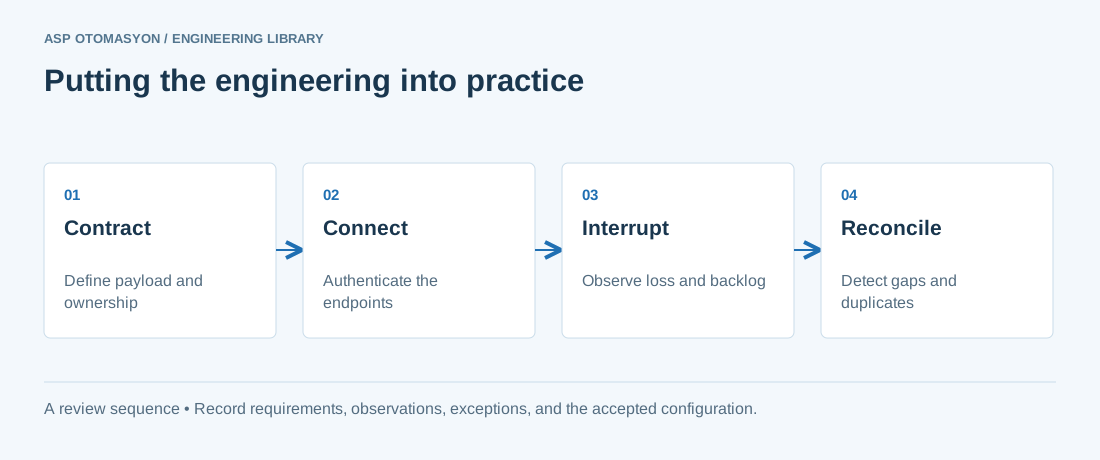
- Specify payload structure, units, identity, time semantics, access permissions, and protocol versions.
- Test backlog growth, connection loss, duplicate delivery, and restart behavior at the consuming application.
- Document how operators see failures and how the system distinguishes replayed data from current process state.
Follow an ASP project guide to connect the fundamentals with implementation and acceptance.
Primary references and further reading
Use the original specifications and product documentation for implementation details. The examples in this guide are illustrative engineering scenarios, not published project results.