
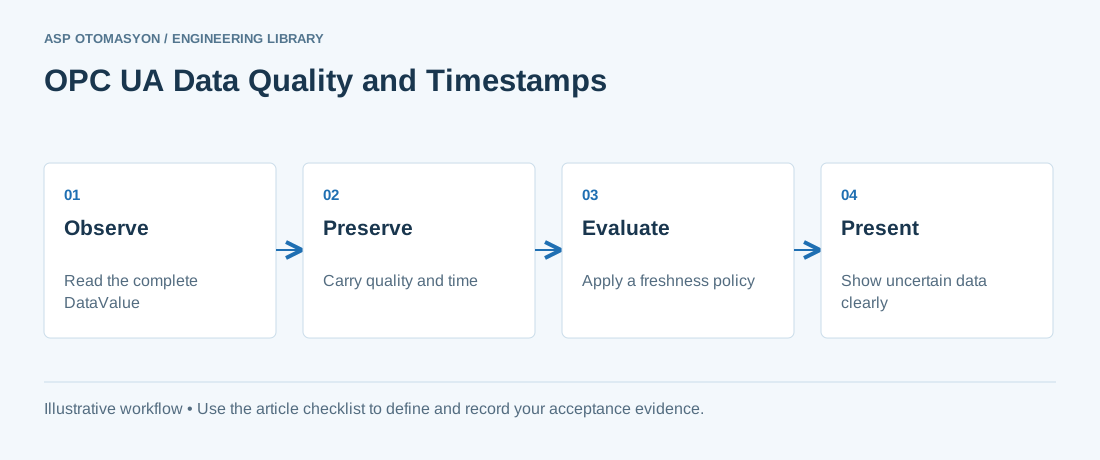
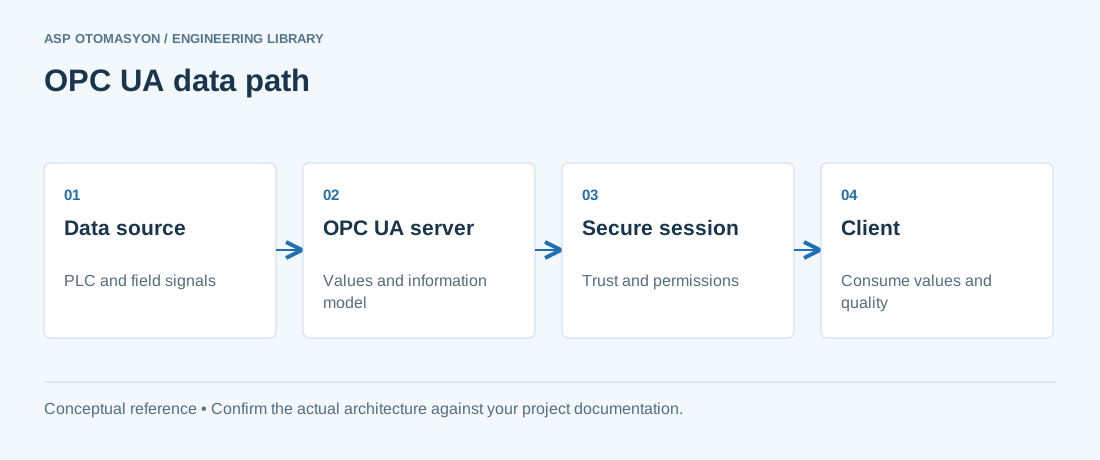
A process value is useful only when the receiver can tell whether it is valid and current enough for its purpose. In OPC UA, keep the value, StatusCode, and timestamps together through the gateway, historian, dashboard, and integration layer. A number without its quality context can look plausible after the data source has failed.
Design the requirement before the configuration
Distinguish source time from server time and arrival time. They describe different points in the data path and may not all be available. A Good status does not by itself satisfy an application-specific freshness requirement. Equally, a stable process value does not need a new source timestamp every display refresh. Define stale-data detection using the source behavior, communication health, and required update policy. Show Bad or Uncertain quality explicitly rather than silently retaining a normal-looking last value.
Worked scenario
Consider a tank level that remains at 42% before a network interruption. A client that shows 42% in its normal color can imply a current measurement. A better display preserves the last observation but marks it unavailable or stale, shows when it was last confirmed, and prevents dependent analytics from treating it as a new sample. The acceptable age must come from the use case, not this example.
What to verify
| Check | Evidence to record |
|---|---|
| Value | Preserve native data type and engineering unit |
| StatusCode | Retain severity and useful diagnostic detail |
| Source timestamp | Keep UTC semantics and source availability |
| Arrival timestamp | Use for transport diagnostics, not as fabricated process time |
Acceptance and handover
Test a constant value, a changing value, a disconnected source, an invalid sensor reading, and a clock offset. Compare the OPC client against the final consuming application. Confirm that exports and calculations preserve the same quality rules shown to an operator.
Continue the engineering work
Use the related technical library for deeper background, or follow an ASP project guide to plan the implementation sequence.
Primary references and further reading
Use the original specifications and product documentation for implementation details. The examples in this guide are illustrative engineering scenarios, not published project results.