
The Programmable Automation Controller (PAC) emerged in the early 2000s as vendors crossed PLC reliability with PC-style capability: multi-tasking, larger memory, data handling, and network-native integration. Today the boundary between high-end PLCs and PACs has blurred — many flagship PLCs offer PAC-class features — but the selection still matters because architecture, tooling, and lifecycle costs differ. Choosing the right platform starts with the application's control demands, not the marketing category.
What Defines a PAC
There is no formal standard that defines a PAC; the term (popularized by ARC Advisory Group) describes controllers that combine:
- Multiple control domains — discrete, process, motion, and drive control in one platform.
- Multi-tasking and event-driven execution — several programs running at different scan rates or triggered by events, not just one cyclic scan.
- Large memory and data structures — arrays, structures, and user-defined types in the controller, plus substantial recipe and data logging.
- Native network and IT connectivity — Ethernet/IP, SQL/database interfaces, web servers, and REST or MQTT integration without extra gateways.
- PC-based programming environment — often IEC 61131-3 plus C/C++ or proprietary high-level languages.
A classic PLC, by contrast, is optimized for deterministic cyclic execution of ladder logic, tight scan times, and hardened I/O scanning — often at a lower cost per point and with a simpler engineering model.
Selection Criteria
| Application profile | Recommended direction |
|---|---|
| Fast discrete machine logic, large I/O counts, standard fieldbuses | PLC — lowest cost, proven ecosystem, best scan determinism. |
| Mixed discrete + process + motion + data logging | PAC — one platform replaces several, simplifies integration. |
| Heavy data handling: recipes, reporting, database writes, web dashboards | PAC or PLC + industrial PC (IPC) combination. |
| Application runs in C/C++/C# with tight OS coupling | Industrial PC with soft-PLC runtime, or PAC with embedded PC core. |
| Extreme environment, decades of field-proven I/O | PLC — the ecosystem and spares are the deciding factor. |
Additional factors that often dominate the decision:
- Installed base and skills — a site standardized on one vendor's PLCs should have strong reasons to introduce a second platform.
- Safety integration — verify the safety-certified counterpart (safety CPU) exists on the chosen platform.
- Toolchain quality — simulation, version control integration, and diagnostics vary widely; test the engineering experience, not the datasheet.
- Lifecycle policy — ask for the vendor's stated support horizon and the migration path to the next generation.
- Communication stack — confirm native OPC UA server, MQTT, and the plant's fieldbus of choice with real protocol versions.
Architecture Patterns
In practice, many plants choose a hybrid architecture that gets the best of both worlds:
- PLC for the machine, PAC for the cell — fast machine logic in PLCs; the PAC coordinates cells, collects data, and talks to MES/ERP.
- PLC + IPC — PLC handles control; an IPC handles data, visualization, and IT integration via OPC UA — a pattern that keeps the control core simple.
- Soft-PLC on IPC — control and HMI on one industrial PC with a certified runtime; common for small machines and retrofit projects.
Whatever the pattern, the data interface should be standards-based: OPC UA for data exchange, standard fieldbuses for I/O, and time synchronization (PTP/NTP) so events across the system line up in the historian.
Cost Model Reality
Hardware price is a small part of the total cost of ownership. The decisive numbers are engineering time, spare-parts availability over 15 years, training, and the cost of the next migration. A cheaper controller that doubles commissioning time or forces a full rewrite at the next modernization is not cheaper. Calculate the platform decision with a 10–15 year horizon and include the cost of the engineering tools per seat — a factor often forgotten until the second project starts.
Summary
PAC vs PLC is not a technology war but an application fit. Choose PLCs for fast, simple, high-I/O discrete control; choose PACs (or PLC + IPC) where data, multi-domain control, and IT integration dominate. Decide on the installed base, toolchain quality, safety support, lifecycle policy, and 15-year cost — then verify the finalists with a pilot project before standardizing.
Apply this to your project
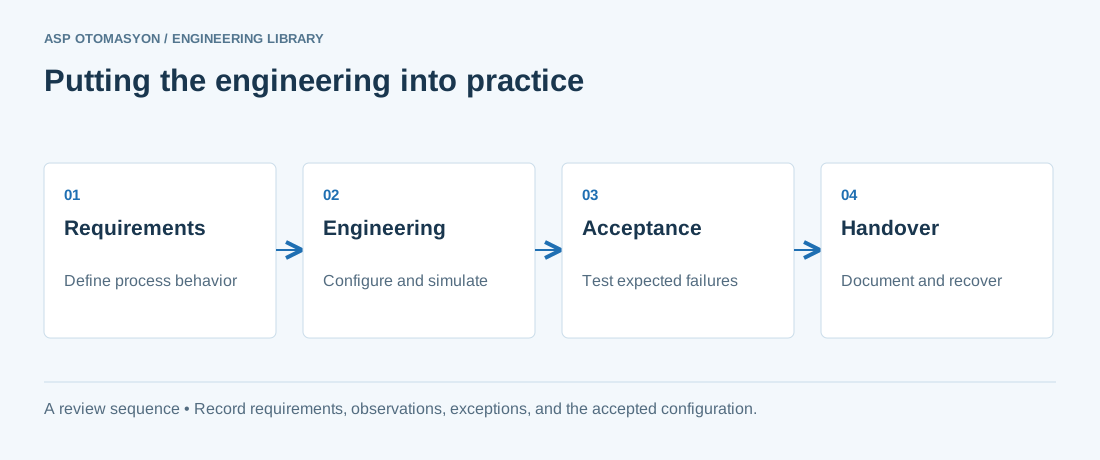
- Define the process states, timing requirements, and permitted behavior after a controller or communication failure.
- List controller, I/O, network, software, and license dependencies before choosing an architecture.
- Record acceptance results and prove that the delivered configuration can be restored from the handover package.
Follow an ASP project guide to connect the fundamentals with implementation and acceptance.
Primary references and further reading
Use the original specifications and product documentation for implementation details. The examples in this guide are illustrative engineering scenarios, not published project results.