
A SCADA acceptance test should show that operators can recognize plant state, issue permitted commands, respond to abnormal conditions, and recover from interruptions. Visual approval is one input. Communications, data quality, authorization, alarms, historical records, and restart behavior also need explicit acceptance evidence.
Build the matrix from the operating requirements and assign a witness for each area. For every test, record preconditions, action, expected response, actual result, configuration revision, and exception handling. Test representative equipment classes and known special cases. A successful point test should not be generalized to every interface when drivers, security settings, or scaling rules differ. Keep commissioning simulations distinguishable from real process values.
For an illustrative pump faceplate, verify stopped, running, unavailable, and communication-failed states; permitted command sources; interlock indications; and alarm navigation. Perform command testing only under approved site conditions. A graphic that changes color after a simulated bit flip has not proved the complete command path or the physical equipment response.
| Check | Evidence to record |
|---|---|
| Display | Correct unit, range, state, and bad-quality presentation |
| Control | Role, command path, permissive, and feedback behavior |
| Records | Alarm time, acknowledgment, history, and export consistency |
| Recovery | Restart, reconnect, failover, and restoration evidence |
Include operator participation and a defect closeout process. A retest must identify the changed configuration, not merely change a status field to passed. Archive the accepted project alongside the results so that a future restore can be compared with the tested baseline.

Use the related technical library for deeper background, or follow an ASP project guide to plan the implementation sequence.
Use the original specifications and product documentation for implementation details. The examples in this guide are illustrative engineering scenarios, not published project results.
","markdown":"# SCADA Acceptance Test Matrix: Beyond Screens That Look Correct\n\n> A SCADA acceptance test should show that operators can recognize plant state, issue permitted commands, respond to abnormal conditions, and recover from…\n\n- Canonical URL: https://wiki.aspotomasyon.com/article/scada-acceptance-test-matrix\n- Publisher: ASP OTOMASYON A.Ş. (ASP OTOMASYON Wiki)\n- Category: Technical Guides\n- Published: 2026-09-13 · Updated: 2026-09-13\n- Reading time: 2 min · Language: English\n\nA SCADA acceptance test should show that operators can recognize plant state, issue permitted commands, respond to abnormal conditions, and recover from interruptions. Visual approval is one input. Communications, data quality, authorization, alarms, historical records, and restart behavior also need explicit acceptance evidence.\n\n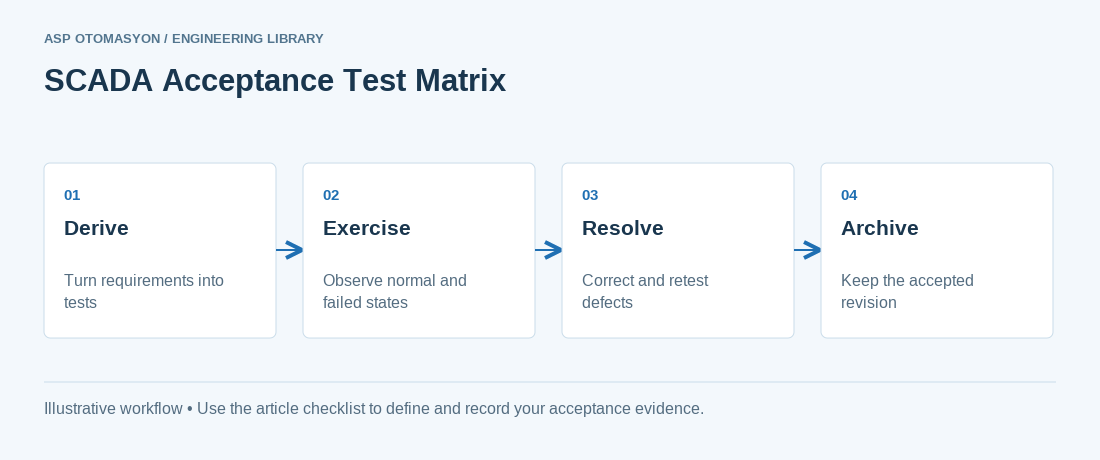\n\n*SCADA Acceptance Test Matrix: Beyond Screens That Look Correct — Derive → Exercise → Resolve → Archive.*\n\n## Design the requirement before the configuration\n\nBuild the matrix from the operating requirements and assign a witness for each area. For every test, record preconditions, action, expected response, actual result, configuration revision, and exception handling. Test representative equipment classes and known special cases. A successful point test should not be generalized to every interface when drivers, security settings, or scaling rules differ. Keep commissioning simulations distinguishable from real process values.\n\n## Worked scenario\n\nFor an illustrative pump faceplate, verify stopped, running, unavailable, and communication-failed states; permitted command sources; interlock indications; and alarm navigation. Perform command testing only under approved site conditions. A graphic that changes color after a simulated bit flip has not proved the complete command path or the physical equipment response.\n\n## What to verify\n\n| Check | Evidence to record |\n| --- | --- |\n| Display | Correct unit, range, state, and bad-quality presentation |\n| Control | Role, command path, permissive, and feedback behavior |\n| Records | Alarm time, acknowledgment, history, and export consistency |\n| Recovery | Restart, reconnect, failover, and restoration evidence |\n\n## Acceptance and handover\n\nInclude operator participation and a defect closeout process. A retest must identify the changed configuration, not merely change a status field to passed. Archive the accepted project alongside the results so that a future restore can be compared with the tested baseline.\n\n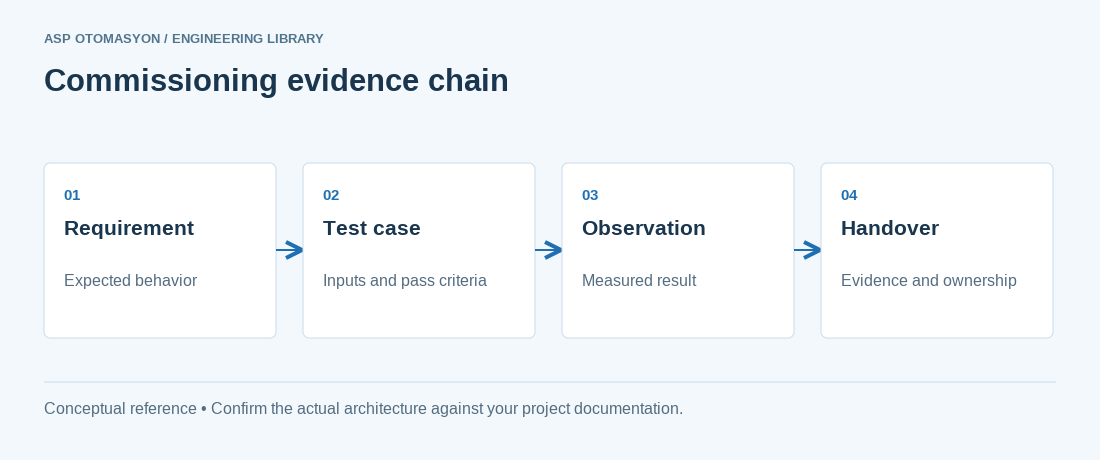\n\n*A commissioning evidence chain: every acceptance result should lead back to a requirement and identify the configuration that was actually tested.*\n\n## Continue the engineering work\n\nUse the [related technical library](https://wiki.aspotomasyon.com/category/technical-guides) for deeper background, or follow an [ASP project guide](https://wiki.aspotomasyon.com/guides) to plan the implementation sequence.\n\n## Primary references and further reading\n\nUse the original specifications and product documentation for implementation details. The examples in this guide are illustrative engineering scenarios, not published project results.\n\n- [NIST SP 800-82 Rev. 3 — OT configuration and operational considerations](https://csrc.nist.gov/pubs/sp/800/82/r3/final)\n- [ISA — Automation standards and committees](https://www.isa.org/standards-and-publications/isa-standards/isa-standards-committees)\n\n---\n\nCite the canonical article: https://wiki.aspotomasyon.com/article/scada-acceptance-test-matrix (SCADA Acceptance Test Matrix: Beyond Screens That Look Correct, ASP OTOMASYON, updated 2026-09-13).\n","headings":[{"id":"design-the-requirement-before-the-configuration","title":"Design the requirement before the configuration"},{"id":"worked-scenario","title":"Worked scenario"},{"id":"what-to-verify","title":"What to verify"},{"id":"acceptance-and-handover","title":"Acceptance and handover"},{"id":"continue-the-engineering-work","title":"Continue the engineering work"},{"id":"primary-references-and-further-reading","title":"Primary references and further reading"}],"faq":[],"references":[{"name":"NIST SP 800-82 Rev. 3 — OT configuration and operational considerations","url":"https://csrc.nist.gov/pubs/sp/800/82/r3/final"},{"name":"ISA — Automation standards and committees","url":"https://www.isa.org/standards-and-publications/isa-standards/isa-standards-committees"}],"related":[{"slug":"machine-commissioning-fat-sat","title":"Machine Commissioning: FAT, SAT and Startup Checklists","summary":"Commissioning is the structured process of proving that a machine or system works as designed — from the first power-on to productive operation.","category":{"slug":"automation-systems","name":"Automation Systems"},"url":"https://wiki.aspotomasyon.com/article/machine-commissioning-fat-sat","markdown_url":"https://wiki.aspotomasyon.com/article/machine-commissioning-fat-sat.md","api_url":"https://wiki.aspotomasyon.com/api/v1/articles/machine-commissioning-fat-sat","published":"2026-08-11T13:05:19+00:00","modified":"2026-09-13T11:07:23+00:00","reading_minutes":5,"word_count":933,"image":"https://wiki.aspotomasyon.com/assets/social/machine-commissioning-fat-sat-42eb5a5f88ea.png"},{"slug":"operator-training-simulators","title":"Operator Training Simulators (OTS) for Process Plants","summary":"Operators of complex process plants make their most important decisions rarely and under pressure: startup, shutdown, abnormal situations, and emergencies…","category":{"slug":"technical-guides","name":"Technical Guides"},"url":"https://wiki.aspotomasyon.com/article/operator-training-simulators","markdown_url":"https://wiki.aspotomasyon.com/article/operator-training-simulators.md","api_url":"https://wiki.aspotomasyon.com/api/v1/articles/operator-training-simulators","published":"2026-08-11T13:05:24+00:00","modified":"2026-09-13T11:07:23+00:00","reading_minutes":4,"word_count":865,"image":"https://wiki.aspotomasyon.com/assets/social/operator-training-simulators-463e38197ad4.png"},{"slug":"cloud-scada-remote-monitoring","title":"Cloud SCADA and Remote Monitoring Architectures","summary":"Cloud SCADA and remote monitoring extend the plant control and visibility layer beyond the control room.","category":{"slug":"digital-transformation","name":"Digital Transformation"},"url":"https://wiki.aspotomasyon.com/article/cloud-scada-remote-monitoring","markdown_url":"https://wiki.aspotomasyon.com/article/cloud-scada-remote-monitoring.md","api_url":"https://wiki.aspotomasyon.com/api/v1/articles/cloud-scada-remote-monitoring","published":"2026-08-06T12:26:37+00:00","modified":"2026-09-13T11:07:23+00:00","reading_minutes":5,"word_count":984,"image":"https://wiki.aspotomasyon.com/assets/social/cloud-scada-remote-monitoring-dd8794c627d4.png"},{"slug":"dcs-vs-plc-selection-guide","title":"DCS vs. PLC — A Comprehensive Selection Guide for Process Applications","summary":"Selecting the right control platform is one of the most consequential decisions in any industrial automation project.","category":{"slug":"automation-systems","name":"Automation Systems"},"url":"https://wiki.aspotomasyon.com/article/dcs-vs-plc-selection-guide","markdown_url":"https://wiki.aspotomasyon.com/article/dcs-vs-plc-selection-guide.md","api_url":"https://wiki.aspotomasyon.com/api/v1/articles/dcs-vs-plc-selection-guide","published":"2026-05-13T11:58:29+00:00","modified":"2026-09-13T11:07:23+00:00","reading_minutes":7,"word_count":1414,"image":"https://wiki.aspotomasyon.com/assets/social/dcs-vs-plc-selection-guide-5527026a81d5.png"}],"citation":"ASP OTOMASYON. SCADA Acceptance Test Matrix: Beyond Screens That Look Correct. Updated 2026-09-13. https://wiki.aspotomasyon.com/article/scada-acceptance-test-matrix"}}