
Redundancy is useful only when the required function survives the failures the design intends to tolerate. A pair of servers does not prove controller, network, power, storage, client, or field-path resilience. Define the failure boundary and acceptance criteria for each function before testing.
Map primary and standby components along the complete path and identify shared dependencies. Document detection time, switchover behavior, permitted interruption, retained state, and recovery to a stable configuration. Distinguish automatic failover from manual restoration and from recovery after multiple faults. Use an approved test plan with operational safeguards; do not disconnect plant equipment simply to see what happens.
In an illustrative SCADA pair, the standby server becomes active but clients continue trying the failed address. Server-role switchover succeeded while operator access did not. A complete test observes the client session, displayed quality, alarms, writes where safely authorized, historian continuity, and the path back to normal operation.
| Check | Evidence to record |
|---|---|
| Dependency | Power, network, storage, identity, time, and licenses |
| Failure | One specifically defined fault per approved test |
| Continuity | Client behavior, process state, data quality, and history |
| Recovery | Rejoin, resynchronization, and prevention of conflicting active roles |
Capture timed observations at both endpoints and preserve relevant logs. Repeat representative failures under expected peak load and document any excluded fault combinations. A successful test supports only its stated scenario; keep those boundaries visible in the handover record.

Use the related technical library for deeper background, or follow an ASP project guide to plan the implementation sequence.
Use the original specifications and product documentation for implementation details. The examples in this guide are illustrative engineering scenarios, not published project results.
","markdown":"# Redundancy Failover Acceptance: Testing the Complete Control Path\n\n> Redundancy is useful only when the required function survives the failures the design intends to tolerate.\n\n- Canonical URL: https://wiki.aspotomasyon.com/article/redundancy-failover-acceptance\n- Publisher: ASP OTOMASYON A.Ş. (ASP OTOMASYON Wiki)\n- Category: Automation Systems\n- Published: 2026-09-13 · Updated: 2026-09-13\n- Reading time: 2 min · Language: English\n\nRedundancy is useful only when the required function survives the failures the design intends to tolerate. A pair of servers does not prove controller, network, power, storage, client, or field-path resilience. Define the failure boundary and acceptance criteria for each function before testing.\n\n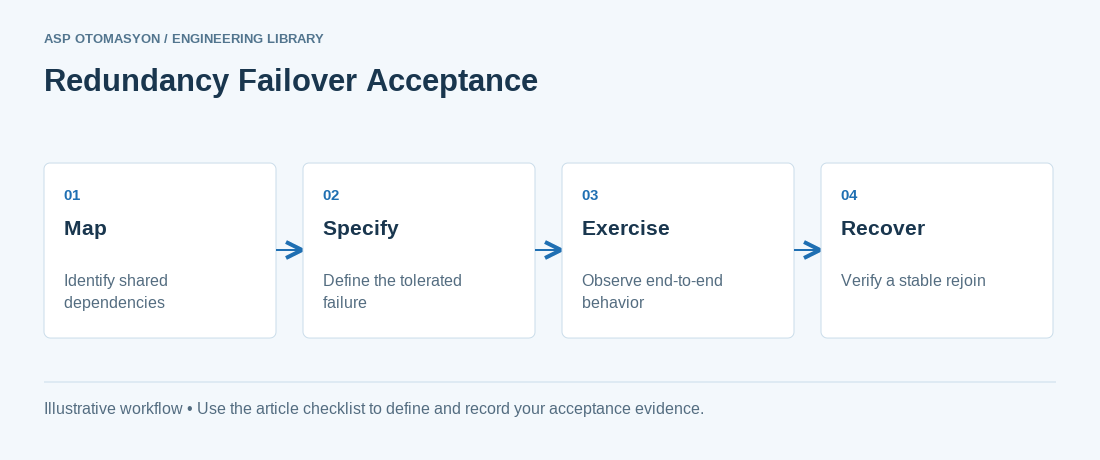\n\n*Redundancy Failover Acceptance: Testing the Complete Control Path — Map → Specify → Exercise → Recover.*\n\n## Design the requirement before the configuration\n\nMap primary and standby components along the complete path and identify shared dependencies. Document detection time, switchover behavior, permitted interruption, retained state, and recovery to a stable configuration. Distinguish automatic failover from manual restoration and from recovery after multiple faults. Use an approved test plan with operational safeguards; do not disconnect plant equipment simply to see what happens.\n\n## Worked scenario\n\nIn an illustrative SCADA pair, the standby server becomes active but clients continue trying the failed address. Server-role switchover succeeded while operator access did not. A complete test observes the client session, displayed quality, alarms, writes where safely authorized, historian continuity, and the path back to normal operation.\n\n## What to verify\n\n| Check | Evidence to record |\n| --- | --- |\n| Dependency | Power, network, storage, identity, time, and licenses |\n| Failure | One specifically defined fault per approved test |\n| Continuity | Client behavior, process state, data quality, and history |\n| Recovery | Rejoin, resynchronization, and prevention of conflicting active roles |\n\n## Acceptance and handover\n\nCapture timed observations at both endpoints and preserve relevant logs. Repeat representative failures under expected peak load and document any excluded fault combinations. A successful test supports only its stated scenario; keep those boundaries visible in the handover record.\n\n\n\n*Conceptual control-system layers. Safety functions, communication paths, and redundancy must be designed for the application; the diagram is not a wiring or safety design.*\n\n## Continue the engineering work\n\nUse the [related technical library](https://wiki.aspotomasyon.com/category/automation-systems) for deeper background, or follow an [ASP project guide](https://wiki.aspotomasyon.com/guides) to plan the implementation sequence.\n\n## Primary references and further reading\n\nUse the original specifications and product documentation for implementation details. The examples in this guide are illustrative engineering scenarios, not published project results.\n\n- [ABB — System 800xA architecture and product documentation](https://new.abb.com/control-systems/system-800xa)\n- [NIST SP 800-82 Rev. 3 — OT architecture and security guidance](https://csrc.nist.gov/pubs/sp/800/82/r3/final)\n\n---\n\nCite the canonical article: https://wiki.aspotomasyon.com/article/redundancy-failover-acceptance (Redundancy Failover Acceptance: Testing the Complete Control Path, ASP OTOMASYON, updated 2026-09-13).\n","headings":[{"id":"design-the-requirement-before-the-configuration","title":"Design the requirement before the configuration"},{"id":"worked-scenario","title":"Worked scenario"},{"id":"what-to-verify","title":"What to verify"},{"id":"acceptance-and-handover","title":"Acceptance and handover"},{"id":"continue-the-engineering-work","title":"Continue the engineering work"},{"id":"primary-references-and-further-reading","title":"Primary references and further reading"}],"faq":[],"references":[{"name":"ABB — System 800xA architecture and product documentation","url":"https://new.abb.com/control-systems/system-800xa"},{"name":"NIST SP 800-82 Rev. 3 — OT architecture and security guidance","url":"https://csrc.nist.gov/pubs/sp/800/82/r3/final"}],"related":[{"slug":"industrial-ethernet-redundancy-rstp-mrp-prp-hsr","title":"Industrial Ethernet Redundancy: RSTP, MRP, PRP and HSR Compared","summary":"A redundant industrial network needs a protocol matched to its topology and device support, plus a failover test that records what the control system actually…","category":{"slug":"technical-guides","name":"Technical Guides"},"url":"https://wiki.aspotomasyon.com/article/industrial-ethernet-redundancy-rstp-mrp-prp-hsr","markdown_url":"https://wiki.aspotomasyon.com/article/industrial-ethernet-redundancy-rstp-mrp-prp-hsr.md","api_url":"https://wiki.aspotomasyon.com/api/v1/articles/industrial-ethernet-redundancy-rstp-mrp-prp-hsr","published":"2026-10-11T11:46:21+00:00","modified":"2026-10-11T11:46:21+00:00","reading_minutes":9,"word_count":1911,"image":"https://wiki.aspotomasyon.com/assets/social/industrial-ethernet-redundancy-rstp-mrp-prp-hsr-8977742b8d7a.png"},{"slug":"opc-ua-redundancy-failover-testing","title":"OPC UA Redundancy: Failover Models and How to Test Them","summary":"OPC UA separates transparent from non-transparent server redundancy and uses a ServiceLevel value to pick the server, so failover tests must check servers and…","category":{"slug":"opc-solutions","name":"OPC Solutions"},"url":"https://wiki.aspotomasyon.com/article/opc-ua-redundancy-failover-testing","markdown_url":"https://wiki.aspotomasyon.com/article/opc-ua-redundancy-failover-testing.md","api_url":"https://wiki.aspotomasyon.com/api/v1/articles/opc-ua-redundancy-failover-testing","published":"2026-10-11T11:46:21+00:00","modified":"2026-10-11T11:46:21+00:00","reading_minutes":9,"word_count":1894,"image":"https://wiki.aspotomasyon.com/assets/social/opc-ua-redundancy-failover-testing-0ddf98f25724.png"},{"slug":"redundant-control-system-architectures","title":"Redundant Control System Architectures","summary":"Redundant control systems keep a plant running when hardware fails. In continuous process industries — refining, petrochemicals, power, pipelines — a control…","category":{"slug":"automation-systems","name":"Automation Systems"},"url":"https://wiki.aspotomasyon.com/article/redundant-control-system-architectures","markdown_url":"https://wiki.aspotomasyon.com/article/redundant-control-system-architectures.md","api_url":"https://wiki.aspotomasyon.com/api/v1/articles/redundant-control-system-architectures","published":"2026-08-06T12:26:37+00:00","modified":"2026-09-13T11:07:23+00:00","reading_minutes":4,"word_count":866,"image":"https://wiki.aspotomasyon.com/assets/social/redundant-control-system-architectures-8fa5b47d3e3f.png"},{"slug":"abb-800xa-dcs-architecture-configuration","title":"ABB 800xA DCS: Architecture and Configuration","summary":"The ABB Ability System 800xA is one of the most advanced Distributed Control Systems (DCS) available for process industries.","category":{"slug":"automation-systems","name":"Automation Systems"},"url":"https://wiki.aspotomasyon.com/article/abb-800xa-dcs-architecture-configuration","markdown_url":"https://wiki.aspotomasyon.com/article/abb-800xa-dcs-architecture-configuration.md","api_url":"https://wiki.aspotomasyon.com/api/v1/articles/abb-800xa-dcs-architecture-configuration","published":"2026-05-13T12:07:53+00:00","modified":"2026-09-13T11:07:23+00:00","reading_minutes":9,"word_count":1882,"image":"https://wiki.aspotomasyon.com/assets/social/abb-800xa-dcs-architecture-configuration-6970a4d1cf7b.png"}],"citation":"ASP OTOMASYON. Redundancy Failover Acceptance: Testing the Complete Control Path. Updated 2026-09-13. https://wiki.aspotomasyon.com/article/redundancy-failover-acceptance"}}