
Vendor access to an industrial system should be an approved activity with a named person, defined target, limited duration, and visible outcome. A permanent tunnel shared by several suppliers makes it difficult to know who changed what or whether access is still needed.
Record the purpose, requested systems, required privileges, expected tools, planned changes, and site contact before enabling access. Use the organization’s approved remote access architecture and authentication controls. Authorize only the necessary destination and time window. Agree how sessions are supervised or recorded, how emergency revocation works, and who can approve a scope change. Troubleshooting permission should not silently become permission to download new control logic.
For an illustrative two-hour diagnostic session, approve read-only access to a named engineering workstation and require a second decision before any configuration write. If the vendor needs another host, stop and amend the request. Afterward, revoke the session and confirm that temporary accounts, files, or communication exceptions have been handled according to the change record.
| Check | Evidence to record |
|---|---|
| Request | Named engineer, employer, target, purpose, and time window |
| Approve | OT owner confirms operational impact and least privilege |
| Observe | Capture activity and deviations using approved monitoring |
| Close | Revoke access, review changes, and archive the work record |
Test access expiration and emergency revocation before relying on them. Periodically reconcile approved vendor relationships against enabled accounts and network paths. Treat authentication, network reachability, and application authorization as separate checks; passing one does not prove the others.

Use the related technical library for deeper background, or follow an ASP project guide to plan the implementation sequence.
Use the original specifications and product documentation for implementation details. The examples in this guide are illustrative engineering scenarios, not published project results.
","markdown":"# OT Vendor Remote Access: An Approval and Closeout Workflow\n\n> Vendor access to an industrial system should be an approved activity with a named person, defined target, limited duration, and visible outcome.\n\n- Canonical URL: https://wiki.aspotomasyon.com/article/ot-vendor-access-approval-workflow\n- Publisher: ASP OTOMASYON A.Ş. (ASP OTOMASYON Wiki)\n- Category: Industrial Cybersecurity\n- Published: 2026-09-13 · Updated: 2026-09-13\n- Reading time: 2 min · Language: English\n\nVendor access to an industrial system should be an approved activity with a named person, defined target, limited duration, and visible outcome. A permanent tunnel shared by several suppliers makes it difficult to know who changed what or whether access is still needed.\n\n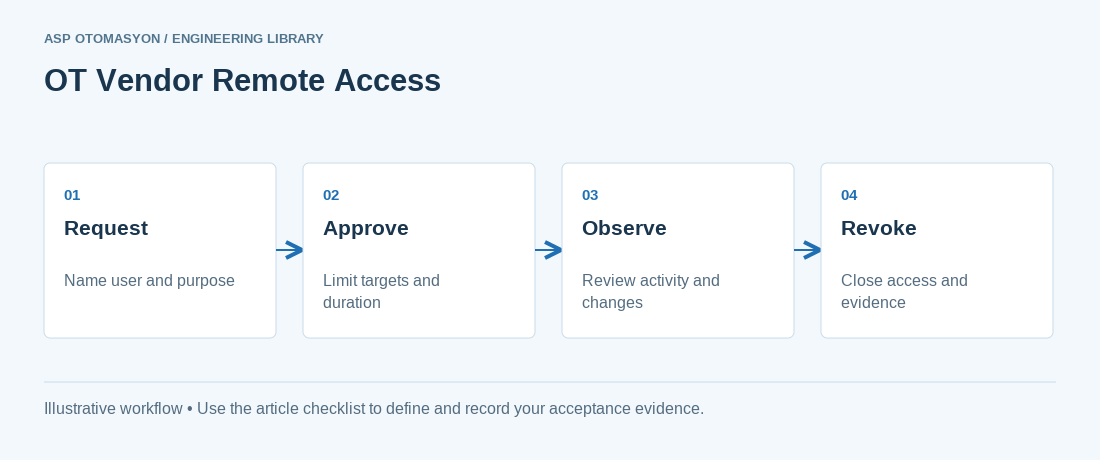\n\n*OT Vendor Remote Access: An Approval and Closeout Workflow — Request → Approve → Observe → Revoke.*\n\n## Design the requirement before the configuration\n\nRecord the purpose, requested systems, required privileges, expected tools, planned changes, and site contact before enabling access. Use the organization’s approved remote access architecture and authentication controls. Authorize only the necessary destination and time window. Agree how sessions are supervised or recorded, how emergency revocation works, and who can approve a scope change. Troubleshooting permission should not silently become permission to download new control logic.\n\n## Worked scenario\n\nFor an illustrative two-hour diagnostic session, approve read-only access to a named engineering workstation and require a second decision before any configuration write. If the vendor needs another host, stop and amend the request. Afterward, revoke the session and confirm that temporary accounts, files, or communication exceptions have been handled according to the change record.\n\n## What to verify\n\n| Check | Evidence to record |\n| --- | --- |\n| Request | Named engineer, employer, target, purpose, and time window |\n| Approve | OT owner confirms operational impact and least privilege |\n| Observe | Capture activity and deviations using approved monitoring |\n| Close | Revoke access, review changes, and archive the work record |\n\n## Acceptance and handover\n\nTest access expiration and emergency revocation before relying on them. Periodically reconcile approved vendor relationships against enabled accounts and network paths. Treat authentication, network reachability, and application authorization as separate checks; passing one does not prove the others.\n\n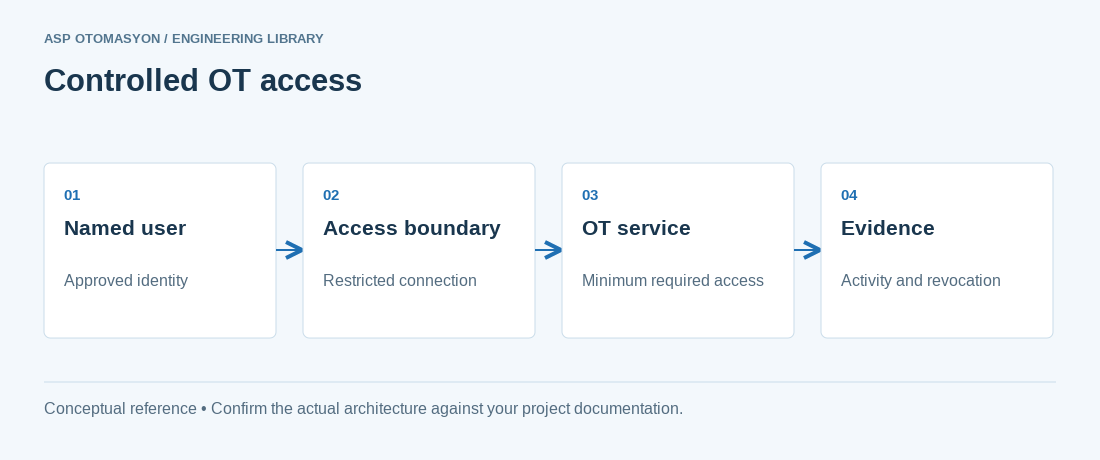\n\n*Conceptual access controls around an OT service. Actual zones, conduits, protections, and response actions require a site-specific assessment.*\n\n## Continue the engineering work\n\nUse the [related technical library](https://wiki.aspotomasyon.com/category/industrial-cybersecurity) for deeper background, or follow an [ASP project guide](https://wiki.aspotomasyon.com/guides) to plan the implementation sequence.\n\n## Primary references and further reading\n\nUse the original specifications and product documentation for implementation details. The examples in this guide are illustrative engineering scenarios, not published project results.\n\n- [NIST SP 800-82 Rev. 3 — Guide to Operational Technology Security](https://csrc.nist.gov/pubs/sp/800/82/r3/final)\n- [ISA — ISA/IEC 62443 series](https://www.isa.org/standards-and-publications/isa-standards/isa-iec-62443-series-of-standards)\n\n---\n\nCite the canonical article: https://wiki.aspotomasyon.com/article/ot-vendor-access-approval-workflow (OT Vendor Remote Access: An Approval and Closeout Workflow, ASP OTOMASYON, updated 2026-09-13).\n","headings":[{"id":"design-the-requirement-before-the-configuration","title":"Design the requirement before the configuration"},{"id":"worked-scenario","title":"Worked scenario"},{"id":"what-to-verify","title":"What to verify"},{"id":"acceptance-and-handover","title":"Acceptance and handover"},{"id":"continue-the-engineering-work","title":"Continue the engineering work"},{"id":"primary-references-and-further-reading","title":"Primary references and further reading"}],"faq":[],"references":[{"name":"NIST SP 800-82 Rev. 3 — Guide to Operational Technology Security","url":"https://csrc.nist.gov/pubs/sp/800/82/r3/final"},{"name":"ISA — ISA/IEC 62443 series","url":"https://www.isa.org/standards-and-publications/isa-standards/isa-iec-62443-series-of-standards"}],"related":[{"slug":"ot-identity-access-management-mfa","title":"OT Identity and Access Management: Accounts, Roles, and MFA","summary":"OT access works best with named identities, roles matched to jobs, and MFA placed at remote entry points rather than at every operator console.","category":{"slug":"industrial-cybersecurity","name":"Industrial Cybersecurity"},"url":"https://wiki.aspotomasyon.com/article/ot-identity-access-management-mfa","markdown_url":"https://wiki.aspotomasyon.com/article/ot-identity-access-management-mfa.md","api_url":"https://wiki.aspotomasyon.com/api/v1/articles/ot-identity-access-management-mfa","published":"2026-10-11T11:46:21+00:00","modified":"2026-10-11T11:46:21+00:00","reading_minutes":9,"word_count":1907,"image":"https://wiki.aspotomasyon.com/assets/social/ot-identity-access-management-mfa-2f4bbf8c3dfc.png"},{"slug":"nis2-directive-operational-technology-compliance","title":"NIS2 and Operational Technology: What Plant Operators Need to Prepare","summary":"NIS2 can reach plant operators through their size and sector, and its risk-management and reporting duties extend to the OT systems that run production.","category":{"slug":"industrial-cybersecurity","name":"Industrial Cybersecurity"},"url":"https://wiki.aspotomasyon.com/article/nis2-directive-operational-technology-compliance","markdown_url":"https://wiki.aspotomasyon.com/article/nis2-directive-operational-technology-compliance.md","api_url":"https://wiki.aspotomasyon.com/api/v1/articles/nis2-directive-operational-technology-compliance","published":"2026-10-11T11:46:21+00:00","modified":"2026-10-11T11:46:21+00:00","reading_minutes":9,"word_count":1896,"image":"https://wiki.aspotomasyon.com/assets/social/nis2-directive-operational-technology-compliance-3d941770fc05.png"},{"slug":"iec-62443-zones-conduits-workflow","title":"IEC 62443 Zones and Conduits: A Practical Partitioning Workflow","summary":"A zone groups assets with shared security needs, a conduit carries the controlled communication between zones, and together they give the IEC 62443 workflow…","category":{"slug":"industrial-cybersecurity","name":"Industrial Cybersecurity"},"url":"https://wiki.aspotomasyon.com/article/iec-62443-zones-conduits-workflow","markdown_url":"https://wiki.aspotomasyon.com/article/iec-62443-zones-conduits-workflow.md","api_url":"https://wiki.aspotomasyon.com/api/v1/articles/iec-62443-zones-conduits-workflow","published":"2026-10-11T11:46:21+00:00","modified":"2026-10-11T11:46:21+00:00","reading_minutes":8,"word_count":1705,"image":"https://wiki.aspotomasyon.com/assets/social/iec-62443-zones-conduits-workflow-9cab65877d4a.png"},{"slug":"scada-acceptance-test-matrix","title":"SCADA Acceptance Test Matrix: Beyond Screens That Look Correct","summary":"A SCADA acceptance test should show that operators can recognize plant state, issue permitted commands, respond to abnormal conditions, and recover from…","category":{"slug":"technical-guides","name":"Technical Guides"},"url":"https://wiki.aspotomasyon.com/article/scada-acceptance-test-matrix","markdown_url":"https://wiki.aspotomasyon.com/article/scada-acceptance-test-matrix.md","api_url":"https://wiki.aspotomasyon.com/api/v1/articles/scada-acceptance-test-matrix","published":"2026-09-13T11:07:23+00:00","modified":"2026-09-13T11:07:23+00:00","reading_minutes":2,"word_count":347,"image":"https://wiki.aspotomasyon.com/assets/social/scada-acceptance-test-matrix-84d84d2728dd.png"}],"citation":"ASP OTOMASYON. OT Vendor Remote Access: An Approval and Closeout Workflow. Updated 2026-09-13. https://wiki.aspotomasyon.com/article/ot-vendor-access-approval-workflow"}}