
An OPC UA subscription should deliver the changes a client needs without making every signal run at the fastest available rate. Size it around process dynamics, client refresh needs, and the amount of interruption you need to tolerate. Sampling, publishing, and queueing are separate settings with different consequences.
The monitored-item sampling interval requests how often the server checks a value. The publishing interval controls when a subscription can send notifications. A server can revise requested values, so retain the revised parameters returned by the service. A queue can retain multiple notifications between publishing opportunities, subject to filters and server limits. None of these settings can reconstruct a change the source driver never acquired. Group fast operational signals separately from slow utility totals, and measure controller and server load before expanding the tag set.
Illustrative sizing: a signal sampled every 100 ms can generate ten samples during a 1 s publishing interval. If every sample changes and every intermediate value matters, a queue of one cannot retain the whole sequence. Start the test with a queue that accommodates the expected changes, then verify server revisions, overflow behavior, and resource use. This is a test assumption, not a guarantee of lossless collection.
| Check | Evidence to record |
|---|---|
| Sampling interval | Compare requested and revised interval; check source update rate |
| Publishing interval | Measure notification latency at the client |
| Queue size | Exercise a burst and inspect overflow/status information |
| Reconnect | Check sequence handling, gaps, and initial values |
Use a controlled signal with a known sequence. Record source values and client observations with timestamps. Repeat with multiple clients and a temporary connection interruption. Accept the configuration only against a defined latency and loss requirement; a dashboard that looks smooth is insufficient evidence.

Use the related technical library for deeper background, or follow an ASP project guide to plan the implementation sequence.
Use the original specifications and product documentation for implementation details. The examples in this guide are illustrative engineering scenarios, not published project results.
","markdown":"# OPC UA Subscription Sizing: Sampling, Publishing, and Queues\n\n> An OPC UA subscription should deliver the changes a client needs without making every signal run at the fastest available rate.\n\n- Canonical URL: https://wiki.aspotomasyon.com/article/opc-ua-subscription-sizing\n- Publisher: ASP OTOMASYON A.Ş. (ASP OTOMASYON Wiki)\n- Category: OPC Solutions\n- Published: 2026-09-13 · Updated: 2026-09-13\n- Reading time: 2 min · Language: English\n\nAn OPC UA subscription should deliver the changes a client needs without making every signal run at the fastest available rate. Size it around process dynamics, client refresh needs, and the amount of interruption you need to tolerate. Sampling, publishing, and queueing are separate settings with different consequences.\n\n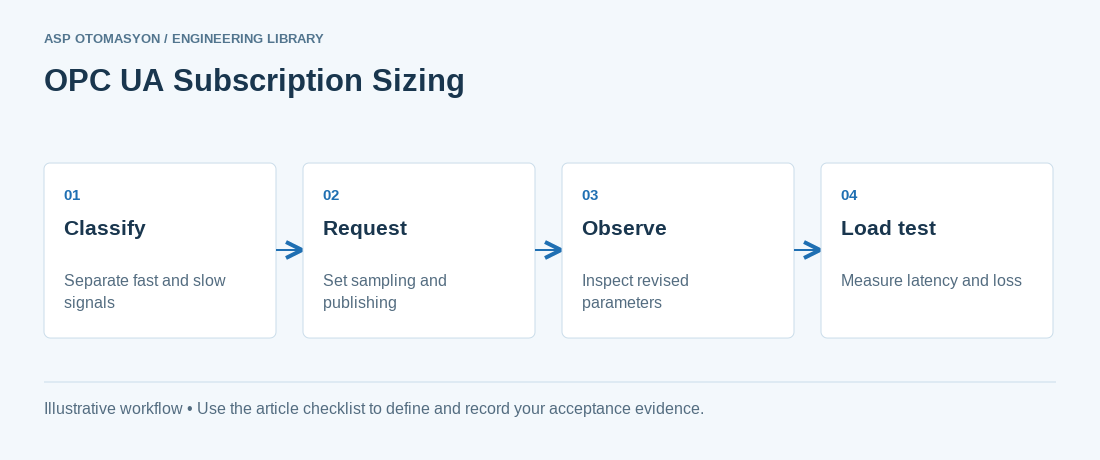\n\n*OPC UA Subscription Sizing: Sampling, Publishing, and Queues — Classify → Request → Observe → Load test.*\n\n## Design the requirement before the configuration\n\nThe monitored-item sampling interval requests how often the server checks a value. The publishing interval controls when a subscription can send notifications. A server can revise requested values, so retain the revised parameters returned by the service. A queue can retain multiple notifications between publishing opportunities, subject to filters and server limits. None of these settings can reconstruct a change the source driver never acquired. Group fast operational signals separately from slow utility totals, and measure controller and server load before expanding the tag set.\n\n## Worked scenario\n\nIllustrative sizing: a signal sampled every 100 ms can generate ten samples during a 1 s publishing interval. If every sample changes and every intermediate value matters, a queue of one cannot retain the whole sequence. Start the test with a queue that accommodates the expected changes, then verify server revisions, overflow behavior, and resource use. This is a test assumption, not a guarantee of lossless collection.\n\n## What to verify\n\n| Check | Evidence to record |\n| --- | --- |\n| Sampling interval | Compare requested and revised interval; check source update rate |\n| Publishing interval | Measure notification latency at the client |\n| Queue size | Exercise a burst and inspect overflow/status information |\n| Reconnect | Check sequence handling, gaps, and initial values |\n\n## Acceptance and handover\n\nUse a controlled signal with a known sequence. Record source values and client observations with timestamps. Repeat with multiple clients and a temporary connection interruption. Accept the configuration only against a defined latency and loss requirement; a dashboard that looks smooth is insufficient evidence.\n\n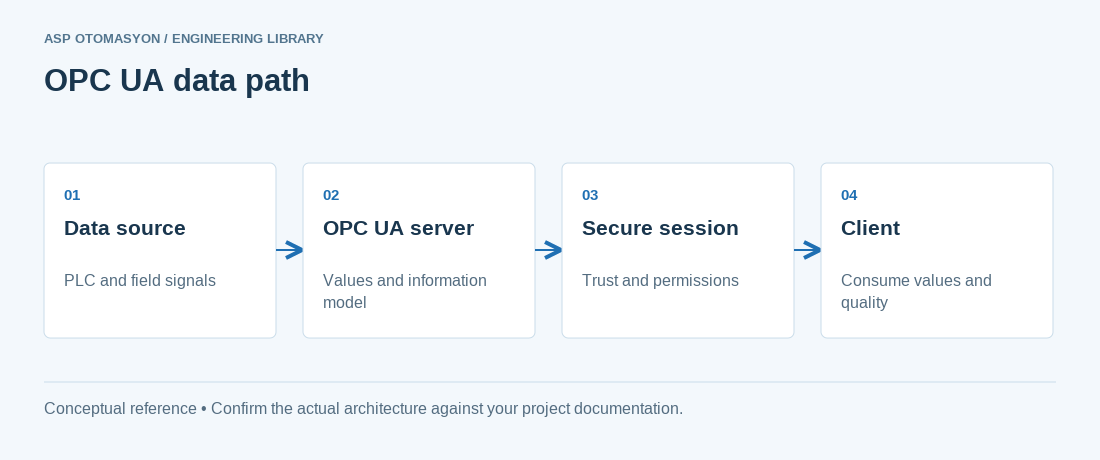\n\n*A conceptual OPC UA client/server path. Application certificates establish application trust; user authorization controls what a connected user may do.*\n\n## Continue the engineering work\n\nUse the [related technical library](https://wiki.aspotomasyon.com/category/opc-solutions) for deeper background, or follow an [ASP project guide](https://wiki.aspotomasyon.com/guides) to plan the implementation sequence.\n\n## Primary references and further reading\n\nUse the original specifications and product documentation for implementation details. The examples in this guide are illustrative engineering scenarios, not published project results.\n\n- [OPC Foundation — MonitoredItem Service Set](https://reference.opcfoundation.org/specs/OPC-10000-4/5.13)\n- [OPC Foundation — OPC UA Part 4: Services](https://reference.opcfoundation.org/specs/OPC-10000-4/)\n- [OPC Foundation — OPC UA Part 2: Security Model](https://reference.opcfoundation.org/specs/OPC-10000-2/)\n\n---\n\nCite the canonical article: https://wiki.aspotomasyon.com/article/opc-ua-subscription-sizing (OPC UA Subscription Sizing: Sampling, Publishing, and Queues, ASP OTOMASYON, updated 2026-09-13).\n","headings":[{"id":"design-the-requirement-before-the-configuration","title":"Design the requirement before the configuration"},{"id":"worked-scenario","title":"Worked scenario"},{"id":"what-to-verify","title":"What to verify"},{"id":"acceptance-and-handover","title":"Acceptance and handover"},{"id":"continue-the-engineering-work","title":"Continue the engineering work"},{"id":"primary-references-and-further-reading","title":"Primary references and further reading"}],"faq":[],"references":[{"name":"OPC Foundation — MonitoredItem Service Set","url":"https://reference.opcfoundation.org/specs/OPC-10000-4/5.13"},{"name":"OPC Foundation — OPC UA Part 4: Services","url":"https://reference.opcfoundation.org/specs/OPC-10000-4/"},{"name":"OPC Foundation — OPC UA Part 2: Security Model","url":"https://reference.opcfoundation.org/specs/OPC-10000-2/"}],"related":[{"slug":"opc-ua-redundancy-failover-testing","title":"OPC UA Redundancy: Failover Models and How to Test Them","summary":"OPC UA separates transparent from non-transparent server redundancy and uses a ServiceLevel value to pick the server, so failover tests must check servers and…","category":{"slug":"opc-solutions","name":"OPC Solutions"},"url":"https://wiki.aspotomasyon.com/article/opc-ua-redundancy-failover-testing","markdown_url":"https://wiki.aspotomasyon.com/article/opc-ua-redundancy-failover-testing.md","api_url":"https://wiki.aspotomasyon.com/api/v1/articles/opc-ua-redundancy-failover-testing","published":"2026-10-11T11:46:21+00:00","modified":"2026-10-11T11:46:21+00:00","reading_minutes":9,"word_count":1894,"image":"https://wiki.aspotomasyon.com/assets/social/opc-ua-redundancy-failover-testing-0ddf98f25724.png"},{"slug":"kepware-kepserverex-configuration-guide","title":"Kepware KEPServerEX Configuration Guide","summary":"Kepware Server (formerly KEPServerEX) is one of the most widely deployed OPC servers, providing connectivity to over 150 industrial protocols and device…","category":{"slug":"opc-solutions","name":"OPC Solutions"},"url":"https://wiki.aspotomasyon.com/article/kepware-kepserverex-configuration-guide","markdown_url":"https://wiki.aspotomasyon.com/article/kepware-kepserverex-configuration-guide.md","api_url":"https://wiki.aspotomasyon.com/api/v1/articles/kepware-kepserverex-configuration-guide","published":"2026-05-12T12:47:31+00:00","modified":"2026-09-13T11:07:23+00:00","reading_minutes":5,"word_count":928,"image":"https://wiki.aspotomasyon.com/assets/social/kepware-kepserverex-configuration-guide-eba1e4597a3a.png"},{"slug":"opc-ua-connection-troubleshooting","title":"OPC UA Connection Troubleshooting and Performance Tuning","summary":"OPC UA is the most common integration fabric in modern industrial systems, and most integration projects eventually hit the same wall: a client that cannot…","category":{"slug":"opc-solutions","name":"OPC Solutions"},"url":"https://wiki.aspotomasyon.com/article/opc-ua-connection-troubleshooting","markdown_url":"https://wiki.aspotomasyon.com/article/opc-ua-connection-troubleshooting.md","api_url":"https://wiki.aspotomasyon.com/api/v1/articles/opc-ua-connection-troubleshooting","published":"2026-08-11T13:05:19+00:00","modified":"2026-09-13T11:07:23+00:00","reading_minutes":5,"word_count":916,"image":"https://wiki.aspotomasyon.com/assets/social/opc-ua-connection-troubleshooting-35c3173b9013.png"},{"slug":"opc-ua-testing-interoperability","title":"OPC UA Testing and Interoperability Tools (UaExpert, CTT)","summary":"OPC UA's promise is interoperability: any certified client can talk to any certified server.","category":{"slug":"opc-solutions","name":"OPC Solutions"},"url":"https://wiki.aspotomasyon.com/article/opc-ua-testing-interoperability","markdown_url":"https://wiki.aspotomasyon.com/article/opc-ua-testing-interoperability.md","api_url":"https://wiki.aspotomasyon.com/api/v1/articles/opc-ua-testing-interoperability","published":"2026-08-11T13:05:19+00:00","modified":"2026-09-13T11:07:23+00:00","reading_minutes":4,"word_count":836,"image":"https://wiki.aspotomasyon.com/assets/social/opc-ua-testing-interoperability-00e5656d2d19.png"}],"citation":"ASP OTOMASYON. OPC UA Subscription Sizing: Sampling, Publishing, and Queues. Updated 2026-09-13. https://wiki.aspotomasyon.com/article/opc-ua-subscription-sizing"}}