
Store and forward retains data during a communication outage and sends it after the connection returns. MQTT delivery options are part of the design, but they do not by themselves prove that a complete historical sequence reaches a database. Define persistence, capacity, replay ordering, and duplicate handling at the application boundaries.
Distinguish a broker session queue from an edge application’s durable local buffer. Specify what survives process restart and power loss, how full storage is handled, and whether new live data takes priority over replay. Assign each record a stable identity and retain its original timestamp. A downstream consumer should be able to detect gaps and apply an idempotent write policy where repeated delivery is possible. A retained MQTT message is a latest-value mechanism, not a history archive.
Illustrative capacity calculation: 50 records per second at an average 200 encoded bytes per record require 36 MB per hour before storage and protocol overhead. An eight-hour outage therefore needs at least 288 MB for payload alone. Measure actual disk usage, index overhead, and replay throughput; include headroom and an explicit full-buffer policy.
| Check | Evidence to record |
|---|---|
| Persistence | Test application restart and approved power-loss scenarios |
| Capacity | Measure stored bytes and define a full-buffer policy |
| Replay | Retain source time and expose replay progress |
| Consumer | Detect missing IDs and tolerate expected duplicate delivery |
Disconnect the upstream path in a representative test, let the backlog grow, then restore it while new records continue arriving. Compare the sent and committed record identities. Measure catch-up time and confirm that operators can distinguish current readings from delayed history.

Use the related technical library for deeper background, or follow an ASP project guide to plan the implementation sequence.
Use the original specifications and product documentation for implementation details. The examples in this guide are illustrative engineering scenarios, not published project results.
","markdown":"# MQTT Store and Forward: Buffering Industrial Data Through Outages\n\n> Store and forward retains data during a communication outage and sends it after the connection returns.\n\n- Canonical URL: https://wiki.aspotomasyon.com/article/mqtt-store-and-forward-design\n- Publisher: ASP OTOMASYON A.Ş. (ASP OTOMASYON Wiki)\n- Category: Modern Connectivity\n- Published: 2026-09-13 · Updated: 2026-09-13\n- Reading time: 2 min · Language: English\n\nStore and forward retains data during a communication outage and sends it after the connection returns. MQTT delivery options are part of the design, but they do not by themselves prove that a complete historical sequence reaches a database. Define persistence, capacity, replay ordering, and duplicate handling at the application boundaries.\n\n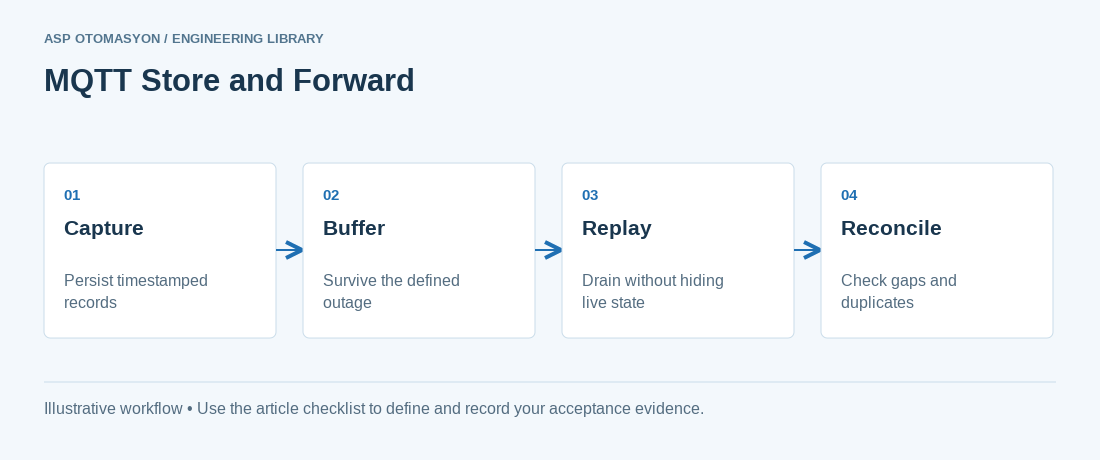\n\n*MQTT Store and Forward: Buffering Industrial Data Through Outages — Capture → Buffer → Replay → Reconcile.*\n\n## Design the requirement before the configuration\n\nDistinguish a broker session queue from an edge application’s durable local buffer. Specify what survives process restart and power loss, how full storage is handled, and whether new live data takes priority over replay. Assign each record a stable identity and retain its original timestamp. A downstream consumer should be able to detect gaps and apply an idempotent write policy where repeated delivery is possible. A retained MQTT message is a latest-value mechanism, not a history archive.\n\n## Worked scenario\n\nIllustrative capacity calculation: 50 records per second at an average 200 encoded bytes per record require 36 MB per hour before storage and protocol overhead. An eight-hour outage therefore needs at least 288 MB for payload alone. Measure actual disk usage, index overhead, and replay throughput; include headroom and an explicit full-buffer policy.\n\n## What to verify\n\n| Check | Evidence to record |\n| --- | --- |\n| Persistence | Test application restart and approved power-loss scenarios |\n| Capacity | Measure stored bytes and define a full-buffer policy |\n| Replay | Retain source time and expose replay progress |\n| Consumer | Detect missing IDs and tolerate expected duplicate delivery |\n\n## Acceptance and handover\n\nDisconnect the upstream path in a representative test, let the backlog grow, then restore it while new records continue arriving. Compare the sent and committed record identities. Measure catch-up time and confirm that operators can distinguish current readings from delayed history.\n\n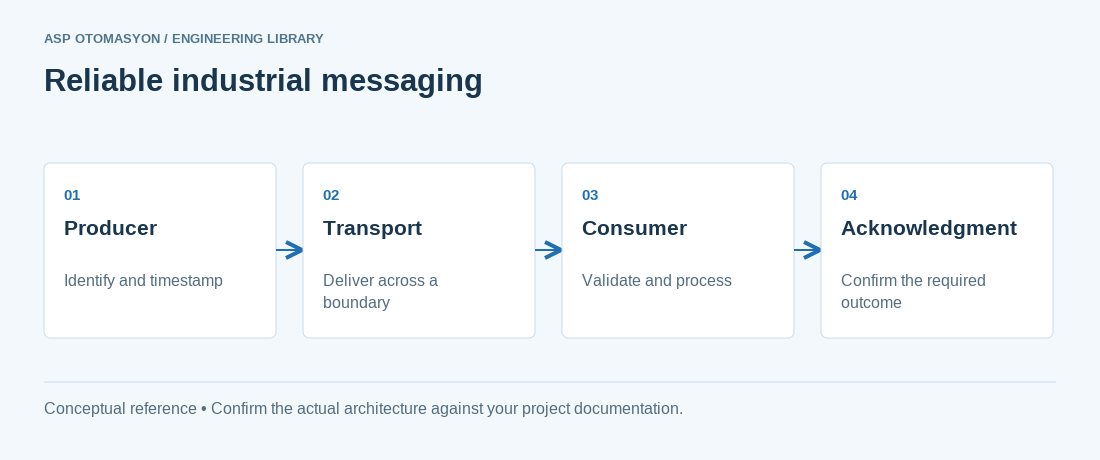\n\n*A generic industrial messaging path. A network or broker acknowledgment is not necessarily confirmation that a downstream business action succeeded.*\n\n## Continue the engineering work\n\nUse the [related technical library](https://wiki.aspotomasyon.com/category/modern-connectivity) for deeper background, or follow an [ASP project guide](https://wiki.aspotomasyon.com/guides) to plan the implementation sequence.\n\n## Primary references and further reading\n\nUse the original specifications and product documentation for implementation details. The examples in this guide are illustrative engineering scenarios, not published project results.\n\n- [OASIS — MQTT 5.0 specification](https://docs.oasis-open.org/mqtt/mqtt/v5.0/mqtt-v5.0.html)\n- [Modbus Organization — Protocol specifications](https://www.modbus.org/modbus-specifications)\n- [Eclipse Foundation — Sparkplug 3.0 specification](https://sparkplug.eclipse.org/specification/version/3.0/)\n\n---\n\nCite the canonical article: https://wiki.aspotomasyon.com/article/mqtt-store-and-forward-design (MQTT Store and Forward: Buffering Industrial Data Through Outages, ASP OTOMASYON, updated 2026-09-13).\n","headings":[{"id":"design-the-requirement-before-the-configuration","title":"Design the requirement before the configuration"},{"id":"worked-scenario","title":"Worked scenario"},{"id":"what-to-verify","title":"What to verify"},{"id":"acceptance-and-handover","title":"Acceptance and handover"},{"id":"continue-the-engineering-work","title":"Continue the engineering work"},{"id":"primary-references-and-further-reading","title":"Primary references and further reading"}],"faq":[],"references":[{"name":"OASIS — MQTT 5.0 specification","url":"https://docs.oasis-open.org/mqtt/mqtt/v5.0/mqtt-v5.0.html"},{"name":"Modbus Organization — Protocol specifications","url":"https://www.modbus.org/modbus-specifications"},{"name":"Eclipse Foundation — Sparkplug 3.0 specification","url":"https://sparkplug.eclipse.org/specification/version/3.0/"}],"related":[{"slug":"mqtt-sparkplug-industrial-iot-deep-dive","title":"MQTT and Sparkplug for Industrial IoT","summary":"MQTT (Message Queuing Telemetry Transport) has become the protocol of choice for Industrial IoT (IIoT) and edge-to-cloud communication, driven by its…","category":{"slug":"modern-connectivity","name":"Modern Connectivity"},"url":"https://wiki.aspotomasyon.com/article/mqtt-sparkplug-industrial-iot-deep-dive","markdown_url":"https://wiki.aspotomasyon.com/article/mqtt-sparkplug-industrial-iot-deep-dive.md","api_url":"https://wiki.aspotomasyon.com/api/v1/articles/mqtt-sparkplug-industrial-iot-deep-dive","published":"2026-05-13T12:07:53+00:00","modified":"2026-09-13T11:07:23+00:00","reading_minutes":11,"word_count":2258,"image":"https://wiki.aspotomasyon.com/assets/social/mqtt-sparkplug-industrial-iot-deep-dive-894e1ae141bf.png"},{"slug":"iiot-sensor-integration-patterns","title":"IIoT Sensor Integration Patterns","summary":"Integrating industrial sensors into an Industrial Internet of Things (IIoT) architecture requires careful selection of sensor technologies, communication…","category":{"slug":"digital-transformation","name":"Digital Transformation"},"url":"https://wiki.aspotomasyon.com/article/iiot-sensor-integration-patterns","markdown_url":"https://wiki.aspotomasyon.com/article/iiot-sensor-integration-patterns.md","api_url":"https://wiki.aspotomasyon.com/api/v1/articles/iiot-sensor-integration-patterns","published":"2026-05-12T12:47:31+00:00","modified":"2026-09-13T11:07:23+00:00","reading_minutes":5,"word_count":965,"image":"https://wiki.aspotomasyon.com/assets/social/iiot-sensor-integration-patterns-083cebd7e251.png"},{"slug":"mqtt-broker-deployment","title":"MQTT Broker Deployment and Hardening","summary":"MQTT is the de facto transport for industrial IoT telemetry: lightweight publish/subscribe over TCP, ideal for the many-to-many data flows of plant-to-cloud…","category":{"slug":"modern-connectivity","name":"Modern Connectivity"},"url":"https://wiki.aspotomasyon.com/article/mqtt-broker-deployment","markdown_url":"https://wiki.aspotomasyon.com/article/mqtt-broker-deployment.md","api_url":"https://wiki.aspotomasyon.com/api/v1/articles/mqtt-broker-deployment","published":"2026-08-11T13:05:24+00:00","modified":"2026-09-13T11:07:23+00:00","reading_minutes":4,"word_count":871,"image":"https://wiki.aspotomasyon.com/assets/social/mqtt-broker-deployment-4fdd84765a13.png"},{"slug":"opc-ua-cloud-integration","title":"OPC UA to Cloud Integration: Azure, AWS and Edge Gateways","summary":"Cloud platforms offer industrial organizations computing power, analytics, and collaboration that on-premises systems cannot match — but the plant floor speaks…","category":{"slug":"opc-solutions","name":"OPC Solutions"},"url":"https://wiki.aspotomasyon.com/article/opc-ua-cloud-integration","markdown_url":"https://wiki.aspotomasyon.com/article/opc-ua-cloud-integration.md","api_url":"https://wiki.aspotomasyon.com/api/v1/articles/opc-ua-cloud-integration","published":"2026-08-11T13:05:19+00:00","modified":"2026-09-13T11:07:23+00:00","reading_minutes":5,"word_count":931,"image":"https://wiki.aspotomasyon.com/assets/social/opc-ua-cloud-integration-d9523b7a18b7.png"}],"citation":"ASP OTOMASYON. MQTT Store and Forward: Buffering Industrial Data Through Outages. Updated 2026-09-13. https://wiki.aspotomasyon.com/article/mqtt-store-and-forward-design"}}