
A Modbus connection can return data successfully while the application reads the wrong value. Common causes include confusing reference numbers with protocol addresses, choosing the wrong function, applying the wrong data type, or decoding a multi-register value in the wrong order. Validate a register map before scaling up a polling configuration.
Treat the device manual as the authority for register meaning and access. Document the function code, protocol address, data width, signedness, scaling, unit, and any validity flag. A manual’s 40001-style holding-register notation is not necessarily the address a client expects you to enter. Modbus defines byte ordering within protocol fields, but how a vendor represents a 32-bit or 64-bit application value across registers must be confirmed for that device.
An illustrative device manual labels a holding register 40001 and states that its protocol address is zero. One client may ask for 40001 while another asks for offset 0; both can be correct under their own configuration conventions. Read a known value and compare it with the device display. For a floating-point pair, use a changing test value and the documented word order instead of accepting the first plausible number.
| Check | Evidence to record |
|---|---|
| Address | Record manual notation and actual protocol offset |
| Function | Distinguish coils, discrete inputs, input and holding registers |
| Representation | Width, signedness, byte/word order, scaling, and unit |
| Behavior | Confirm update rate, exception responses, and invalid states |
Begin with read-only values and a conservative polling load. Keep a small evidence table of raw registers and decoded results. Test zero, a known nonzero value, and a negative value where supported. Obtain explicit operational authorization before testing any write-capable register.

Use the related technical library for deeper background, or follow an ASP project guide to plan the implementation sequence.
Use the original specifications and product documentation for implementation details. The examples in this guide are illustrative engineering scenarios, not published project results.
","markdown":"# Modbus Register Maps: Addressing, Data Types, and Byte Order\n\n> A Modbus connection can return data successfully while the application reads the wrong value.\n\n- Canonical URL: https://wiki.aspotomasyon.com/article/modbus-register-map-validation\n- Publisher: ASP OTOMASYON A.Ş. (ASP OTOMASYON Wiki)\n- Category: Modern Connectivity\n- Published: 2026-09-13 · Updated: 2026-09-13\n- Reading time: 2 min · Language: English\n\nA Modbus connection can return data successfully while the application reads the wrong value. Common causes include confusing reference numbers with protocol addresses, choosing the wrong function, applying the wrong data type, or decoding a multi-register value in the wrong order. Validate a register map before scaling up a polling configuration.\n\n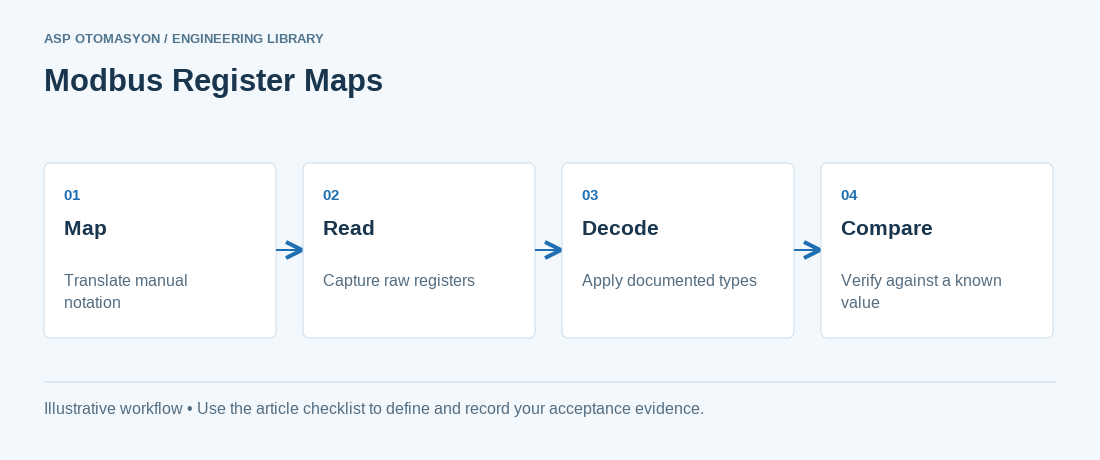\n\n*Modbus Register Maps: Addressing, Data Types, and Byte Order — Map → Read → Decode → Compare.*\n\n## Design the requirement before the configuration\n\nTreat the device manual as the authority for register meaning and access. Document the function code, protocol address, data width, signedness, scaling, unit, and any validity flag. A manual’s 40001-style holding-register notation is not necessarily the address a client expects you to enter. Modbus defines byte ordering within protocol fields, but how a vendor represents a 32-bit or 64-bit application value across registers must be confirmed for that device.\n\n## Worked scenario\n\nAn illustrative device manual labels a holding register 40001 and states that its protocol address is zero. One client may ask for 40001 while another asks for offset 0; both can be correct under their own configuration conventions. Read a known value and compare it with the device display. For a floating-point pair, use a changing test value and the documented word order instead of accepting the first plausible number.\n\n## What to verify\n\n| Check | Evidence to record |\n| --- | --- |\n| Address | Record manual notation and actual protocol offset |\n| Function | Distinguish coils, discrete inputs, input and holding registers |\n| Representation | Width, signedness, byte/word order, scaling, and unit |\n| Behavior | Confirm update rate, exception responses, and invalid states |\n\n## Acceptance and handover\n\nBegin with read-only values and a conservative polling load. Keep a small evidence table of raw registers and decoded results. Test zero, a known nonzero value, and a negative value where supported. Obtain explicit operational authorization before testing any write-capable register.\n\n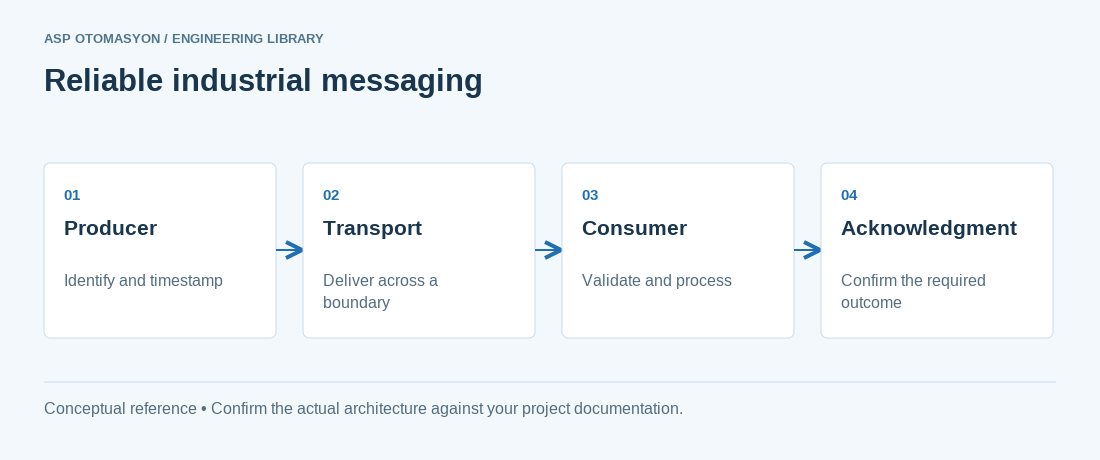\n\n*A generic industrial messaging path. A network or broker acknowledgment is not necessarily confirmation that a downstream business action succeeded.*\n\n## Continue the engineering work\n\nUse the [related technical library](https://wiki.aspotomasyon.com/category/modern-connectivity) for deeper background, or follow an [ASP project guide](https://wiki.aspotomasyon.com/guides) to plan the implementation sequence.\n\n## Primary references and further reading\n\nUse the original specifications and product documentation for implementation details. The examples in this guide are illustrative engineering scenarios, not published project results.\n\n- [Modbus Organization — Application Protocol Specification V1.1b3](https://www.modbus.org/docs/Modbus_Application_Protocol_V1_1b3.pdf)\n- [OASIS — MQTT 5.0 specification](https://docs.oasis-open.org/mqtt/mqtt/v5.0/mqtt-v5.0.html)\n- [Modbus Organization — Protocol specifications](https://www.modbus.org/modbus-specifications)\n- [Eclipse Foundation — Sparkplug 3.0 specification](https://sparkplug.eclipse.org/specification/version/3.0/)\n\n---\n\nCite the canonical article: https://wiki.aspotomasyon.com/article/modbus-register-map-validation (Modbus Register Maps: Addressing, Data Types, and Byte Order, ASP OTOMASYON, updated 2026-09-13).\n","headings":[{"id":"design-the-requirement-before-the-configuration","title":"Design the requirement before the configuration"},{"id":"worked-scenario","title":"Worked scenario"},{"id":"what-to-verify","title":"What to verify"},{"id":"acceptance-and-handover","title":"Acceptance and handover"},{"id":"continue-the-engineering-work","title":"Continue the engineering work"},{"id":"primary-references-and-further-reading","title":"Primary references and further reading"}],"faq":[],"references":[{"name":"Modbus Organization — Application Protocol Specification V1.1b3","url":"https://www.modbus.org/docs/Modbus_Application_Protocol_V1_1b3.pdf"},{"name":"OASIS — MQTT 5.0 specification","url":"https://docs.oasis-open.org/mqtt/mqtt/v5.0/mqtt-v5.0.html"},{"name":"Modbus Organization — Protocol specifications","url":"https://www.modbus.org/modbus-specifications"},{"name":"Eclipse Foundation — Sparkplug 3.0 specification","url":"https://sparkplug.eclipse.org/specification/version/3.0/"}],"related":[{"slug":"modbus-tcpip-protocol-deep-dive","title":"Modbus TCP/IP Protocol: Deep Dive","summary":"Modbus is the oldest and most widely deployed industrial communication protocol in the world.","category":{"slug":"modern-connectivity","name":"Modern Connectivity"},"url":"https://wiki.aspotomasyon.com/article/modbus-tcpip-protocol-deep-dive","markdown_url":"https://wiki.aspotomasyon.com/article/modbus-tcpip-protocol-deep-dive.md","api_url":"https://wiki.aspotomasyon.com/api/v1/articles/modbus-tcpip-protocol-deep-dive","published":"2026-05-13T12:07:53+00:00","modified":"2026-09-13T11:07:23+00:00","reading_minutes":10,"word_count":2192,"image":"https://wiki.aspotomasyon.com/assets/social/modbus-tcpip-protocol-deep-dive-c377f0d645c1.png"},{"slug":"protocol-gateway-patterns","title":"Protocol Gateway and Translation Patterns","summary":"No plant runs one protocol: Modbus coexists with PROFINET, EtherNet/IP with OPC UA, HART with MQTT — and the systems that need the data (SCADA, MES, cloud)…","category":{"slug":"modern-connectivity","name":"Modern Connectivity"},"url":"https://wiki.aspotomasyon.com/article/protocol-gateway-patterns","markdown_url":"https://wiki.aspotomasyon.com/article/protocol-gateway-patterns.md","api_url":"https://wiki.aspotomasyon.com/api/v1/articles/protocol-gateway-patterns","published":"2026-08-11T13:05:24+00:00","modified":"2026-09-13T11:07:23+00:00","reading_minutes":4,"word_count":871,"image":"https://wiki.aspotomasyon.com/assets/social/protocol-gateway-patterns-48062598cdfb.png"},{"slug":"plc-to-scada-communication-setup","title":"Connecting PLCs to SCADA: Communication Setup Guide","summary":"Connecting PLCs to SCADA is the integration task at the heart of most industrial monitoring projects.","category":{"slug":"technical-guides","name":"Technical Guides"},"url":"https://wiki.aspotomasyon.com/article/plc-to-scada-communication-setup","markdown_url":"https://wiki.aspotomasyon.com/article/plc-to-scada-communication-setup.md","api_url":"https://wiki.aspotomasyon.com/api/v1/articles/plc-to-scada-communication-setup","published":"2026-08-06T12:26:37+00:00","modified":"2026-09-13T11:07:23+00:00","reading_minutes":5,"word_count":936,"image":"https://wiki.aspotomasyon.com/assets/social/plc-to-scada-communication-setup-83b2e771588c.png"},{"slug":"kepware-driver-selection-architecture","title":"Kepware Driver Selection and Channel/Tag Architecture","summary":"KEPServerEX is the most widely deployed industrial connectivity platform: it converts dozens of native protocols — Siemens, Allen-Bradley, Modbus, DNP3…","category":{"slug":"opc-solutions","name":"OPC Solutions"},"url":"https://wiki.aspotomasyon.com/article/kepware-driver-selection-architecture","markdown_url":"https://wiki.aspotomasyon.com/article/kepware-driver-selection-architecture.md","api_url":"https://wiki.aspotomasyon.com/api/v1/articles/kepware-driver-selection-architecture","published":"2026-08-11T13:05:19+00:00","modified":"2026-09-13T11:07:23+00:00","reading_minutes":5,"word_count":921,"image":"https://wiki.aspotomasyon.com/assets/social/kepware-driver-selection-architecture-22591e1f10b4.png"}],"citation":"ASP OTOMASYON. Modbus Register Maps: Addressing, Data Types, and Byte Order. Updated 2026-09-13. https://wiki.aspotomasyon.com/article/modbus-register-map-validation"}}