
Downtime reason codes turn machine-state observations into explanations that production teams can act on. The taxonomy must be small enough to use consistently and specific enough to distinguish different losses. Define the timing and ownership rules as carefully as the code labels.
Separate the detected machine state from the attributed reason. A stopped bit does not identify whether the cause is a fault, lack of material, changeover, or scheduled inactivity. Decide how short stops, overlapping causes, planned time, and operator corrections are handled. Preserve the original event timeline and the audit trail of reclassification. Use the same definitions across shifts before comparing lines or sites.
In an illustrative ten-minute stoppage, material starvation occupies the first six minutes and a machine fault the next four. Assigning the entire event to whichever reason was entered last hides the change. Choose an explicit splitting or primary-cause policy and apply it consistently. The correct approach depends on the decisions the report is intended to support.
| Check | Evidence to record |
|---|---|
| Detection | Start/end rules, source quality, and minimum event duration |
| Attribution | Reason hierarchy, ownership, and unknown-state handling |
| Correction | Who may edit, required context, and preserved audit trail |
| Review | Unknown share, recurrent causes, and actions with owners |
Pilot the codes with operators and compare automatic event timing with observed production. Review frequently selected generic codes and unresolved events. Do not force a guessed reason merely to complete a report; an explicit unknown can reveal a measurement or workflow problem that needs attention.

Use the related technical library for deeper background, or follow an ASP project guide to plan the implementation sequence.
Use the original specifications and product documentation for implementation details. The examples in this guide are illustrative engineering scenarios, not published project results.
","markdown":"# MES Downtime Reason Codes: Making Loss Data Useful to Operations\n\n> Downtime reason codes turn machine-state observations into explanations that production teams can act on.\n\n- Canonical URL: https://wiki.aspotomasyon.com/article/mes-downtime-reason-codes\n- Publisher: ASP OTOMASYON A.Ş. (ASP OTOMASYON Wiki)\n- Category: Digital Transformation\n- Published: 2026-09-13 · Updated: 2026-09-13\n- Reading time: 2 min · Language: English\n\nDowntime reason codes turn machine-state observations into explanations that production teams can act on. The taxonomy must be small enough to use consistently and specific enough to distinguish different losses. Define the timing and ownership rules as carefully as the code labels.\n\n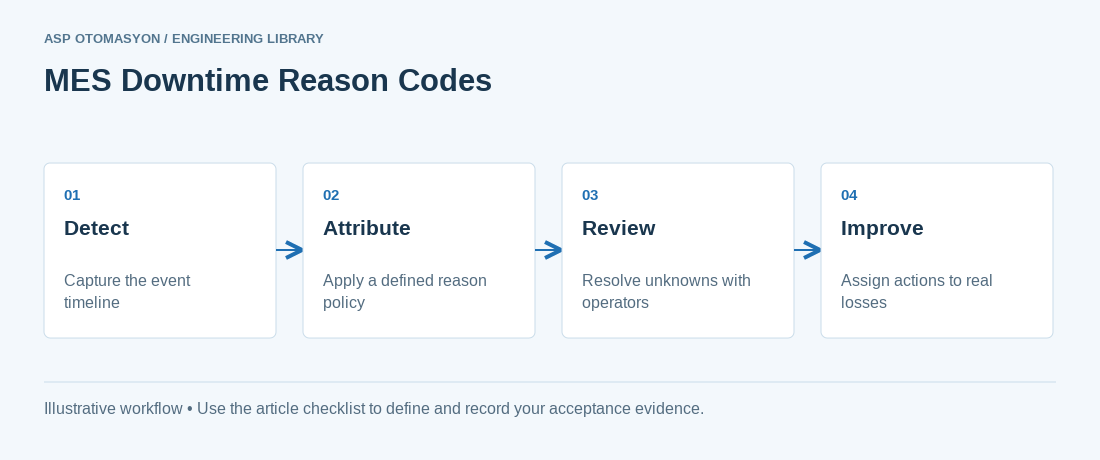\n\n*MES Downtime Reason Codes: Making Loss Data Useful to Operations — Detect → Attribute → Review → Improve.*\n\n## Design the requirement before the configuration\n\nSeparate the detected machine state from the attributed reason. A stopped bit does not identify whether the cause is a fault, lack of material, changeover, or scheduled inactivity. Decide how short stops, overlapping causes, planned time, and operator corrections are handled. Preserve the original event timeline and the audit trail of reclassification. Use the same definitions across shifts before comparing lines or sites.\n\n## Worked scenario\n\nIn an illustrative ten-minute stoppage, material starvation occupies the first six minutes and a machine fault the next four. Assigning the entire event to whichever reason was entered last hides the change. Choose an explicit splitting or primary-cause policy and apply it consistently. The correct approach depends on the decisions the report is intended to support.\n\n## What to verify\n\n| Check | Evidence to record |\n| --- | --- |\n| Detection | Start/end rules, source quality, and minimum event duration |\n| Attribution | Reason hierarchy, ownership, and unknown-state handling |\n| Correction | Who may edit, required context, and preserved audit trail |\n| Review | Unknown share, recurrent causes, and actions with owners |\n\n## Acceptance and handover\n\nPilot the codes with operators and compare automatic event timing with observed production. Review frequently selected generic codes and unresolved events. Do not force a guessed reason merely to complete a report; an explicit unknown can reveal a measurement or workflow problem that needs attention.\n\n\n\n*An industrial data workflow. Each handoff needs an owner and a documented data contract; collecting more signals alone does not establish business value.*\n\n## Continue the engineering work\n\nUse the [related technical library](https://wiki.aspotomasyon.com/category/digital-transformation) for deeper background, or follow an [ASP project guide](https://wiki.aspotomasyon.com/guides) to plan the implementation sequence.\n\n## Primary references and further reading\n\nUse the original specifications and product documentation for implementation details. The examples in this guide are illustrative engineering scenarios, not published project results.\n\n- [ISA — ISA-95 enterprise/control system integration](https://www.isa.org/standards-and-publications/isa-standards/isa-95-standard)\n- [OPC Foundation — Information modelling](https://opcfoundation.org/about/opc-technologies/opc-ua/)\n\n---\n\nCite the canonical article: https://wiki.aspotomasyon.com/article/mes-downtime-reason-codes (MES Downtime Reason Codes: Making Loss Data Useful to Operations, ASP OTOMASYON, updated 2026-09-13).\n","headings":[{"id":"design-the-requirement-before-the-configuration","title":"Design the requirement before the configuration"},{"id":"worked-scenario","title":"Worked scenario"},{"id":"what-to-verify","title":"What to verify"},{"id":"acceptance-and-handover","title":"Acceptance and handover"},{"id":"continue-the-engineering-work","title":"Continue the engineering work"},{"id":"primary-references-and-further-reading","title":"Primary references and further reading"}],"faq":[],"references":[{"name":"ISA — ISA-95 enterprise/control system integration","url":"https://www.isa.org/standards-and-publications/isa-standards/isa-95-standard"},{"name":"OPC Foundation — Information modelling","url":"https://opcfoundation.org/about/opc-technologies/opc-ua/"}],"related":[{"slug":"iso-22400-manufacturing-kpis","title":"ISO 22400 Manufacturing KPIs: Definitions, Time Models, and OEE","summary":"Two sites can report the same OEE and mean different things, so a standard vocabulary, formulas, and time model must be fixed before any comparison is made.","category":{"slug":"digital-transformation","name":"Digital Transformation"},"url":"https://wiki.aspotomasyon.com/article/iso-22400-manufacturing-kpis","markdown_url":"https://wiki.aspotomasyon.com/article/iso-22400-manufacturing-kpis.md","api_url":"https://wiki.aspotomasyon.com/api/v1/articles/iso-22400-manufacturing-kpis","published":"2026-10-11T11:46:21+00:00","modified":"2026-10-11T11:46:21+00:00","reading_minutes":9,"word_count":1833,"image":"https://wiki.aspotomasyon.com/assets/social/iso-22400-manufacturing-kpis-db5807fb3c80.png"},{"slug":"packml-machine-state-model-omac","title":"PackML Machine State Model: Modes, States, and Tags","summary":"PackML gives packaging machines one unit mode model, one standard state model, and standard tags, so a line controller can command and read every machine the…","category":{"slug":"automation-systems","name":"Automation Systems"},"url":"https://wiki.aspotomasyon.com/article/packml-machine-state-model-omac","markdown_url":"https://wiki.aspotomasyon.com/article/packml-machine-state-model-omac.md","api_url":"https://wiki.aspotomasyon.com/api/v1/articles/packml-machine-state-model-omac","published":"2026-10-11T11:46:21+00:00","modified":"2026-10-11T11:46:21+00:00","reading_minutes":9,"word_count":1906,"image":"https://wiki.aspotomasyon.com/assets/social/packml-machine-state-model-omac-762e3ee18199.png"},{"slug":"oee-methodology-implementation","title":"OEE: Methodology, Calculation and Implementation Pitfalls","summary":"Overall Equipment Effectiveness (OEE) is the standard metric of manufacturing productivity: it combines availability, performance, and quality into one number…","category":{"slug":"digital-transformation","name":"Digital Transformation"},"url":"https://wiki.aspotomasyon.com/article/oee-methodology-implementation","markdown_url":"https://wiki.aspotomasyon.com/article/oee-methodology-implementation.md","api_url":"https://wiki.aspotomasyon.com/api/v1/articles/oee-methodology-implementation","published":"2026-08-11T13:05:19+00:00","modified":"2026-09-13T11:07:23+00:00","reading_minutes":5,"word_count":920,"image":"https://wiki.aspotomasyon.com/assets/social/oee-methodology-implementation-708d3413bca6.png"},{"slug":"plc-programming-best-practices","title":"PLC Programming Best Practices","summary":"Writing reliable, maintainable PLC code is critical for industrial automation systems that must operate 24/7 in harsh environments.","category":{"slug":"automation-systems","name":"Automation Systems"},"url":"https://wiki.aspotomasyon.com/article/plc-programming-best-practices","markdown_url":"https://wiki.aspotomasyon.com/article/plc-programming-best-practices.md","api_url":"https://wiki.aspotomasyon.com/api/v1/articles/plc-programming-best-practices","published":"2026-05-12T12:47:31+00:00","modified":"2026-09-13T11:07:23+00:00","reading_minutes":5,"word_count":1097,"image":"https://wiki.aspotomasyon.com/assets/social/plc-programming-best-practices-d3e7ade0882c.png"}],"citation":"ASP OTOMASYON. MES Downtime Reason Codes: Making Loss Data Useful to Operations. Updated 2026-09-13. https://wiki.aspotomasyon.com/article/mes-downtime-reason-codes"}}