
A Distributed Control System (DCS) is an automated control system used in process industries where the controller elements are distributed throughout the system rather than centralized in a single location. DCS platforms are the backbone of continuous and batch process control in industries such as oil & gas, chemical manufacturing, power generation, water treatment, and pharmaceuticals.
A modern DCS architecture is organized into several distinct layers, each serving a specific function in the control hierarchy:
\n\nDCS controllers are purpose-built industrial computers designed for deterministic execution of control strategies. Unlike general-purpose PLCs, DCS controllers are optimized for continuous process control with built-in redundancy (hot-standby pairs), automatic failover, and loop-tuning capabilities. Major DCS platforms include ABB Ability System 800xA, Emerson DeltaV, Honeywell Experion PKS, and Siemens SIMATIC PCS 7 and SIMATIC PCS neo.
\n\nInput/Output modules bridge the gap between field instruments and controllers. They handle analog signals (4–20 mA, 0–10 V), digital signals (24 VDC discrete), and increasingly smart fieldbus protocols such as HART, FOUNDATION Fieldbus, and PROFIBUS PA. Modern DCS I/O supports Electronic Marshalling, which eliminates the need for physical cross-wiring and dramatically reduces engineering time.
\n\nThe HMI provides operators with real-time visualization of the process. DCS HMIs follow ISA-101 design principles with high-performance graphics, alarm management per ISA-18.2, and trend displays. ASP OTOMASYON specializes in designing operator interfaces that reduce cognitive load and improve situational awareness.
\n\nEngineering workstations are used to configure control strategies, tune loop parameters, manage alarms, and deploy software updates. They typically support IEC 61131-3 programming languages as well as vendor-specific function block libraries.
\n\nWhile both DCS and PLC-based systems can control industrial processes, they are designed for different primary use cases:
\n\n| Feature | DCS | PLC + SCADA |
|---|---|---|
| Primary Use Case | Continuous/batch process control | Discrete manufacturing, machine control |
| Loop Count | Hundreds to thousands of PID loops | Tens to hundreds of loops |
| Redundancy | Built-in (controller, network, power) | Optional, added at extra cost |
| Scalability | Designed for plant-wide expansion | Modular but requires integration effort |
| Engineering Environment | Integrated single-platform engineering | Separate PLC programming + HMI/SCADA |
| Alarm Management | ISA-18.2 compliant, built-in | Requires SCADA-level implementation |
| Typical Scan Rate | 50–500 ms (process-optimized) | 1–100 ms (high-speed discrete) |
| Cost per I/O Point | Higher (includes integrated features) | Lower (basic hardware) |
DCS platforms excel in environments that demand high availability, complex analog control, and integrated safety systems:
\n\nASP OTOMASYON A.S. has extensive experience deploying and maintaining DCS solutions across Turkey and the surrounding region. ASP provides DCS installation, PLC/DCS programming, upgrade, and service support; agree the project scope and platform requirements with the engineering team. We specialize in DCS migration projects — helping facilities upgrade legacy control systems to modern platforms while minimizing production downtime.
\n\nFor process industries seeking reliability, scalability, and integrated safety, a well-designed DCS remains the gold standard for plant-wide automation.
Compare the delivered engineering environment, alarm handling, historian integration, lifecycle support, and recovery procedures alongside controller hardware. DCS and PLC/SCADA capabilities overlap: loop count, scan rate, redundancy, and cost depend on the selected products and configuration. Treat any broad comparison table as a starting point, then request an application-specific design and demonstration.
Continue with the related practical guide.
Follow an ASP project guide to connect the fundamentals with implementation and acceptance.

Use the original specifications and product documentation for implementation details. The examples in this guide are illustrative engineering scenarios, not published project results.
","markdown":"# Introduction to Distributed Control Systems (DCS)\n\n> A Distributed Control System (DCS) is an automated control system used in process industries where the controller elements are distributed throughout the…\n\n- Canonical URL: https://wiki.aspotomasyon.com/article/introduction-to-distributed-control-systems-dcs\n- Publisher: ASP OTOMASYON A.Ş. (ASP OTOMASYON Wiki)\n- Category: Automation Systems\n- Published: 2026-05-12 · Updated: 2026-09-13\n- Reading time: 5 min · Language: English\n\nA **Distributed Control System (DCS)** is an automated control system used in process industries where the controller elements are distributed throughout the system rather than centralized in a single location. DCS platforms are the backbone of continuous and batch process control in industries such as oil & gas, chemical manufacturing, power generation, water treatment, and pharmaceuticals.\n\n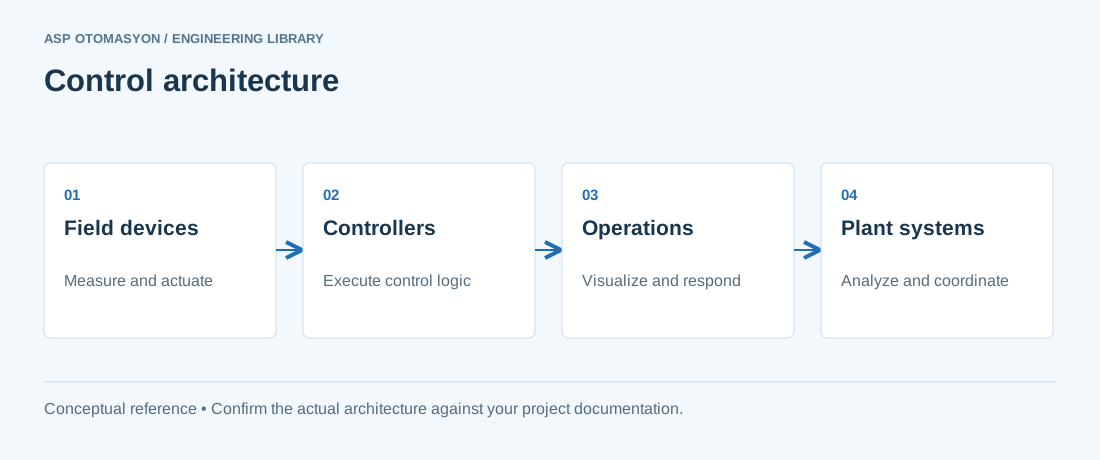\n\n*Conceptual control-system layers. Safety functions, communication paths, and redundancy must be designed for the application; the diagram is not a wiring or safety design.*\n\n## Architecture Overview\n\nA modern DCS architecture is organized into several distinct layers, each serving a specific function in the control hierarchy:\n\n- **Field Level** — Sensors, transmitters, and final control elements (valves, motors) that interact directly with the physical process.\n- **Control Level** — Distributed controllers and I/O modules that execute real-time control logic, typically with scan rates of 50–500 ms.\n- **Supervisory Level** — Human-Machine Interface (HMI) stations, engineering workstations, and historian servers.\n- **Enterprise Level** — Integration with ERP, MES, and business intelligence systems via OPC UA or REST APIs.\n\n## Core Components\n\n### Controllers\n\nDCS controllers are purpose-built industrial computers designed for deterministic execution of control strategies. Unlike general-purpose PLCs, DCS controllers are optimized for continuous process control with built-in redundancy (hot-standby pairs), automatic failover, and loop-tuning capabilities. Major DCS platforms include ABB Ability System 800xA, Emerson DeltaV, Honeywell Experion PKS, and Siemens SIMATIC PCS 7 and SIMATIC PCS neo.\n\n### I/O Modules\n\nInput/Output modules bridge the gap between field instruments and controllers. They handle analog signals (4–20 mA, 0–10 V), digital signals (24 VDC discrete), and increasingly smart fieldbus protocols such as HART, FOUNDATION Fieldbus, and PROFIBUS PA. Modern DCS I/O supports **Electronic Marshalling**, which eliminates the need for physical cross-wiring and dramatically reduces engineering time.\n\n### Human-Machine Interface (HMI)\n\nThe HMI provides operators with real-time visualization of the process. DCS HMIs follow ISA-101 design principles with high-performance graphics, alarm management per ISA-18.2, and trend displays. ASP OTOMASYON specializes in designing operator interfaces that reduce cognitive load and improve situational awareness.\n\n### Engineering Stations\n\nEngineering workstations are used to configure control strategies, tune loop parameters, manage alarms, and deploy software updates. They typically support IEC 61131-3 programming languages as well as vendor-specific function block libraries.\n\n## DCS vs. PLC Systems\n\nWhile both DCS and PLC-based systems can control industrial processes, they are designed for different primary use cases:\n\n| Feature | DCS | PLC + SCADA |\n| --- | --- | --- |\n| Primary Use Case | Continuous/batch process control | Discrete manufacturing, machine control |\n| Loop Count | Hundreds to thousands of PID loops | Tens to hundreds of loops |\n| Redundancy | Built-in (controller, network, power) | Optional, added at extra cost |\n| Scalability | Designed for plant-wide expansion | Modular but requires integration effort |\n| Engineering Environment | Integrated single-platform engineering | Separate PLC programming + HMI/SCADA |\n| Alarm Management | ISA-18.2 compliant, built-in | Requires SCADA-level implementation |\n| Typical Scan Rate | 50–500 ms (process-optimized) | 1–100 ms (high-speed discrete) |\n| Cost per I/O Point | Higher (includes integrated features) | Lower (basic hardware) |\n\n## Use Cases in Process Industries\n\nDCS platforms excel in environments that demand high availability, complex analog control, and integrated safety systems:\n\n1. **Oil & Gas Refineries** — Crude distillation unit control, hydrocracking, and blending optimization with thousands of PID loops.\n2. **Power Generation** — Boiler control, turbine supervisory control, and balance-of-plant operations in thermal and combined-cycle plants.\n3. **Chemical Processing** — Batch recipe management, reactor temperature control, and safety instrumented systems (SIS) integration.\n4. **Water & Wastewater** — Pump station control, treatment process automation, and remote telemetry across distributed assets.\n\n## ASP OTOMASYON DCS Expertise\n\nASP OTOMASYON A.S. has extensive experience deploying and maintaining DCS solutions across Turkey and the surrounding region. ASP provides DCS installation, PLC/DCS programming, upgrade, and service support; agree the project scope and platform requirements with the engineering team. We specialize in **DCS migration projects** — helping facilities upgrade legacy control systems to modern platforms while minimizing production downtime.\n\n> For process industries seeking reliability, scalability, and integrated safety, a well-designed DCS remains the gold standard for plant-wide automation.\n\n---\n\n## References & Further Reading\n\n1. [ISA-101.01 Human-Machine Interfaces for Process Automation Systems](https://www.isa.org/standards-and-publications/isa-standards/isa-101-standards) — Official standard for HMI design in process industries, directly applicable to DCS operator interfaces.\n2. [ISA-18.2 Management of Alarm Systems for the Process Industries](https://www.isa.org/standards-and-publications/isa-standards/isa-18-series-of-standards) — Standard for alarm management in DCS environments, specifying lifecycle, design, and performance metrics.\n3. [ABB Ability System 800xA — Distributed Control System](https://new.abb.com/control-systems/system-800xa) — Official product page for ABB's flagship DCS platform, covering architecture, features, and specifications.\n4. [Emerson DeltaV DCS Platform](https://www.emerson.com/en/automation-systems/deltav) — Official documentation for Emerson's distributed control system, including architecture, I/O subsystems, and batch capabilities.\n5. [Honeywell Experion PKS — Process Knowledge System](https://process.honeywell.com/us/en/solutions/experion-pks) — Official product information for Honeywell's DCS platform with integrated safety and asset management.\n6. [IEC 61131-3: Programmable Controllers — Programming Languages](https://www.iec.ch) — International standard defining the five programming languages supported by modern DCS engineering environments.\n\n## Evaluate the complete operating system\n\nCompare the delivered engineering environment, alarm handling, historian integration, lifecycle support, and recovery procedures alongside controller hardware. DCS and PLC/SCADA capabilities overlap: loop count, scan rate, redundancy, and cost depend on the selected products and configuration. Treat any broad comparison table as a starting point, then request an application-specific design and demonstration.\n\nContinue with [the related practical guide](https://wiki.aspotomasyon.com/article/control-system-modernization-retrofit).\n\n## Apply this to your project\n\n- Define the process states, timing requirements, and permitted behavior after a controller or communication failure.\n- List controller, I/O, network, software, and license dependencies before choosing an architecture.\n- Record acceptance results and prove that the delivered configuration can be restored from the handover package.\n\n[Follow an ASP project guide](https://wiki.aspotomasyon.com/guides) to connect the fundamentals with implementation and acceptance.\n\n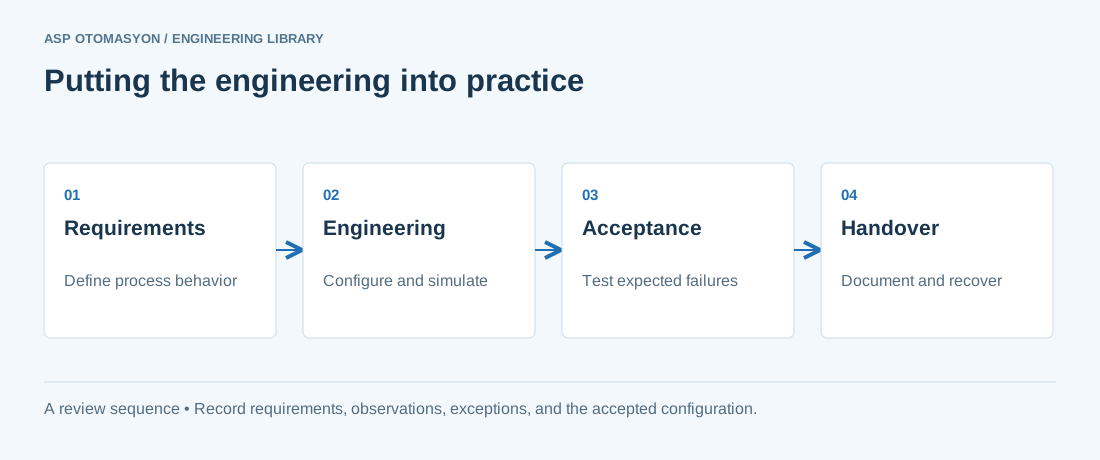\n\n*Engineering review sequence: Requirements → Engineering → Acceptance → Handover. Keep the recorded evidence with the accepted configuration.*\n\n## Primary references and further reading\n\nUse the original specifications and product documentation for implementation details. The examples in this guide are illustrative engineering scenarios, not published project results.\n\n- [NIST SP 800-82 Rev. 3 — OT architecture and security guidance](https://csrc.nist.gov/pubs/sp/800/82/r3/final)\n\n---\n\nCite the canonical article: https://wiki.aspotomasyon.com/article/introduction-to-distributed-control-systems-dcs (Introduction to Distributed Control Systems (DCS), ASP OTOMASYON, updated 2026-09-13).\n","headings":[{"id":"architecture-overview","title":"Architecture Overview"},{"id":"core-components","title":"Core Components"},{"id":"dcs-vs-plc-systems","title":"DCS vs. PLC Systems"},{"id":"use-cases-in-process-industries","title":"Use Cases in Process Industries"},{"id":"asp-otomasyon-dcs-expertise","title":"ASP OTOMASYON DCS Expertise"},{"id":"references-further-reading","title":"References & Further Reading"},{"id":"evaluate-the-complete-operating-system","title":"Evaluate the complete operating system"},{"id":"apply-this-to-your-project","title":"Apply this to your project"},{"id":"primary-references-and-further-reading","title":"Primary references and further reading"}],"faq":[],"references":[{"name":"ISA-101.01 Human-Machine Interfaces for Process Automation Systems","url":"https://www.isa.org/standards-and-publications/isa-standards/isa-101-standards"},{"name":"ISA-18.2 Management of Alarm Systems for the Process Industries","url":"https://www.isa.org/standards-and-publications/isa-standards/isa-18-series-of-standards"},{"name":"ABB Ability System 800xA — Distributed Control System","url":"https://new.abb.com/control-systems/system-800xa"},{"name":"Emerson DeltaV DCS Platform","url":"https://www.emerson.com/en/automation-systems/deltav"},{"name":"Honeywell Experion PKS — Process Knowledge System","url":"https://process.honeywell.com/us/en/solutions/experion-pks"},{"name":"IEC 61131-3: Programmable Controllers — Programming Languages","url":"https://www.iec.ch"},{"name":"NIST SP 800-82 Rev. 3 — OT architecture and security guidance","url":"https://csrc.nist.gov/pubs/sp/800/82/r3/final"}],"related":[{"slug":"dcs-vs-plc-selection-guide","title":"DCS vs. PLC — A Comprehensive Selection Guide for Process Applications","summary":"Selecting the right control platform is one of the most consequential decisions in any industrial automation project.","category":{"slug":"automation-systems","name":"Automation Systems"},"url":"https://wiki.aspotomasyon.com/article/dcs-vs-plc-selection-guide","markdown_url":"https://wiki.aspotomasyon.com/article/dcs-vs-plc-selection-guide.md","api_url":"https://wiki.aspotomasyon.com/api/v1/articles/dcs-vs-plc-selection-guide","published":"2026-05-13T11:58:29+00:00","modified":"2026-09-13T11:07:23+00:00","reading_minutes":7,"word_count":1414,"image":"https://wiki.aspotomasyon.com/assets/social/dcs-vs-plc-selection-guide-5527026a81d5.png"},{"slug":"scada-system-architecture-design-patterns","title":"SCADA System Architecture and Design Patterns","summary":"Supervisory Control and Data Acquisition (SCADA) systems form the backbone of modern industrial monitoring and control.","category":{"slug":"automation-systems","name":"Automation Systems"},"url":"https://wiki.aspotomasyon.com/article/scada-system-architecture-design-patterns","markdown_url":"https://wiki.aspotomasyon.com/article/scada-system-architecture-design-patterns.md","api_url":"https://wiki.aspotomasyon.com/api/v1/articles/scada-system-architecture-design-patterns","published":"2026-05-13T12:07:53+00:00","modified":"2026-09-13T11:07:23+00:00","reading_minutes":9,"word_count":1887,"image":"https://wiki.aspotomasyon.com/assets/social/scada-system-architecture-design-patterns-d28081d36299.png"},{"slug":"data-historian-selection-deployment","title":"Data Historian Selection and Deployment","summary":"A data historian is the long-term memory of an industrial plant. Where a PLC or SCADA system keeps live values in memory, a historian collects time-stamped…","category":{"slug":"digital-transformation","name":"Digital Transformation"},"url":"https://wiki.aspotomasyon.com/article/data-historian-selection-deployment","markdown_url":"https://wiki.aspotomasyon.com/article/data-historian-selection-deployment.md","api_url":"https://wiki.aspotomasyon.com/api/v1/articles/data-historian-selection-deployment","published":"2026-08-06T12:26:37+00:00","modified":"2026-09-13T11:07:23+00:00","reading_minutes":5,"word_count":954,"image":"https://wiki.aspotomasyon.com/assets/social/data-historian-selection-deployment-9daadd28e9f8.png"},{"slug":"ethercat-fundamentals-distributed-clocks","title":"EtherCAT Fundamentals: Frames, Topology, and Distributed Clocks","summary":"EtherCAT sends frames that each device reads and writes as they pass, so cycle time, topology, and clock synchronization become engineering decisions you can…","category":{"slug":"modern-connectivity","name":"Modern Connectivity"},"url":"https://wiki.aspotomasyon.com/article/ethercat-fundamentals-distributed-clocks","markdown_url":"https://wiki.aspotomasyon.com/article/ethercat-fundamentals-distributed-clocks.md","api_url":"https://wiki.aspotomasyon.com/api/v1/articles/ethercat-fundamentals-distributed-clocks","published":"2026-10-11T11:46:21+00:00","modified":"2026-10-11T11:46:21+00:00","reading_minutes":9,"word_count":1796,"image":"https://wiki.aspotomasyon.com/assets/social/ethercat-fundamentals-distributed-clocks-a86776332437.png"}],"citation":"ASP OTOMASYON. Introduction to Distributed Control Systems (DCS). Updated 2026-09-13. https://wiki.aspotomasyon.com/article/introduction-to-distributed-control-systems-dcs"}}