
A time-synchronization plan defines how accurately different systems must agree and what happens when they do not. Historians, alarms, gateways, and analytics depend on time for different reasons. Choose the architecture from those requirements instead of assuming that every device needs the same protocol or precision.
Inventory clock sources, time zones, timestamp generation points, and each system’s synchronization capabilities. NTP is commonly used for general network time; PTP can support tighter synchronization in suitable systems, but results depend on supported profiles, hardware timestamping, and network design. Specify observed offset and holdover expectations rather than quoting a protocol name as a performance guarantee. Store and exchange unambiguous timestamps, commonly UTC, while presenting local time with a clear zone.
Consider an illustrative alarm investigation in which a PLC timestamp and a SCADA arrival timestamp differ by two seconds. The difference may include clock offset, source acquisition, queueing, and network delay. Do not infer the event order from displayed seconds alone. Identify where each timestamp was created and compare independently measured clock behavior.
| Check | Evidence to record |
|---|---|
| Requirement | Accuracy, event ordering, and allowed holdover |
| Architecture | Approved sources, boundaries, profiles, and dependencies |
| Observation | Offset, synchronization state, and source changes |
| Failure | Loss of source, restart, leap handling, and clock correction behavior |
Test loss and recovery of the selected time source in a representative environment. Confirm that logs reveal synchronization failures and that applications handle time correction without creating misleading intervals. Document who owns the time infrastructure and how changes are communicated to OT consumers.

Use the related technical library for deeper background, or follow an ASP project guide to plan the implementation sequence.
Use the original specifications and product documentation for implementation details. The examples in this guide are illustrative engineering scenarios, not published project results.
","markdown":"# Industrial Time Synchronization: A Practical NTP and PTP Plan\n\n> A time-synchronization plan defines how accurately different systems must agree and what happens when they do not.\n\n- Canonical URL: https://wiki.aspotomasyon.com/article/industrial-time-synchronization-plan\n- Publisher: ASP OTOMASYON A.Ş. (ASP OTOMASYON Wiki)\n- Category: Modern Connectivity\n- Published: 2026-09-13 · Updated: 2026-09-13\n- Reading time: 2 min · Language: English\n\nA time-synchronization plan defines how accurately different systems must agree and what happens when they do not. Historians, alarms, gateways, and analytics depend on time for different reasons. Choose the architecture from those requirements instead of assuming that every device needs the same protocol or precision.\n\n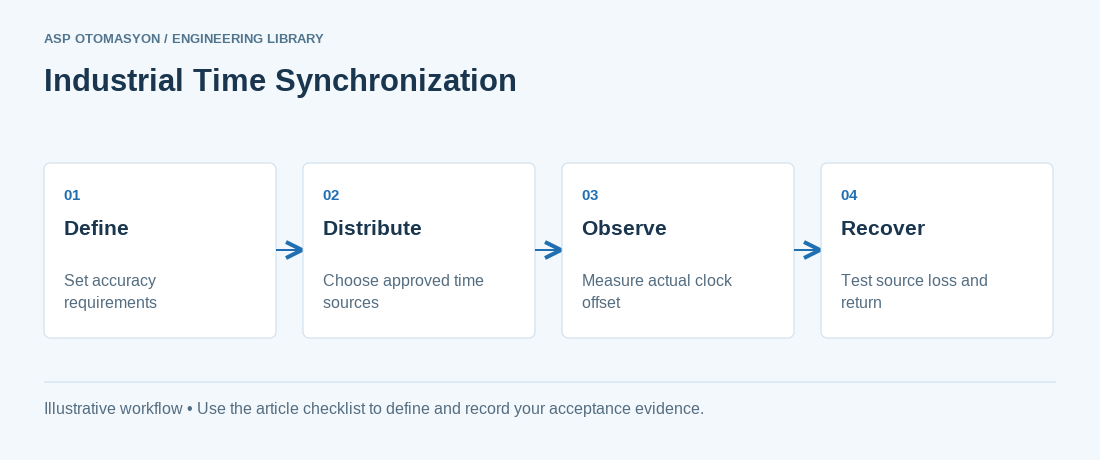\n\n*Industrial Time Synchronization: A Practical NTP and PTP Plan — Define → Distribute → Observe → Recover.*\n\n## Design the requirement before the configuration\n\nInventory clock sources, time zones, timestamp generation points, and each system’s synchronization capabilities. NTP is commonly used for general network time; PTP can support tighter synchronization in suitable systems, but results depend on supported profiles, hardware timestamping, and network design. Specify observed offset and holdover expectations rather than quoting a protocol name as a performance guarantee. Store and exchange unambiguous timestamps, commonly UTC, while presenting local time with a clear zone.\n\n## Worked scenario\n\nConsider an illustrative alarm investigation in which a PLC timestamp and a SCADA arrival timestamp differ by two seconds. The difference may include clock offset, source acquisition, queueing, and network delay. Do not infer the event order from displayed seconds alone. Identify where each timestamp was created and compare independently measured clock behavior.\n\n## What to verify\n\n| Check | Evidence to record |\n| --- | --- |\n| Requirement | Accuracy, event ordering, and allowed holdover |\n| Architecture | Approved sources, boundaries, profiles, and dependencies |\n| Observation | Offset, synchronization state, and source changes |\n| Failure | Loss of source, restart, leap handling, and clock correction behavior |\n\n## Acceptance and handover\n\nTest loss and recovery of the selected time source in a representative environment. Confirm that logs reveal synchronization failures and that applications handle time correction without creating misleading intervals. Document who owns the time infrastructure and how changes are communicated to OT consumers.\n\n\n\n*A generic industrial messaging path. A network or broker acknowledgment is not necessarily confirmation that a downstream business action succeeded.*\n\n## Continue the engineering work\n\nUse the [related technical library](https://wiki.aspotomasyon.com/category/modern-connectivity) for deeper background, or follow an [ASP project guide](https://wiki.aspotomasyon.com/guides) to plan the implementation sequence.\n\n## Primary references and further reading\n\nUse the original specifications and product documentation for implementation details. The examples in this guide are illustrative engineering scenarios, not published project results.\n\n- [IETF — RFC 5905: Network Time Protocol Version 4](https://www.rfc-editor.org/rfc/rfc5905)\n- [OASIS — MQTT 5.0 specification](https://docs.oasis-open.org/mqtt/mqtt/v5.0/mqtt-v5.0.html)\n- [Modbus Organization — Protocol specifications](https://www.modbus.org/modbus-specifications)\n- [Eclipse Foundation — Sparkplug 3.0 specification](https://sparkplug.eclipse.org/specification/version/3.0/)\n\n---\n\nCite the canonical article: https://wiki.aspotomasyon.com/article/industrial-time-synchronization-plan (Industrial Time Synchronization: A Practical NTP and PTP Plan, ASP OTOMASYON, updated 2026-09-13).\n","headings":[{"id":"design-the-requirement-before-the-configuration","title":"Design the requirement before the configuration"},{"id":"worked-scenario","title":"Worked scenario"},{"id":"what-to-verify","title":"What to verify"},{"id":"acceptance-and-handover","title":"Acceptance and handover"},{"id":"continue-the-engineering-work","title":"Continue the engineering work"},{"id":"primary-references-and-further-reading","title":"Primary references and further reading"}],"faq":[],"references":[{"name":"IETF — RFC 5905: Network Time Protocol Version 4","url":"https://www.rfc-editor.org/rfc/rfc5905"},{"name":"OASIS — MQTT 5.0 specification","url":"https://docs.oasis-open.org/mqtt/mqtt/v5.0/mqtt-v5.0.html"},{"name":"Modbus Organization — Protocol specifications","url":"https://www.modbus.org/modbus-specifications"},{"name":"Eclipse Foundation — Sparkplug 3.0 specification","url":"https://sparkplug.eclipse.org/specification/version/3.0/"}],"related":[{"slug":"industrial-communication-protocol-selection-guide","title":"Choosing an Industrial Communication Protocol: A Decision Guide","summary":"Pick an industrial protocol by the job it must do (cyclic control, device access, plant data, or telemetry), then match timing, data model, and security to…","category":{"slug":"modern-connectivity","name":"Modern Connectivity"},"url":"https://wiki.aspotomasyon.com/article/industrial-communication-protocol-selection-guide","markdown_url":"https://wiki.aspotomasyon.com/article/industrial-communication-protocol-selection-guide.md","api_url":"https://wiki.aspotomasyon.com/api/v1/articles/industrial-communication-protocol-selection-guide","published":"2026-10-11T11:46:21+00:00","modified":"2026-10-11T11:46:21+00:00","reading_minutes":9,"word_count":1767,"image":"https://wiki.aspotomasyon.com/assets/social/industrial-communication-protocol-selection-guide-bbf4fa97587d.png"},{"slug":"ethercat-fundamentals-distributed-clocks","title":"EtherCAT Fundamentals: Frames, Topology, and Distributed Clocks","summary":"EtherCAT sends frames that each device reads and writes as they pass, so cycle time, topology, and clock synchronization become engineering decisions you can…","category":{"slug":"modern-connectivity","name":"Modern Connectivity"},"url":"https://wiki.aspotomasyon.com/article/ethercat-fundamentals-distributed-clocks","markdown_url":"https://wiki.aspotomasyon.com/article/ethercat-fundamentals-distributed-clocks.md","api_url":"https://wiki.aspotomasyon.com/api/v1/articles/ethercat-fundamentals-distributed-clocks","published":"2026-10-11T11:46:21+00:00","modified":"2026-10-11T11:46:21+00:00","reading_minutes":9,"word_count":1796,"image":"https://wiki.aspotomasyon.com/assets/social/ethercat-fundamentals-distributed-clocks-a86776332437.png"},{"slug":"industrial-ip-vlan-design","title":"IP Addressing and VLAN Design for Industrial Networks","summary":"Every industrial network needs an address plan and a segmentation plan — and most plants have neither: PLCs on 192.168.0.x with default subnets, a flat LAN…","category":{"slug":"modern-connectivity","name":"Modern Connectivity"},"url":"https://wiki.aspotomasyon.com/article/industrial-ip-vlan-design","markdown_url":"https://wiki.aspotomasyon.com/article/industrial-ip-vlan-design.md","api_url":"https://wiki.aspotomasyon.com/api/v1/articles/industrial-ip-vlan-design","published":"2026-08-11T13:05:24+00:00","modified":"2026-09-13T11:07:23+00:00","reading_minutes":4,"word_count":861,"image":"https://wiki.aspotomasyon.com/assets/social/industrial-ip-vlan-design-7609d7239f1d.png"},{"slug":"iiot-sensor-integration-patterns","title":"IIoT Sensor Integration Patterns","summary":"Integrating industrial sensors into an Industrial Internet of Things (IIoT) architecture requires careful selection of sensor technologies, communication…","category":{"slug":"digital-transformation","name":"Digital Transformation"},"url":"https://wiki.aspotomasyon.com/article/iiot-sensor-integration-patterns","markdown_url":"https://wiki.aspotomasyon.com/article/iiot-sensor-integration-patterns.md","api_url":"https://wiki.aspotomasyon.com/api/v1/articles/iiot-sensor-integration-patterns","published":"2026-05-12T12:47:31+00:00","modified":"2026-09-13T11:07:23+00:00","reading_minutes":5,"word_count":965,"image":"https://wiki.aspotomasyon.com/assets/social/iiot-sensor-integration-patterns-083cebd7e251.png"}],"citation":"ASP OTOMASYON. Industrial Time Synchronization: A Practical NTP and PTP Plan. Updated 2026-09-13. https://wiki.aspotomasyon.com/article/industrial-time-synchronization-plan"}}