
A tag name is an identifier; a data contract explains what that identifier means and how it behaves. Agree both before connecting PLC, SCADA, historian, and MES systems. This prevents different consumers from interpreting the same temperature, counter, or machine state in incompatible ways.
Use a stable asset identifier and a documented hierarchy that can survive a display-name change. Separate physical assets, functional locations, and production equipment when they have different lifecycles. For each signal, document its type, unit, scaling, quality rules, timestamp meaning, owner, and change process. Avoid packing every attribute into the name: a readable namespace plus metadata is easier to maintain than an acronym that nobody can decode. Explicitly distinguish instantaneous values, interval aggregates, cumulative counters, and commands.
An illustrative contract for Plant01.Line02.Filler01.GoodCount might specify an unsigned cumulative counter, units of bottles, source timestamps in UTC, reset behavior at a production-order boundary, and quality inherited from the source connection. MES must not assume it is an interval total. Calculate deltas with reset detection and reconcile them against accepted production records before using the count in a performance report.
| Check | Evidence to record |
|---|---|
| Identity | Stable asset ID, signal ID, and human-readable description |
| Semantics | Type, unit, range, quality, timestamp, and counter/reset behavior |
| Ownership | Responsible engineer and consuming systems |
| Change | Version, compatibility impact, migration, and retirement date |
Validate a sample contract with the person who programs the source and the person who consumes the data. Test unit conversion, counter reset, missing values, and a renamed asset. Keep a machine-readable contract next to the integration configuration and review both together.

Use the related technical library for deeper background, or follow an ASP project guide to plan the implementation sequence.
Use the original specifications and product documentation for implementation details. The examples in this guide are illustrative engineering scenarios, not published project results.
","markdown":"# Industrial Tag Naming and Data Contracts for PLC, SCADA, and MES\n\n> A tag name is an identifier; a data contract explains what that identifier means and how it behaves.\n\n- Canonical URL: https://wiki.aspotomasyon.com/article/industrial-tag-naming-data-contracts\n- Publisher: ASP OTOMASYON A.Ş. (ASP OTOMASYON Wiki)\n- Category: Digital Transformation\n- Published: 2026-09-13 · Updated: 2026-09-13\n- Reading time: 2 min · Language: English\n\nA tag name is an identifier; a data contract explains what that identifier means and how it behaves. Agree both before connecting PLC, SCADA, historian, and MES systems. This prevents different consumers from interpreting the same temperature, counter, or machine state in incompatible ways.\n\n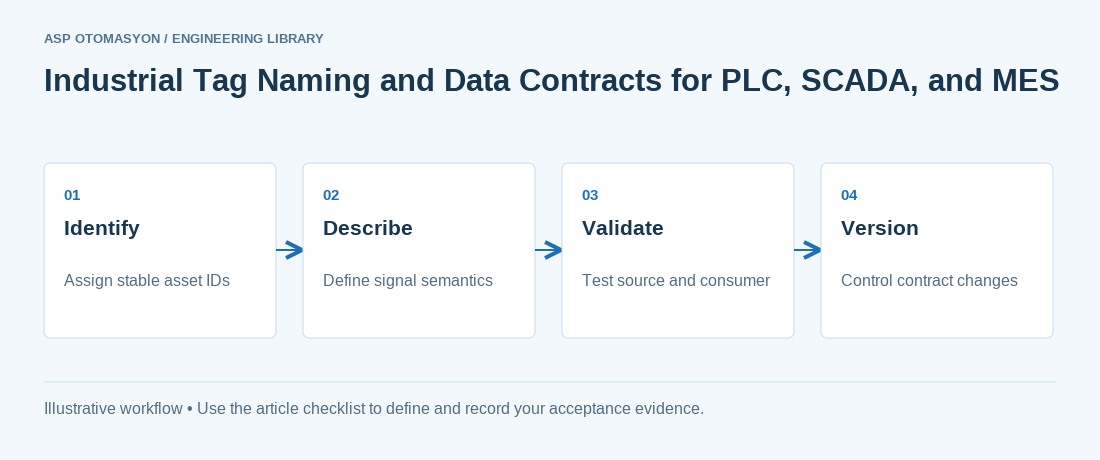\n\n*Industrial Tag Naming and Data Contracts for PLC, SCADA, and MES — Identify → Describe → Validate → Version.*\n\n## Design the requirement before the configuration\n\nUse a stable asset identifier and a documented hierarchy that can survive a display-name change. Separate physical assets, functional locations, and production equipment when they have different lifecycles. For each signal, document its type, unit, scaling, quality rules, timestamp meaning, owner, and change process. Avoid packing every attribute into the name: a readable namespace plus metadata is easier to maintain than an acronym that nobody can decode. Explicitly distinguish instantaneous values, interval aggregates, cumulative counters, and commands.\n\n## Worked scenario\n\nAn illustrative contract for Plant01.Line02.Filler01.GoodCount might specify an unsigned cumulative counter, units of bottles, source timestamps in UTC, reset behavior at a production-order boundary, and quality inherited from the source connection. MES must not assume it is an interval total. Calculate deltas with reset detection and reconcile them against accepted production records before using the count in a performance report.\n\n## What to verify\n\n| Check | Evidence to record |\n| --- | --- |\n| Identity | Stable asset ID, signal ID, and human-readable description |\n| Semantics | Type, unit, range, quality, timestamp, and counter/reset behavior |\n| Ownership | Responsible engineer and consuming systems |\n| Change | Version, compatibility impact, migration, and retirement date |\n\n## Acceptance and handover\n\nValidate a sample contract with the person who programs the source and the person who consumes the data. Test unit conversion, counter reset, missing values, and a renamed asset. Keep a machine-readable contract next to the integration configuration and review both together.\n\n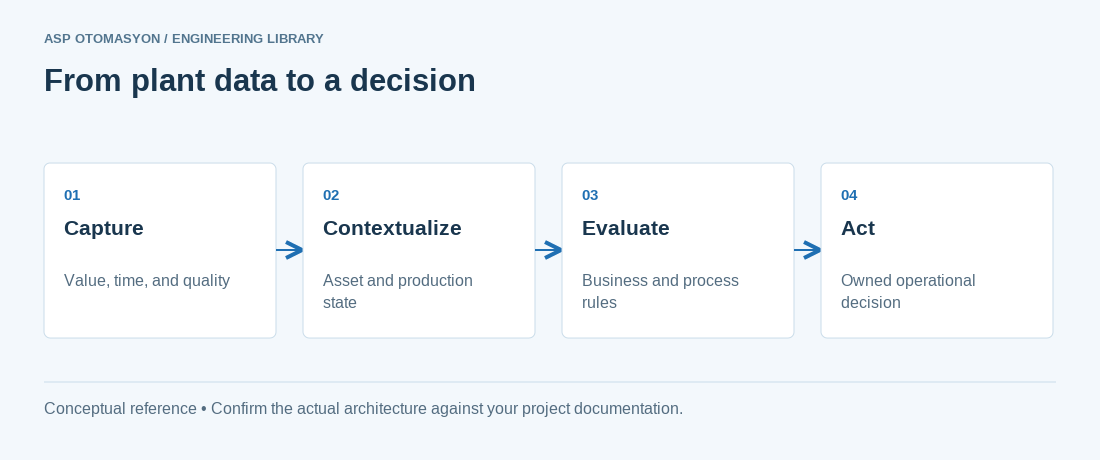\n\n*An industrial data workflow. Each handoff needs an owner and a documented data contract; collecting more signals alone does not establish business value.*\n\n## Continue the engineering work\n\nUse the [related technical library](https://wiki.aspotomasyon.com/category/digital-transformation) for deeper background, or follow an [ASP project guide](https://wiki.aspotomasyon.com/guides) to plan the implementation sequence.\n\n## Primary references and further reading\n\nUse the original specifications and product documentation for implementation details. The examples in this guide are illustrative engineering scenarios, not published project results.\n\n- [ISA — ISA-95 enterprise/control system integration](https://www.isa.org/standards-and-publications/isa-standards/isa-95-standard)\n- [OPC Foundation — Information modelling](https://opcfoundation.org/about/opc-technologies/opc-ua/)\n\n---\n\nCite the canonical article: https://wiki.aspotomasyon.com/article/industrial-tag-naming-data-contracts (Industrial Tag Naming and Data Contracts for PLC, SCADA, and MES, ASP OTOMASYON, updated 2026-09-13).\n","headings":[{"id":"design-the-requirement-before-the-configuration","title":"Design the requirement before the configuration"},{"id":"worked-scenario","title":"Worked scenario"},{"id":"what-to-verify","title":"What to verify"},{"id":"acceptance-and-handover","title":"Acceptance and handover"},{"id":"continue-the-engineering-work","title":"Continue the engineering work"},{"id":"primary-references-and-further-reading","title":"Primary references and further reading"}],"faq":[],"references":[{"name":"ISA — ISA-95 enterprise/control system integration","url":"https://www.isa.org/standards-and-publications/isa-standards/isa-95-standard"},{"name":"OPC Foundation — Information modelling","url":"https://opcfoundation.org/about/opc-technologies/opc-ua/"}],"related":[{"slug":"asset-administration-shell-digital-twin-interoperability","title":"Asset Administration Shell: A Standard Digital Twin Container","summary":"The Asset Administration Shell gives each physical asset a standard digital container of submodels, so engineering, operations, and enterprise systems can…","category":{"slug":"digital-transformation","name":"Digital Transformation"},"url":"https://wiki.aspotomasyon.com/article/asset-administration-shell-digital-twin-interoperability","markdown_url":"https://wiki.aspotomasyon.com/article/asset-administration-shell-digital-twin-interoperability.md","api_url":"https://wiki.aspotomasyon.com/api/v1/articles/asset-administration-shell-digital-twin-interoperability","published":"2026-10-11T11:46:21+00:00","modified":"2026-10-11T11:46:21+00:00","reading_minutes":9,"word_count":1876,"image":"https://wiki.aspotomasyon.com/assets/social/asset-administration-shell-digital-twin-interoperability-aa58402e4e17.png"},{"slug":"industry-4-0-implementation-roadmap","title":"Industry 4.0 Implementation Roadmap","summary":"Implementing Industry 4.0 is not a single project — it is a multi-year transformation journey that requires strategic planning, cross-functional alignment, and…","category":{"slug":"digital-transformation","name":"Digital Transformation"},"url":"https://wiki.aspotomasyon.com/article/industry-4-0-implementation-roadmap","markdown_url":"https://wiki.aspotomasyon.com/article/industry-4-0-implementation-roadmap.md","api_url":"https://wiki.aspotomasyon.com/api/v1/articles/industry-4-0-implementation-roadmap","published":"2026-05-12T12:47:31+00:00","modified":"2026-09-13T11:07:23+00:00","reading_minutes":5,"word_count":1079,"image":"https://wiki.aspotomasyon.com/assets/social/industry-4-0-implementation-roadmap-5af6ee703d9f.png"},{"slug":"opc-ua-cloud-integration","title":"OPC UA to Cloud Integration: Azure, AWS and Edge Gateways","summary":"Cloud platforms offer industrial organizations computing power, analytics, and collaboration that on-premises systems cannot match — but the plant floor speaks…","category":{"slug":"opc-solutions","name":"OPC Solutions"},"url":"https://wiki.aspotomasyon.com/article/opc-ua-cloud-integration","markdown_url":"https://wiki.aspotomasyon.com/article/opc-ua-cloud-integration.md","api_url":"https://wiki.aspotomasyon.com/api/v1/articles/opc-ua-cloud-integration","published":"2026-08-11T13:05:19+00:00","modified":"2026-09-13T11:07:23+00:00","reading_minutes":5,"word_count":931,"image":"https://wiki.aspotomasyon.com/assets/social/opc-ua-cloud-integration-d9523b7a18b7.png"},{"slug":"opc-ua-companion-specifications","title":"OPC UA Companion Specifications — Industry-Specific Information Models","summary":"OPC UA Companion Specifications define standardized information models for specific industries and application domains.","category":{"slug":"opc-solutions","name":"OPC Solutions"},"url":"https://wiki.aspotomasyon.com/article/opc-ua-companion-specifications","markdown_url":"https://wiki.aspotomasyon.com/article/opc-ua-companion-specifications.md","api_url":"https://wiki.aspotomasyon.com/api/v1/articles/opc-ua-companion-specifications","published":"2026-05-13T11:58:29+00:00","modified":"2026-09-13T11:07:23+00:00","reading_minutes":5,"word_count":1095,"image":"https://wiki.aspotomasyon.com/assets/social/opc-ua-companion-specifications-40cb237797f5.png"}],"citation":"ASP OTOMASYON. Industrial Tag Naming and Data Contracts for PLC, SCADA, and MES. Updated 2026-09-13. https://wiki.aspotomasyon.com/article/industrial-tag-naming-data-contracts"}}