
Historian storage settings decide which evidence survives for later analysis. Deadband and compression can reduce volume, but aggressive settings may hide short events, distort derived metrics, or make a reconstructed trend appear more certain than the observations support. Select settings by signal purpose and validate the exported data.
Separate acquisition rate, exception filtering, archive compression, and query interpolation. They act at different stages, and similarly named options can behave differently between products. A temperature used for a long-term energy balance may tolerate a different recording policy from a sequence event or batch-quality measurement. Document the smallest change and shortest event that consumers need to observe, then compare the proposed archive against a higher-resolution reference.
Imagine a pressure signal with a brief excursion between otherwise stable values. A low-resolution acquisition schedule may miss it before compression is involved. A filter can also discard observed changes, while a chart may draw a smooth line between the retained points. Inspect raw archive records and quality states alongside the visual trend before concluding that the process was stable.
| Check | Evidence to record |
|---|---|
| Acquisition | Can the source observe the event of interest? |
| Filtering | Which observed changes are intentionally discarded? |
| Compression | What error or time bounds does the product actually enforce? |
| Retrieval | Are values raw, interpolated, or aggregated? |
Test steady values, ramps, steps, short excursions, and bad-quality intervals. Recalculate the consuming metric from both the reference and proposed archive. Record acceptable differences, units, and product settings. Revisit the policy when a new use case requires more detail than the old archive retained.

Use the related technical library for deeper background, or follow an ASP project guide to plan the implementation sequence.
Use the original specifications and product documentation for implementation details. The examples in this guide are illustrative engineering scenarios, not published project results.
","markdown":"# Historian Deadband and Compression: Keeping the Data That Matters\n\n> Historian storage settings decide which evidence survives for later analysis. Deadband and compression can reduce volume, but aggressive settings may hide…\n\n- Canonical URL: https://wiki.aspotomasyon.com/article/historian-deadband-compression-selection\n- Publisher: ASP OTOMASYON A.Ş. (ASP OTOMASYON Wiki)\n- Category: Digital Transformation\n- Published: 2026-09-13 · Updated: 2026-09-13\n- Reading time: 2 min · Language: English\n\nHistorian storage settings decide which evidence survives for later analysis. Deadband and compression can reduce volume, but aggressive settings may hide short events, distort derived metrics, or make a reconstructed trend appear more certain than the observations support. Select settings by signal purpose and validate the exported data.\n\n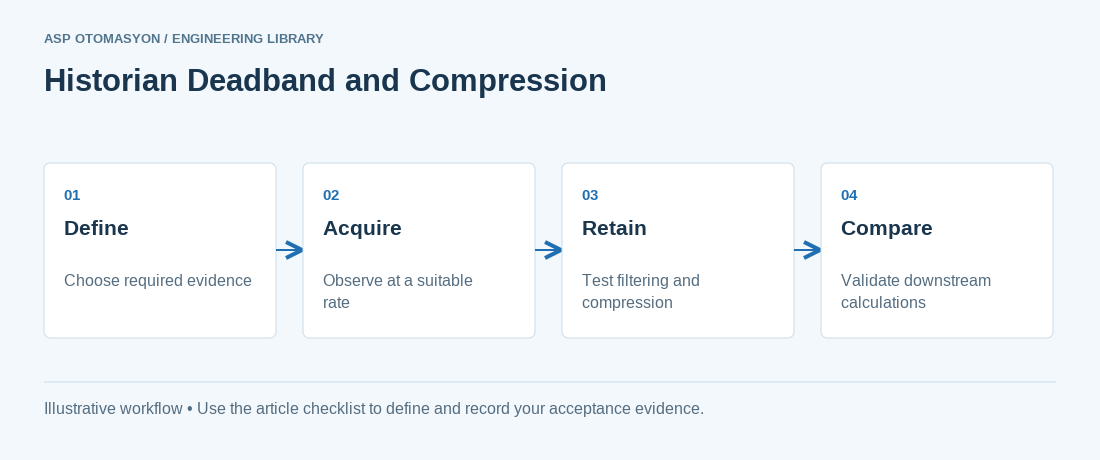\n\n*Historian Deadband and Compression: Keeping the Data That Matters — Define → Acquire → Retain → Compare.*\n\n## Design the requirement before the configuration\n\nSeparate acquisition rate, exception filtering, archive compression, and query interpolation. They act at different stages, and similarly named options can behave differently between products. A temperature used for a long-term energy balance may tolerate a different recording policy from a sequence event or batch-quality measurement. Document the smallest change and shortest event that consumers need to observe, then compare the proposed archive against a higher-resolution reference.\n\n## Worked scenario\n\nImagine a pressure signal with a brief excursion between otherwise stable values. A low-resolution acquisition schedule may miss it before compression is involved. A filter can also discard observed changes, while a chart may draw a smooth line between the retained points. Inspect raw archive records and quality states alongside the visual trend before concluding that the process was stable.\n\n## What to verify\n\n| Check | Evidence to record |\n| --- | --- |\n| Acquisition | Can the source observe the event of interest? |\n| Filtering | Which observed changes are intentionally discarded? |\n| Compression | What error or time bounds does the product actually enforce? |\n| Retrieval | Are values raw, interpolated, or aggregated? |\n\n## Acceptance and handover\n\nTest steady values, ramps, steps, short excursions, and bad-quality intervals. Recalculate the consuming metric from both the reference and proposed archive. Record acceptable differences, units, and product settings. Revisit the policy when a new use case requires more detail than the old archive retained.\n\n\n\n*An industrial data workflow. Each handoff needs an owner and a documented data contract; collecting more signals alone does not establish business value.*\n\n## Continue the engineering work\n\nUse the [related technical library](https://wiki.aspotomasyon.com/category/digital-transformation) for deeper background, or follow an [ASP project guide](https://wiki.aspotomasyon.com/guides) to plan the implementation sequence.\n\n## Primary references and further reading\n\nUse the original specifications and product documentation for implementation details. The examples in this guide are illustrative engineering scenarios, not published project results.\n\n- [ISA — ISA-95 enterprise/control system integration](https://www.isa.org/standards-and-publications/isa-standards/isa-95-standard)\n- [OPC Foundation — Information modelling](https://opcfoundation.org/about/opc-technologies/opc-ua/)\n\n---\n\nCite the canonical article: https://wiki.aspotomasyon.com/article/historian-deadband-compression-selection (Historian Deadband and Compression: Keeping the Data That Matters, ASP OTOMASYON, updated 2026-09-13).\n","headings":[{"id":"design-the-requirement-before-the-configuration","title":"Design the requirement before the configuration"},{"id":"worked-scenario","title":"Worked scenario"},{"id":"what-to-verify","title":"What to verify"},{"id":"acceptance-and-handover","title":"Acceptance and handover"},{"id":"continue-the-engineering-work","title":"Continue the engineering work"},{"id":"primary-references-and-further-reading","title":"Primary references and further reading"}],"faq":[],"references":[{"name":"ISA — ISA-95 enterprise/control system integration","url":"https://www.isa.org/standards-and-publications/isa-standards/isa-95-standard"},{"name":"OPC Foundation — Information modelling","url":"https://opcfoundation.org/about/opc-technologies/opc-ua/"}],"related":[{"slug":"control-loop-performance-monitoring","title":"Control Loop Performance Monitoring: Finding Poorly Performing Loops","summary":"Find poorly performing control loops by ranking them on historian indicators such as mode, output saturation, error, and oscillation, then diagnose the cause…","category":{"slug":"automation-systems","name":"Automation Systems"},"url":"https://wiki.aspotomasyon.com/article/control-loop-performance-monitoring","markdown_url":"https://wiki.aspotomasyon.com/article/control-loop-performance-monitoring.md","api_url":"https://wiki.aspotomasyon.com/api/v1/articles/control-loop-performance-monitoring","published":"2026-10-11T11:46:21+00:00","modified":"2026-10-11T11:46:21+00:00","reading_minutes":8,"word_count":1654,"image":"https://wiki.aspotomasyon.com/assets/social/control-loop-performance-monitoring-c39fee111db3.png"},{"slug":"scada-system-architecture-design-patterns","title":"SCADA System Architecture and Design Patterns","summary":"Supervisory Control and Data Acquisition (SCADA) systems form the backbone of modern industrial monitoring and control.","category":{"slug":"automation-systems","name":"Automation Systems"},"url":"https://wiki.aspotomasyon.com/article/scada-system-architecture-design-patterns","markdown_url":"https://wiki.aspotomasyon.com/article/scada-system-architecture-design-patterns.md","api_url":"https://wiki.aspotomasyon.com/api/v1/articles/scada-system-architecture-design-patterns","published":"2026-05-13T12:07:53+00:00","modified":"2026-09-13T11:07:23+00:00","reading_minutes":9,"word_count":1887,"image":"https://wiki.aspotomasyon.com/assets/social/scada-system-architecture-design-patterns-d28081d36299.png"},{"slug":"opc-da-to-ua-migration-guide","title":"Migrating from OPC DA to OPC UA","summary":"Migrating from OPC DA to OPC UA is one of the most common infrastructure projects in industrial IT. OPC DA (Data Access) has served industry for more than two…","category":{"slug":"opc-solutions","name":"OPC Solutions"},"url":"https://wiki.aspotomasyon.com/article/opc-da-to-ua-migration-guide","markdown_url":"https://wiki.aspotomasyon.com/article/opc-da-to-ua-migration-guide.md","api_url":"https://wiki.aspotomasyon.com/api/v1/articles/opc-da-to-ua-migration-guide","published":"2026-08-06T12:26:37+00:00","modified":"2026-09-13T11:07:23+00:00","reading_minutes":5,"word_count":999,"image":"https://wiki.aspotomasyon.com/assets/social/opc-da-to-ua-migration-guide-4dc7a9d57cd5.png"},{"slug":"data-historian-selection-deployment","title":"Data Historian Selection and Deployment","summary":"A data historian is the long-term memory of an industrial plant. Where a PLC or SCADA system keeps live values in memory, a historian collects time-stamped…","category":{"slug":"digital-transformation","name":"Digital Transformation"},"url":"https://wiki.aspotomasyon.com/article/data-historian-selection-deployment","markdown_url":"https://wiki.aspotomasyon.com/article/data-historian-selection-deployment.md","api_url":"https://wiki.aspotomasyon.com/api/v1/articles/data-historian-selection-deployment","published":"2026-08-06T12:26:37+00:00","modified":"2026-09-13T11:07:23+00:00","reading_minutes":5,"word_count":954,"image":"https://wiki.aspotomasyon.com/assets/social/data-historian-selection-deployment-9daadd28e9f8.png"}],"citation":"ASP OTOMASYON. Historian Deadband and Compression: Keeping the Data That Matters. Updated 2026-09-13. https://wiki.aspotomasyon.com/article/historian-deadband-compression-selection"}}