
A compressed-air improvement project needs measurements that explain how demand, pressure, and compressor operation interact. Electricity consumption alone cannot show whether the system is serving productive demand, compensating for leaks, or running inefficiently at low load. Plan the measurement boundary before recommending equipment or control changes.
Identify compressors, dryers, storage, distribution zones, and significant users. Collect electrical energy or power, delivered flow with its stated reference conditions, pressure at relevant points, and operating state. Align timestamps and capture production context. A flow reading in actual volume is not directly interchangeable with a normalized volume without the required conditions. Observe a representative operating cycle rather than selecting an unusually quiet or busy shift.
An illustrative review finds nearly unchanged electrical demand during a period with substantially lower production. That observation suggests a useful investigation, not a quantified leak rate. Compare compressor loading, system pressure, isolated-zone tests where approved, and demand from non-production users. Verify the effect of any change against the same measurement boundary.
| Check | Evidence to record |
|---|---|
| Power | Compressor and relevant auxiliary loads included |
| Flow | Location, direction, range, and reference conditions recorded |
| Pressure | Supply and critical user locations compared |
| Context | Production states, schedules, and exceptional uses recorded |
Create a time-aligned baseline with data-quality checks. After an approved improvement, compare equivalent operating conditions and examine whether pressure service was maintained. Keep estimated savings separate from measured results, and document any changed production or boundary conditions.

Use the related technical library for deeper background, or follow an ASP project guide to plan the implementation sequence.
Use the original specifications and product documentation for implementation details. The examples in this guide are illustrative engineering scenarios, not published project results.
","markdown":"# Compressed Air Monitoring: A Measurement Plan Before Optimization\n\n> A compressed-air improvement project needs measurements that explain how demand, pressure, and compressor operation interact.\n\n- Canonical URL: https://wiki.aspotomasyon.com/article/compressed-air-monitoring-plan\n- Publisher: ASP OTOMASYON A.Ş. (ASP OTOMASYON Wiki)\n- Category: Energy Management Systems\n- Published: 2026-09-13 · Updated: 2026-09-13\n- Reading time: 2 min · Language: English\n\nA compressed-air improvement project needs measurements that explain how demand, pressure, and compressor operation interact. Electricity consumption alone cannot show whether the system is serving productive demand, compensating for leaks, or running inefficiently at low load. Plan the measurement boundary before recommending equipment or control changes.\n\n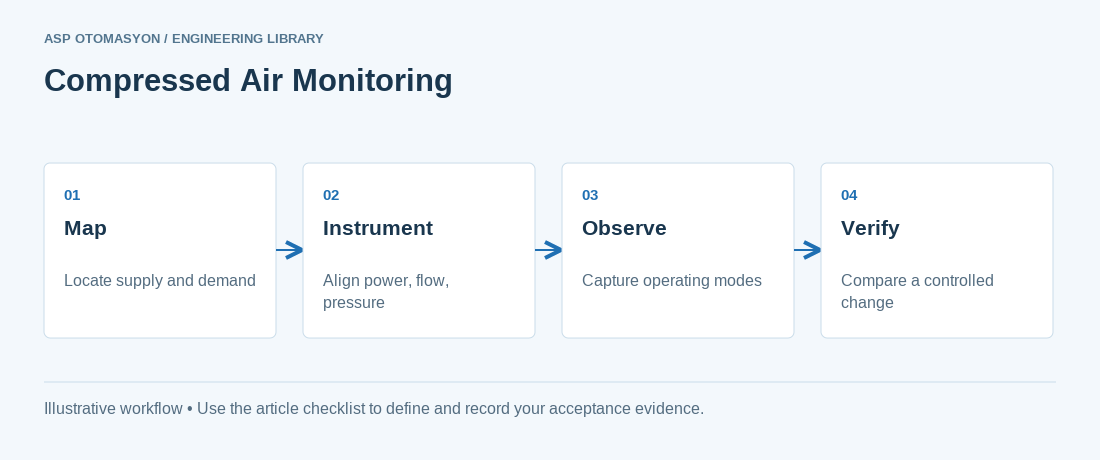\n\n*Compressed Air Monitoring: A Measurement Plan Before Optimization — Map → Instrument → Observe → Verify.*\n\n## Design the requirement before the configuration\n\nIdentify compressors, dryers, storage, distribution zones, and significant users. Collect electrical energy or power, delivered flow with its stated reference conditions, pressure at relevant points, and operating state. Align timestamps and capture production context. A flow reading in actual volume is not directly interchangeable with a normalized volume without the required conditions. Observe a representative operating cycle rather than selecting an unusually quiet or busy shift.\n\n## Worked scenario\n\nAn illustrative review finds nearly unchanged electrical demand during a period with substantially lower production. That observation suggests a useful investigation, not a quantified leak rate. Compare compressor loading, system pressure, isolated-zone tests where approved, and demand from non-production users. Verify the effect of any change against the same measurement boundary.\n\n## What to verify\n\n| Check | Evidence to record |\n| --- | --- |\n| Power | Compressor and relevant auxiliary loads included |\n| Flow | Location, direction, range, and reference conditions recorded |\n| Pressure | Supply and critical user locations compared |\n| Context | Production states, schedules, and exceptional uses recorded |\n\n## Acceptance and handover\n\nCreate a time-aligned baseline with data-quality checks. After an approved improvement, compare equivalent operating conditions and examine whether pressure service was maintained. Keep estimated savings separate from measured results, and document any changed production or boundary conditions.\n\n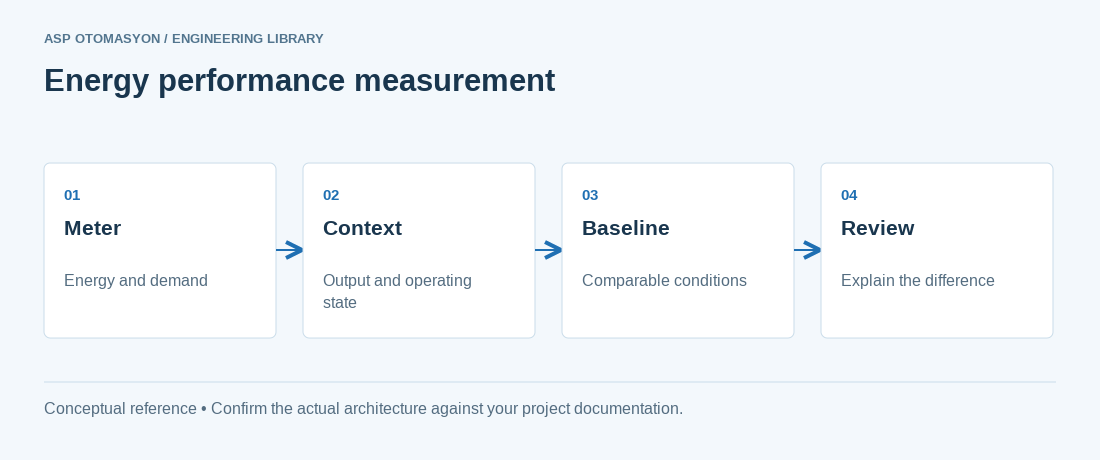\n\n*Energy-performance analysis needs both consumption and operating context. A lower meter total does not by itself demonstrate improved efficiency.*\n\n## Continue the engineering work\n\nUse the [related technical library](https://wiki.aspotomasyon.com/category/energy-management-systems) for deeper background, or follow an [ASP project guide](https://wiki.aspotomasyon.com/guides) to plan the implementation sequence.\n\n## Primary references and further reading\n\nUse the original specifications and product documentation for implementation details. The examples in this guide are illustrative engineering scenarios, not published project results.\n\n- [ISO — ISO 50001 energy management](https://www.iso.org/iso-50001-energy-management.html)\n- [U.S. Department of Energy — Compressed air systems](https://www.energy.gov/cmei/ito/compressed-air-systems)\n\n---\n\nCite the canonical article: https://wiki.aspotomasyon.com/article/compressed-air-monitoring-plan (Compressed Air Monitoring: A Measurement Plan Before Optimization, ASP OTOMASYON, updated 2026-09-13).\n","headings":[{"id":"design-the-requirement-before-the-configuration","title":"Design the requirement before the configuration"},{"id":"worked-scenario","title":"Worked scenario"},{"id":"what-to-verify","title":"What to verify"},{"id":"acceptance-and-handover","title":"Acceptance and handover"},{"id":"continue-the-engineering-work","title":"Continue the engineering work"},{"id":"primary-references-and-further-reading","title":"Primary references and further reading"}],"faq":[],"references":[{"name":"ISO — ISO 50001 energy management","url":"https://www.iso.org/iso-50001-energy-management.html"},{"name":"U.S. Department of Energy — Compressed air systems","url":"https://www.energy.gov/cmei/ito/compressed-air-systems"}],"related":[{"slug":"compressed-air-system-optimization","title":"Compressed Air System Energy Optimization","summary":"Compressed air is often called the fourth utility of industry — and the most expensive one.","category":{"slug":"energy-management-systems","name":"Energy Management Systems"},"url":"https://wiki.aspotomasyon.com/article/compressed-air-system-optimization","markdown_url":"https://wiki.aspotomasyon.com/article/compressed-air-system-optimization.md","api_url":"https://wiki.aspotomasyon.com/api/v1/articles/compressed-air-system-optimization","published":"2026-08-06T12:26:37+00:00","modified":"2026-09-13T11:07:23+00:00","reading_minutes":4,"word_count":865,"image":"https://wiki.aspotomasyon.com/assets/social/compressed-air-system-optimization-8cdcbe34310f.png"},{"slug":"iso-50001-energy-management","title":"ISO 50001 Energy Management Systems","summary":"ISO 50001 is the international standard for energy management systems (EnMS). It provides a framework — built on the Plan-Do-Check-Act cycle — that…","category":{"slug":"energy-management-systems","name":"Energy Management Systems"},"url":"https://wiki.aspotomasyon.com/article/iso-50001-energy-management","markdown_url":"https://wiki.aspotomasyon.com/article/iso-50001-energy-management.md","api_url":"https://wiki.aspotomasyon.com/api/v1/articles/iso-50001-energy-management","published":"2026-08-06T12:26:37+00:00","modified":"2026-09-13T11:07:23+00:00","reading_minutes":5,"word_count":887,"image":"https://wiki.aspotomasyon.com/assets/social/iso-50001-energy-management-53ab37655f52.png"},{"slug":"hvac-optimization-industrial","title":"HVAC System Optimization for Industrial Facilities","summary":"HVAC in industrial facilities is a different problem than in commercial buildings: the loads include process heat, equipment, and ventilation requirements…","category":{"slug":"energy-management-systems","name":"Energy Management Systems"},"url":"https://wiki.aspotomasyon.com/article/hvac-optimization-industrial","markdown_url":"https://wiki.aspotomasyon.com/article/hvac-optimization-industrial.md","api_url":"https://wiki.aspotomasyon.com/api/v1/articles/hvac-optimization-industrial","published":"2026-08-11T13:05:24+00:00","modified":"2026-09-13T11:07:23+00:00","reading_minutes":4,"word_count":868,"image":"https://wiki.aspotomasyon.com/assets/social/hvac-optimization-industrial-21bec03cc33d.png"},{"slug":"ghg-protocol-emissions-inventory-manufacturing-sites","title":"GHG Protocol Emissions Inventory for Manufacturing Sites","summary":"A site GHG inventory is only as sound as its boundary, activity data, and audit trail, so start with the GHG Protocol scopes and the meters that feed them.","category":{"slug":"energy-management-systems","name":"Energy Management Systems"},"url":"https://wiki.aspotomasyon.com/article/ghg-protocol-emissions-inventory-manufacturing-sites","markdown_url":"https://wiki.aspotomasyon.com/article/ghg-protocol-emissions-inventory-manufacturing-sites.md","api_url":"https://wiki.aspotomasyon.com/api/v1/articles/ghg-protocol-emissions-inventory-manufacturing-sites","published":"2026-10-11T11:46:21+00:00","modified":"2026-10-11T11:46:21+00:00","reading_minutes":9,"word_count":1767,"image":"https://wiki.aspotomasyon.com/assets/social/ghg-protocol-emissions-inventory-manufacturing-sites-ef133a264c46.png"}],"citation":"ASP OTOMASYON. Compressed Air Monitoring: A Measurement Plan Before Optimization. Updated 2026-09-13. https://wiki.aspotomasyon.com/article/compressed-air-monitoring-plan"}}