
An alarm-flood test examines whether operators can understand and respond to a burst of abnormal conditions. It should evaluate alarm design, navigation, suppression behavior, event records, and recovery. Run it in an approved simulation or test environment; generating a flood in a live plant can create operational risk.
Select scenarios from the process and alarm philosophy, such as loss of a shared utility or a communication interruption. Identify the expected initiating alarms, consequential alarms, operator actions, and permitted suppression rules. An alarm count alone does not show whether the operator can find the cause. Inspect message clarity, priority use, state-dependent behavior, acknowledgment, and the transition back to normal.
An illustrative utility failure triggers low-flow alarms on several users. The review should ask whether the initiating problem remains visible and whether repeated or consequential notifications obscure required actions. The solution might involve rationalization, state-based handling, or clearer context, but it must preserve necessary warnings and follow the approved alarm philosophy.
| Check | Evidence to record |
|---|---|
| Scenario | Initiating condition, affected equipment, and expected operator actions |
| Presentation | Priority, wording, navigation, and active-state visibility |
| History | Event ordering, acknowledgment, suppression, and return-to-normal records |
| Recovery | Behavior when the initiating problem clears or reappears |
Record the operator’s task sequence and observations as well as quantitative alarm behavior. Treat nuisance removal and protection requirements as separate design decisions. Resolve changes through the site’s alarm-management process and repeat the affected scenarios before release.

Use the related technical library for deeper background, or follow an ASP project guide to plan the implementation sequence.
Use the original specifications and product documentation for implementation details. The examples in this guide are illustrative engineering scenarios, not published project results.
","markdown":"# Alarm Flood Testing: Checking Operator Workload Before Startup\n\n> An alarm-flood test examines whether operators can understand and respond to a burst of abnormal conditions.\n\n- Canonical URL: https://wiki.aspotomasyon.com/article/alarm-flood-test-plan\n- Publisher: ASP OTOMASYON A.Ş. (ASP OTOMASYON Wiki)\n- Category: Technical Guides\n- Published: 2026-09-13 · Updated: 2026-09-13\n- Reading time: 2 min · Language: English\n\nAn alarm-flood test examines whether operators can understand and respond to a burst of abnormal conditions. It should evaluate alarm design, navigation, suppression behavior, event records, and recovery. Run it in an approved simulation or test environment; generating a flood in a live plant can create operational risk.\n\n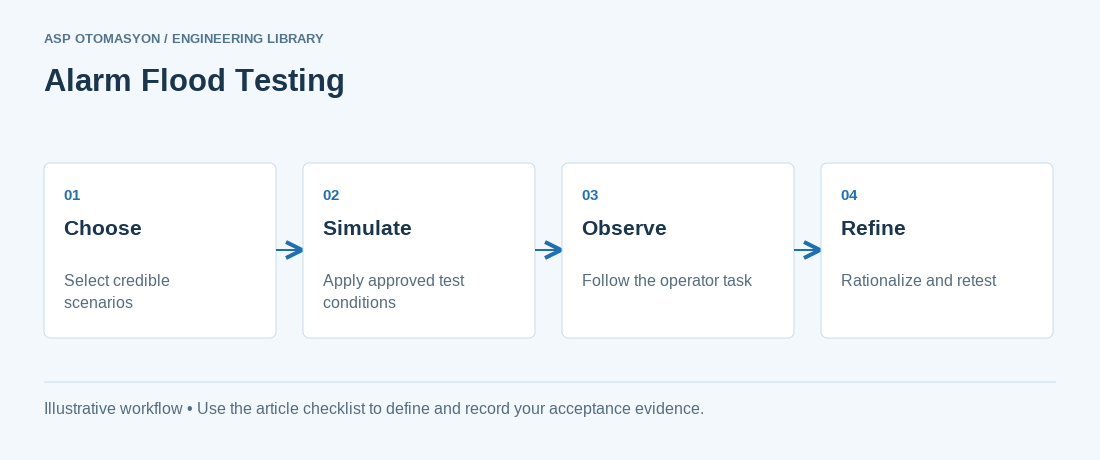\n\n*Alarm Flood Testing: Checking Operator Workload Before Startup — Choose → Simulate → Observe → Refine.*\n\n## Design the requirement before the configuration\n\nSelect scenarios from the process and alarm philosophy, such as loss of a shared utility or a communication interruption. Identify the expected initiating alarms, consequential alarms, operator actions, and permitted suppression rules. An alarm count alone does not show whether the operator can find the cause. Inspect message clarity, priority use, state-dependent behavior, acknowledgment, and the transition back to normal.\n\n## Worked scenario\n\nAn illustrative utility failure triggers low-flow alarms on several users. The review should ask whether the initiating problem remains visible and whether repeated or consequential notifications obscure required actions. The solution might involve rationalization, state-based handling, or clearer context, but it must preserve necessary warnings and follow the approved alarm philosophy.\n\n## What to verify\n\n| Check | Evidence to record |\n| --- | --- |\n| Scenario | Initiating condition, affected equipment, and expected operator actions |\n| Presentation | Priority, wording, navigation, and active-state visibility |\n| History | Event ordering, acknowledgment, suppression, and return-to-normal records |\n| Recovery | Behavior when the initiating problem clears or reappears |\n\n## Acceptance and handover\n\nRecord the operator’s task sequence and observations as well as quantitative alarm behavior. Treat nuisance removal and protection requirements as separate design decisions. Resolve changes through the site’s alarm-management process and repeat the affected scenarios before release.\n\n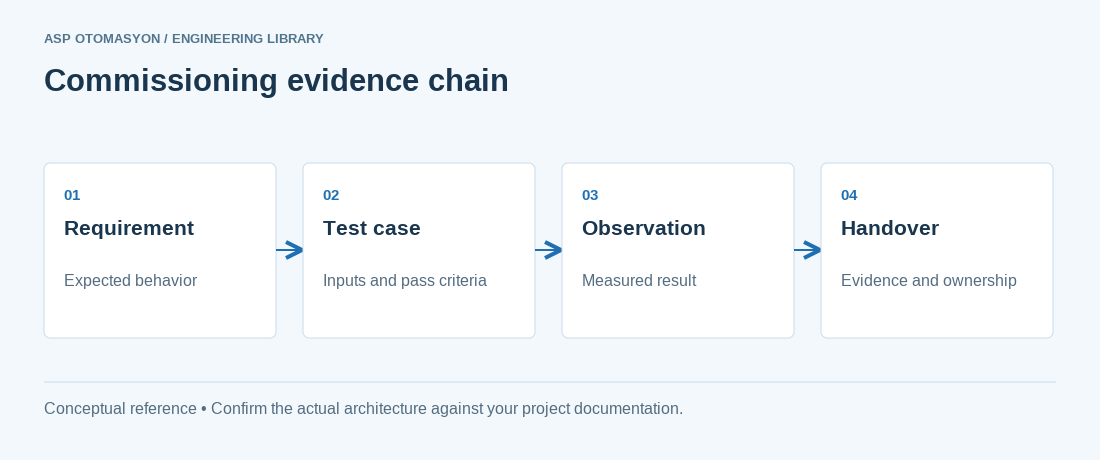\n\n*A commissioning evidence chain: every acceptance result should lead back to a requirement and identify the configuration that was actually tested.*\n\n## Continue the engineering work\n\nUse the [related technical library](https://wiki.aspotomasyon.com/category/technical-guides) for deeper background, or follow an [ASP project guide](https://wiki.aspotomasyon.com/guides) to plan the implementation sequence.\n\n## Primary references and further reading\n\nUse the original specifications and product documentation for implementation details. The examples in this guide are illustrative engineering scenarios, not published project results.\n\n- [ISA — ISA-18 alarm management standards](https://www.isa.org/standards-and-publications/isa-standards/isa-18-series-of-standards)\n- [NIST SP 800-82 Rev. 3 — OT configuration and operational considerations](https://csrc.nist.gov/pubs/sp/800/82/r3/final)\n- [ISA — Automation standards and committees](https://www.isa.org/standards-and-publications/isa-standards/isa-standards-committees)\n\n---\n\nCite the canonical article: https://wiki.aspotomasyon.com/article/alarm-flood-test-plan (Alarm Flood Testing: Checking Operator Workload Before Startup, ASP OTOMASYON, updated 2026-09-13).\n","headings":[{"id":"design-the-requirement-before-the-configuration","title":"Design the requirement before the configuration"},{"id":"worked-scenario","title":"Worked scenario"},{"id":"what-to-verify","title":"What to verify"},{"id":"acceptance-and-handover","title":"Acceptance and handover"},{"id":"continue-the-engineering-work","title":"Continue the engineering work"},{"id":"primary-references-and-further-reading","title":"Primary references and further reading"}],"faq":[],"references":[{"name":"ISA — ISA-18 alarm management standards","url":"https://www.isa.org/standards-and-publications/isa-standards/isa-18-series-of-standards"},{"name":"NIST SP 800-82 Rev. 3 — OT configuration and operational considerations","url":"https://csrc.nist.gov/pubs/sp/800/82/r3/final"},{"name":"ISA — Automation standards and committees","url":"https://www.isa.org/standards-and-publications/isa-standards/isa-standards-committees"}],"related":[{"slug":"steam-system-efficiency","title":"Steam System Efficiency and Condensate Recovery","summary":"Steam remains the workhorse of industrial thermal energy: process heating, sterilization, tracing, and power.","category":{"slug":"energy-management-systems","name":"Energy Management Systems"},"url":"https://wiki.aspotomasyon.com/article/steam-system-efficiency","markdown_url":"https://wiki.aspotomasyon.com/article/steam-system-efficiency.md","api_url":"https://wiki.aspotomasyon.com/api/v1/articles/steam-system-efficiency","published":"2026-08-11T13:05:24+00:00","modified":"2026-09-13T11:07:23+00:00","reading_minutes":4,"word_count":855,"image":"https://wiki.aspotomasyon.com/assets/social/steam-system-efficiency-cf802b12753c.png"},{"slug":"energy-baseline-normalization","title":"Energy Baseline Normalization: Comparing Production Fairly","summary":"Energy performance cannot be assessed reliably by comparing two meter totals without checking what the plant produced and how it operated.","category":{"slug":"energy-management-systems","name":"Energy Management Systems"},"url":"https://wiki.aspotomasyon.com/article/energy-baseline-normalization","markdown_url":"https://wiki.aspotomasyon.com/article/energy-baseline-normalization.md","api_url":"https://wiki.aspotomasyon.com/api/v1/articles/energy-baseline-normalization","published":"2026-09-13T11:07:23+00:00","modified":"2026-09-13T11:07:23+00:00","reading_minutes":2,"word_count":348,"image":"https://wiki.aspotomasyon.com/assets/social/energy-baseline-normalization-66cfd6729deb.png"},{"slug":"mqtt-broker-deployment","title":"MQTT Broker Deployment and Hardening","summary":"MQTT is the de facto transport for industrial IoT telemetry: lightweight publish/subscribe over TCP, ideal for the many-to-many data flows of plant-to-cloud…","category":{"slug":"modern-connectivity","name":"Modern Connectivity"},"url":"https://wiki.aspotomasyon.com/article/mqtt-broker-deployment","markdown_url":"https://wiki.aspotomasyon.com/article/mqtt-broker-deployment.md","api_url":"https://wiki.aspotomasyon.com/api/v1/articles/mqtt-broker-deployment","published":"2026-08-11T13:05:24+00:00","modified":"2026-09-13T11:07:23+00:00","reading_minutes":4,"word_count":871,"image":"https://wiki.aspotomasyon.com/assets/social/mqtt-broker-deployment-4fdd84765a13.png"},{"slug":"alarm-management-isa-18-2","title":"Alarm Management per ISA-18.2","summary":"ISA-18.2 — Management of Alarm Systems for the Process Industries — is the international standard that defines the lifecycle, design, and performance…","category":{"slug":"technical-guides","name":"Technical Guides"},"url":"https://wiki.aspotomasyon.com/article/alarm-management-isa-18-2","markdown_url":"https://wiki.aspotomasyon.com/article/alarm-management-isa-18-2.md","api_url":"https://wiki.aspotomasyon.com/api/v1/articles/alarm-management-isa-18-2","published":"2026-07-21T14:45:28+00:00","modified":"2026-09-13T11:07:23+00:00","reading_minutes":4,"word_count":781,"image":"https://wiki.aspotomasyon.com/assets/social/alarm-management-isa-18-2-93b35e664a52.png"}],"citation":"ASP OTOMASYON. Alarm Flood Testing: Checking Operator Workload Before Startup. Updated 2026-09-13. https://wiki.aspotomasyon.com/article/alarm-flood-test-plan"}}